



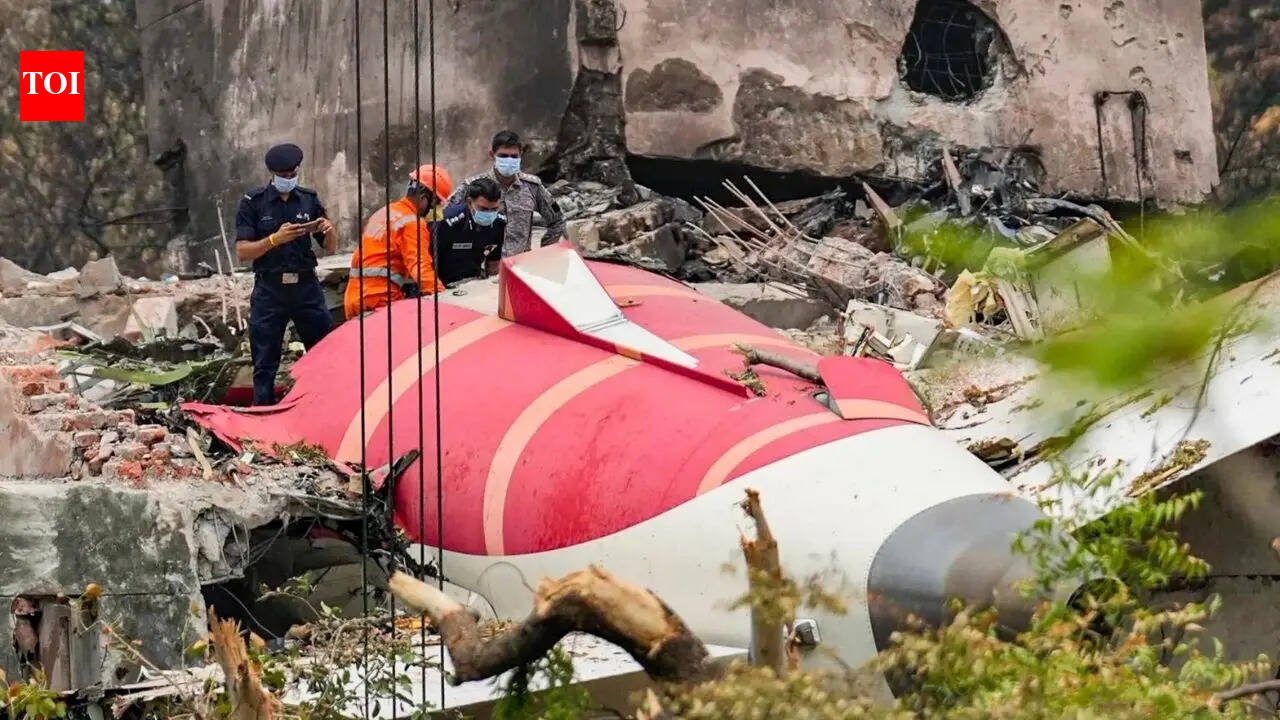
Did India’s deadliest air disaster in decades begin with a mechanical failure, seconds before the fuel switches cutoff? A deep-dive into the central unresolved question of the Air India flight 171 Ahmedabad accident inquiry.MUMBAI: On the afternoon of June 12, a Boeing 787-8 Dreamliner lifted off runway 23 at the Ahmedabad airport, bound for London Gatwick with 242 people aboard. Thirty-two seconds later, the aircraft was falling. By 1:39:05 pm, one of the pilots had transmitted a desperate Mayday, Mayday, Mayday call before the aircraft struck the BJ Medical College hostel complex, 1.6 km from the departure end of the runway. Two hundred and forty-one people died. One passenger survived.In the months that followed, a narrative took hold in certain sections of the international and domestic media and in online aviation forums that the accident was caused by a deliberate act. That the Pilot-in-Command of Air India 171 had, for reasons unknown, reached across the centre pedestal and moved both fuel control switches from RUN to CUTOFF during the initial climb, starving both engines of fuel and causing the crash. The theory took-off, it was simple to grasp and seemed to connect the dots.There was one problem, the official investigation had not said that. But it did not say otherwise, either. The deadline for submission of final report is June 12. Three months before the deadline an Indian pilots’ organisation has formally raised a technical question that cuts to the very foundation of that suicide-narrative.The question is: Did the Ram Air Turbine deploy before the fuel control switches moved?
What is a Ram Air Turbine?
It is Boeing 787’s emergency power system, the absolute last resort that comes to the aid of pilots when every other electrical power generation on the aircraft has stopped. In aviation, everyone calls it the RAT. It’s a small wind turbine that deploys automatically after a complete power failure. It can be deployed manually as well. RAT lives in a small compartment in the under belly of the aircraft, folded away, and in the normal course of events it stays there for the entire life of the plane. When deployed, its small propeller swings out into the airstream. The propeller spins in the wind, drives a hydraulic pump and a generator which keeps just enough of the flight controls alive for the crew to have a fighting chance at landing the aircraft. It’s a bellwether of sorts signalling a catastrophic emergency, if it is visible it means something has gone very badly wrong with the aircraft.Going back to the core question asked by pilots’ body, if the RAT deployed first and the fuel switches moved after that, it would mean the aircraft had already lost electrical power before anyone touched anything, that the emergency had begun on its own, independent of any crew action, and that the fuel switch movements recorded seconds later were not the cause of the disaster but a consequence of the technical problem. The suicide theory won’t hold ground because it would mean the two pilots died trying to save 241 people from the doings of an errant aircraft. On that fateful day, Air India B787’s RAT deployed just as the aircraft lifted off, even before the aircraft could cross the airport boundary wall, said the Aircraft Accident Investigation Bureau (AAIB)’s preliminary report. A larger proof of early RAT deployment also sits in the very same preliminary report that was used to drive the suicide narrative.
The evidence as recorded by AAIB
There is a crucial photograph in the preliminary report. It appears on page 14 of the 15 paged report, the investigators seem to have included that picture almost as an afterthought. It is a CCTV frame, slightly grainy the way airport security footage always is, showing Air India VT-ANB just after it has lifted off runway 23. The aircraft looks normal, it is climbing. The landing gear is still down. Just behind the landing gear, on the underside of the fuselage, circled in the report with a small annotation is the RAT, already deployed, a device that should never be visible on a healthy aircraft, let alone in the first few seconds after lift-off. The RAT already extended, the report notes this and moves on.To know what happened first, the RAT deployment or the fuel switches moved to CUTOFF, it is essential to study in seconds the timeline after the B787 lift-off. The AAIB preliminary report establishes the following sequence taken from data recorded in a black box, the ‘Enhanced Airborne Flight Recorder’ (EAFR) of the Boeing 787-8 involved:
- 1:38:33 pm — Aircraft crossed the take-off decision speed, at 153 knots indicated airspeed.
- 1:38:35 pm — Vr speed achieved at 155 kts, the speed at which the control column when pulled back the aircraft lifts off.
- 1:38:39 pm — Air/ground sensors transitioned to air mode, consistent with liftoff. This tells the aircraft sensors that the plane has left the ground.
- 1:38:42 pm — The aircraft reached its maximum recorded airspeed of 180 knots.
Immediately thereafter, the report states, Engine 1 and Engine 2 fuel cutoff switches transitioned from RUN to CUTOFF, one after another, with a time gap of approximately one second.Then comes the most interpreted line in the report. “In the cockpit voice recording, one of the pilots is heard asking the other why did he cutoff. The other pilot responded that he did not do so.” The report thereafter speaks about the above-mentioned CCTV footage. “RAT getting deployed during the initial climb immediately after lift-off. “
- 1:38:47 pm — The RAT hydraulic pump began supplying hydraulic power, as both engine N2 values (rotational speed) had passed below minimum idle speed
- 1:38:52 pm — Engine 1 fuel cutoff switch returned from CUTOFF to RUN
- 1:38:56 pm — Engine 2 fuel cutoff switch returned from CUTOFF to RUN
- 1:39:05 pm — Mayday call transmitted
- 1:39:11 pm— EAFR recording stopped
(report gives timings in UTC)
The four-second window. why it matters?
At first glance, the AAIB timeline appears straightforward: fuel switches moved at approximately 1:38:42 pm; RAT began supplying hydraulic power at 1:38:47 pm, four seconds later.Using the timeline, the chronology of events the AAIB report implied is: first, the engines starved (either because a pilot manually cut off the fuel to both engines or because the aircraft cut off the fuel without input from pilot, an uncommanded fuel switch cutoff, a technical glitch) and second, the RAT deployed as a consequence.But the Federation of Indian Pilots (FIP), in two letters, dated March 12, addressed to the AAIB director general has identified what it describes a technical discrepancy at the heart of this sequence of events, a discrepancy that has significant implications for the entire causal chain.
The FIP’s argument rests on RAT manufacturer’s documentation
The pilots’ body draws the AAIB’s attention to page 288 of the “Boeing 787 Electrical System Familiarisation” training manual published by Hamilton Sundstrand, now Collins Aerospace, a unit of RTX Corporation, the original equipment manufacturer (OEM) of the B787 RAT system. The document states plainly that the RAT deployment signal is generated 10 seconds after complete loss of electrical supply. Then on page 292 of the same document, it states each Bus Power Control Unit (BPCU) independently requests RAT deployment 15 seconds after either continuous loss of power.To reiterate, the document published by the RAT manufacturer has two trigger thresholds, 10 seconds and 15 seconds, depending on the specific logic pathway activated. After the trigger, the small door that keeps RAT encased in the aircraft belly opens, the small propeller juts out and extends into the air stream to spin and generate power, all of which would take another handful of seconds.That is where the discrepancy is located because the AAIB preliminary report records the elapsed time between the second fuel cutoff switch movement at 1:38:43 pm and RAT hydraulic power supply at 1:38:47 pm as four seconds.The core argument made by the pilots’ body is this: AAIB report states RAT deployed four seconds after power failed, but the equipment manufacturer puts a time of 10-15 seconds for RAT to deploy after power failure. According to the manufacturer’s own system documentation, the RAT on a Boeing 787 cannot begin supplying hydraulic power just four seconds after losing electrical supply.The technical implication is this: if the RAT system’s own design logic requires 10 to 15 seconds to trigger from electrical loss, and the preliminary report records only a 4-second gap between fuel cutoff and RAT hydraulic output, then the RAT may have been triggered by a condition that preceded the fuel cutoff events and not followed them.Something may have gone wrong with the aircraft’s electrical system before the fuel switches moved.
The CCTV evidence and the second fip letter
The FIP’s second letter to the AAIB sent on the same date raises a separate but related line of inquiry rooted in visual evidence.Four sequential photographic frames extracted from CCTV footage obtained from Ahmedabad airport show a small dark object appearing and progressively increasing in size on the aircraft’s underbelly, at the location corresponding to the RAT door, states the FIP letter. This sequence begins while the aircraft is still rolling on the runway, before the fuel control switches could have moved, since the black box data confirms those switches transitioned only after the aircraft was airborne and had reached 180 knots.“The sequence from Frame 1 to Frame 4 appears consistent with RAT door opening and/or RAT deployment while the aircraft is rolling on the runway,” the letter states, highlighting those last few words in a bold font.The FIP letter requested that the AAIB formally correlate this visual sequence with the EAFR-black box timeline. It also suggested that a flight simulator reconstruction be conducted with time-synchronised overlay of the photographic sequence, under two scenarios: an electrical failure leading to automatic RAT deployment, and manual selection of fuel control switches to CUTOFF by the flight crew.“The purpose of the above exercise is to ascertain whether the root cause relates to a technical failure or to deliberate pilot action,” said the FIP letter. It then requests that the Final AAIB report be released only after this simulator evaluation is completed and formally recorded. The deadline for final report release is June 12, 2026.
What the preliminary report does and does not say
The AAIB preliminary report is a factual document, all preliminary reports under UN’s International Civil Aviation Organization (ICAO) Annex 13 conventions are required to carry technical facts and data from black boxes. Under the ICAO provisions, a report should not apportion blame.But the AAIB preliminary report’s structure and language is not neutral. Several details have fed the media narrative of deliberate pilot action.The AAIB report notes that the co-pilot was ‘Pilot Flying’ and the Pilot-in-command was ‘Pilot Monitoring’ for the said flight. The report records the cockpit voice recorder exchange in which one pilot denies cutting off fuel. It paraphrases the conversation. It also offers no analysis of what that exchange means or whether there was any other conversation after that question and answer sequence. It records the transition of fuel switches to CUTOFF “immediately” after the aircraft reached maximum recorded airspeed, without discussing what action, by the man or machine, may have caused those switches to move. One can always argue that these details will be revealed in the final report, the preliminary report comes a month after the accident and so it is too early to put out conclusive arguments.The AAIB report separately notes a detail. A US Federation Aviation Administration’s Special Airworthiness Information Bulletin issued in December 2018 regarding the potential disengagement of the fuel control switch locking feature on Boeing aircraft, based on reports from 737 operators that switches had been installed with the locking feature disengaged. The AAIB notes that this bulletin was advisory and not mandatory, that Air India had not carried out the suggested inspections on VT-ANB. It also notes that there has been no defect reported pertaining to the fuel control switch since 2023 on VT-ANB. The throttle control module was replaced on VT-ANB in 2019 and in 2023.The report does not pursue this thread further, but its presence in the preliminary findings is notable. The locking feature exists precisely to prevent inadvertent movement of fuel control switches. If that feature was compromised on VT-ANB, it could have been worn, disengaged, or otherwise degraded, then switches that should have required deliberate and purposeful action to move could theoretically have moved without deliberate action.
Three possible readings
The discrepancy between the RAT OEM documentation and the AAIB’s recorded timeline can be put into three broad interpretations, said senior pilots.The first is that the timeline is accurate, and the 4-second gap reflects not automatic RAT deployment triggered by electrical loss, but manual RAT deployment, commanded by a crew member almost simultaneously with the fuel cutoff. Manual deployment bypasses the automatic trigger logic entirely. Under this reading, a crew member, perhaps recognising a sudden emergency, may have manually deployed the RAT even as the fuel switches were being moved, whether deliberately or as part of a panicked emergency response.The second is that there is a recording or synchronisation issue in the EAFR data. The FIP letter raises this possibility, asking the AAIB to clarify what specific EAFR parameter was used to determine the time when “RAT hydraulic pump began supplying hydraulic power,” and whether the Bureau has technically validated the parameter definitions, sampling resolution, and time-base synchronisation underlying the recorded 4-second interval. If the EAFR parameter captures the onset of electrical distress rather than the physical output of the RAT turbine, the apparent 4-second interval may represent an earlier trigger event, one that preceded the fuel switch movements.The third is the one the FIP is most explicitly gesturing toward without fully stating, that the electrical failure occurred before the fuel switches moved. That VT-ANB suffered a catastrophic loss of electrical power, from an as-yet unidentified cause, sometime during the initial climb before 1:38:42 pm; that this triggered the RAT deployment sequence. The recorded fuel switch movements were not the initiating event, it happened later, perhaps an inadvertent mechanical displacement caused by the power loss and its effects on cockpit systems, or a crew response to a total electrical failure whose cause they could not immediately identify. This reading would be consistent with the cockpit voice recording of one pilot denying that he moved the switches. It would also be consistent with the FIP’s reading of the CCTV frames showing RAT door movement while the aircraft was still on the runway.
What the AAIB must now answer
The FIP, in its March 2026 letters, has posed specific, technically documented questions to the AAIB that take on the sequencing issue. These questions deserve to be answered, clearly and on the record, in the final report.
- What is the precise EAFR-recorded timestamp for the RAT deployment command? (not the timestamp for hydraulic output, but the command itself).
- What specific EAFR parameter was used to determine the 1:38:47 pm figure for RAT hydraulic pump began supplying hydraulic power?
- Has the AAIB reconciled the 10-second versus 15-second automatic trigger thresholds from OEM documentation with the aircraft’s specific configuration and software standard, and if so, how does either threshold produce a 4-second deployment-to-hydraulic-output interval?
Beyond these specific questions, the FIP has called for a flight simulator reconstruction using the actual photographic frame sequence overlaid on DFDR data, under both the electrical failure and deliberate-crew-action scenarios. Simulator reconstructions are standard tools of modern accident investigation. This is a case where the two scenarios produce fundamentally different moral and legal outcomes for the reputations of the dead crew and for the families of 241 victims.
The stakes of getting this wrong
If the investigation concludes that deliberate pilot action caused the crash without exhaustively ruling out a technical failure scenario the two dead pilots, who cannot speak for themselves, will carry a legacy of mass murder for the rest of recorded history. The airline, Boeing, the OEM, regulators, and the safety system as a whole will be insulated from scrutiny they may deserve. If there indeed is an undetected systemic failure in the B787’s electrical architecture or fuel control system, it will go unaddressed. That would mean the investigation failed in entirety because under ICAO norms aircraft investigations are carried out only and only to learn lessons, to prevent a repeat. The Federation of Indian Pilots has placed specific, technically documented, formally submitted evidence before the investigation authority. With that the question of whether the RAT deployed before or after the fuel control switches moved is now the most crucial one in this investigation. The final report of the Air India 171 Ahmedabad accident will be one of the most consequential aviation safety documents in the history of Indian civil aviation. Before it is published, the four-second question deserves a complete, transparent, and technically rigorous answer.


