


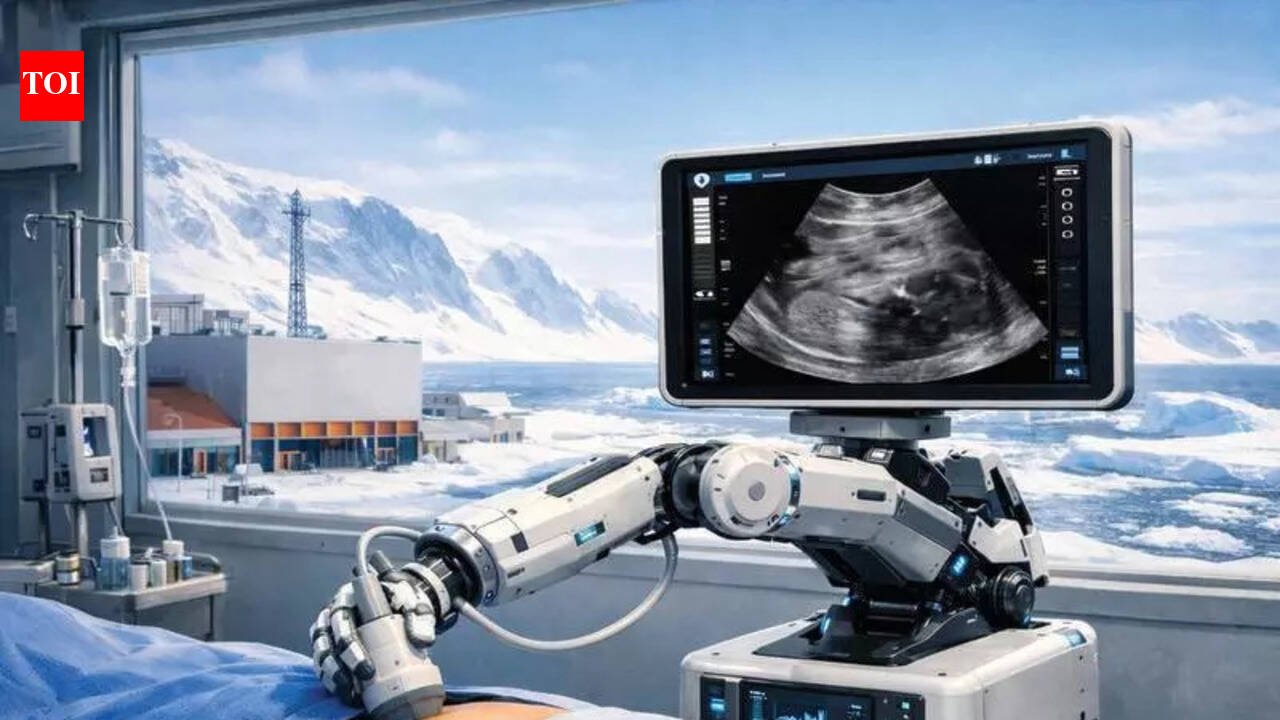
Panaji: In a breakthrough for remote healthcare delivery, doctors at AIIMS, New Delhi, performed a real-time ultrasound examination on a person stationed 12,000km away at India’s Maitri research station in Antarctica, demonstrating emergency medical care in the world’s most hostile regions.The technology addresses a critical gap in Antarctic healthcare and will also benefit high-altitude regions, offshore platforms, disaster zones, island territories, and rural areas across India. It is the result of strong collaboration between the National Centre for Polar and Ocean Research (NCPOR), AIIMS, IIT Delhi and startups. “This is the first known implementation of such a tele-robotic diagnostic system at an Antarctic research station globally, positioning India at the forefront of medical innovation in polar environments,” said the NCPOR director Thamban Meloth.The NCPOR sends teams of researchers on an expedition every year to the polar regions and the Himalayas, where polar scientists and support staff operate in extreme cold and prolonged isolation with limited medical facilities. While trained medical officers are available, specialist consultation from India is severely constrained during emergencies such as trauma, abdominal pain, or suspected internal injuries.“Healthcare delivery in Antarctica remains uniquely challenging. Expedition members operate in extreme cold, prolonged isolation, and environments with limited medical infrastructure. While trained medical officers and essential diagnostic equipment are available at stations, access to super-specialist consultation from India can be constrained by geographical distance and operational limitations,” said Meloth.The NCPOR supported the transportation and deployment of the system at Maitri station, Antarctica, from Goa.The system will enable doctors in India to conduct ultrasound scans remotely, strengthening rapid diagnosis and supporting decisions to evacuate any of the 25-30 polar scientists and staff stationed at Maitri during Antarctic winters.“The objectives of the demonstration were to validate technical feasibility under Antarctic conditions and to demonstrate seamless real-time connectivity between AIIMS and Maitri station,” said NCPOR group director (Antarctic operations) Shailendra Saini.The successful demonstration marked a landmark achievement in India’s Antarctic programme, which maintained a scientific presence in Antarctica for three decades under the earth sciences ministry. The clinical use of this technology began during the Covid pandemic at AIIMS, New Delhi, where tele-robotic ultrasound was used for imaging Covid patients.


