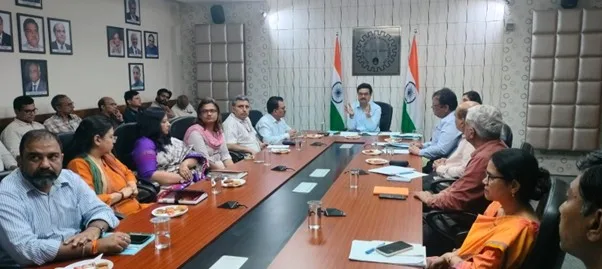
New Delhi, Mar 10: The All India Council for Technical Education (AICTE) has launched 500 Offline ATAL Faculty Development Programs (FDPs) for the academic year 2026–27. The initiative was inaugurated by the Chairman of AICTE, Prof Yogesh Singh.
In his inaugural address, Prof Singh emphasised the significance of FDPs in providing quality training to faculty members. He highlighted the importance of hands-on experience, project-based learning, laboratory-based learning, and technology-driven learning in technical education.
“Technology is the key to accelerating the growth of the country,” Prof Singh said, adding that FDPs are one of the main instruments to strengthen the technical education system so that the nation can develop greater technological expertise. This initiative, he said, reflects AICTE’s commitment to promoting continuous professional development and enhancing the quality of technical education in India.
The Member Secretary of AICTE, Prof Shyama Rath, appreciated the initiative and encouraged faculty members to participate in the FDPs so that they can better prepare students to become a future-ready workforce.
The offline FDPs aim to foster a culture of continuous professional development, with 500 programs proposed for this year. Each basic FDP is a six-day course. Additionally, 50 advanced FDPs, each of two weeks’ duration, will be organised. Only AICTE-approved institutions are eligible to apply for the Offline ATAL FDPs. The programmes are designed to benefit faculty members by enhancing their knowledge and skills, which can then be effectively imparted to students. The application portal is now open, and institutions interested in conducting FDPs can submit their applications until 13 April 2026. Institutes can commence the FDPs from 15 June 2026.
The 17 focus areas covered under this FDP include advanced materials, rare-earth and critical minerals, semiconductors, space and defence, blue and green economy, high-performance computing, energy sustainability and climate change, advanced computing (supercomputing, AI, data science), next-generation communications, smart cities and mobility, agrotech and food processing, healthcare and med-tech, disaster management and resilient infrastructure, manufacturing and Industry 4.0, quantum technology, hydrogen energy, cyber-physical systems and cybersecurity, and other emerging technology areas.
The 17 focus areas covered under this FDP include advanced materials, rare-earth and critical minerals, semiconductors, space and defence, blue and green economy, high-performance computing, energy sustainability and climate change, advanced computing (supercomputing, AI, data science), next-generation communications, smart cities and mobility, agrotech and food processing, healthcare and med-tech, disaster management and resilient infrastructure, manufacturing and Industry 4.0, quantum technology, hydrogen energy, cyber-physical systems and cybersecurity, and other emerging technology areas.