



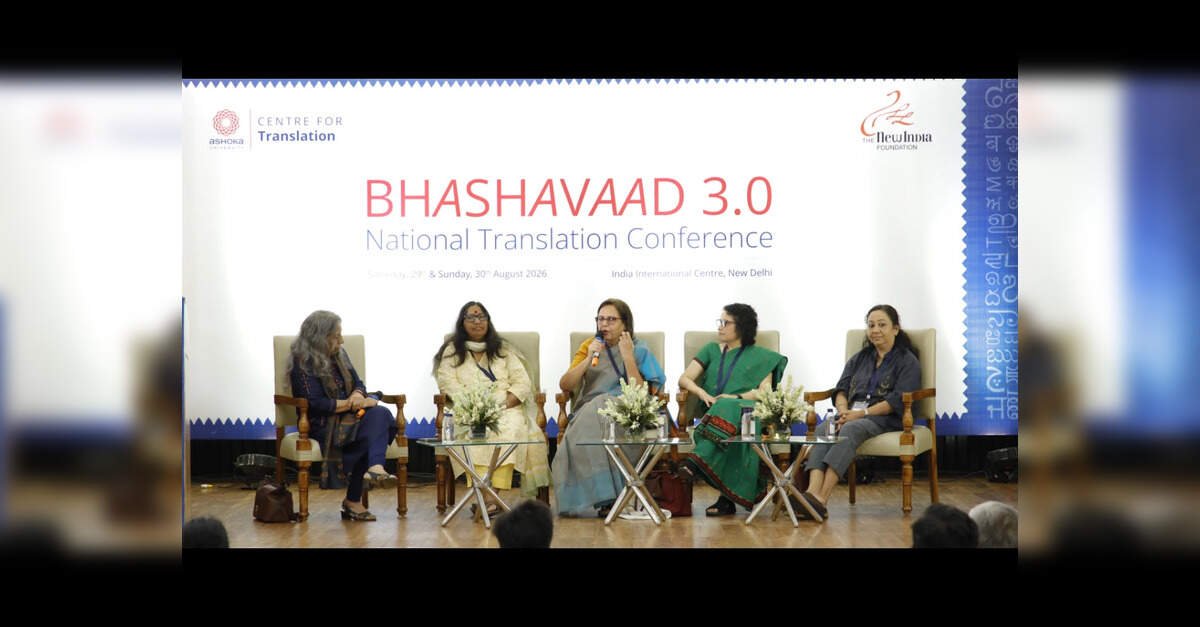
New Delhi: Artificial intelligence can assist literary translation but continues to require substantial human intervention and editorial judgement, according to findings presented at the third edition of Bhashavaad, the national translation conference organised by Ashoka University‘s Ashoka Centre for Translation.
The two-day conference, held on August 29 and 30, brought together writers, translators, publishers and scholars to discuss the changing role of translation and Indian languages amid the growing use of artificial intelligence.
A presentation on the ACT-IDAF Fellowship for Research into AI Translation from Malayalam examined the capabilities and limitations of AI in literary translation. The study found that AI could respond effectively to targeted, context-specific guidance from humans, but its outputs continued to require significant human intervention to accurately represent the literary, cultural and psychological texture of the original work.
The findings were discussed as part of wider sessions on the impact of AI on translation, writing and publishing.
AI and the publishing industry
A panel on ‘Writing and Publishing in the Age of AI’, featuring Karthika VK, Chiki Sarkar, Arunava Sinha and Debayan Gupta, examined how AI is already being used across the publishing process.
The discussion covered AI’s potential to improve efficiency and expand access, while also raising questions around authorship, originality, creativity and the economics of publishing.
Chiki Sarkar, founder of Juggernaut Books, said AI and creativity should not necessarily be viewed as opposing forces, pointing to its use in areas including editing, manuscript review, ideation and illustration.
Another session, ‘Are Translators Redundant?’, examined whether advances in AI could reduce the role of human translators. Panellists discussed the potential of AI to support translators while highlighting the importance of human interpretation, particularly when dealing with cultural context. The discussion also covered copyright, ethics and the changing responsibilities of translators, editors and publishers.
Focus on India’s linguistic diversity
The conference also examined the role of translation in India’s multilingual literary landscape.
A session on Adivasi poetry brought together Kanji Patel, Ramesh Karthik Nayak, Malsawmi Jacob and Parwati Tirkey to discuss contemporary Adivasi languages and literary traditions. The discussion examined the role of translation in bringing these works to wider audiences and preserving linguistic and literary traditions.
The conference also featured discussions on Indian identity, modernity, reading habits and the relationship between writers and translators.
Urvashi Butalia, who moderated the session ‘Being Indian, Being Modern’, said conversations around modernity and marginalisation should not be defined solely by dominant voices.
The opening day featured a keynote by Simona Sawhney, Professor of Literature at IIT Delhi, on translation as a process through which meaning changes as it moves between languages.
Rita Kothari and Arunava Sinha, Co-Directors of the Ashoka Centre for Translation, said translation can help Indian literature reach readers beyond individual linguistic communities.
The conference concluded on August 30 with discussions on the future of translation, Indian languages and publishing in the context of technological change.
The Ashoka Centre for Translation also showcased its ongoing publishing initiatives, including Women Translating Women and Chronicles, along with upcoming projects aimed at expanding the reach of Indian literature.


