



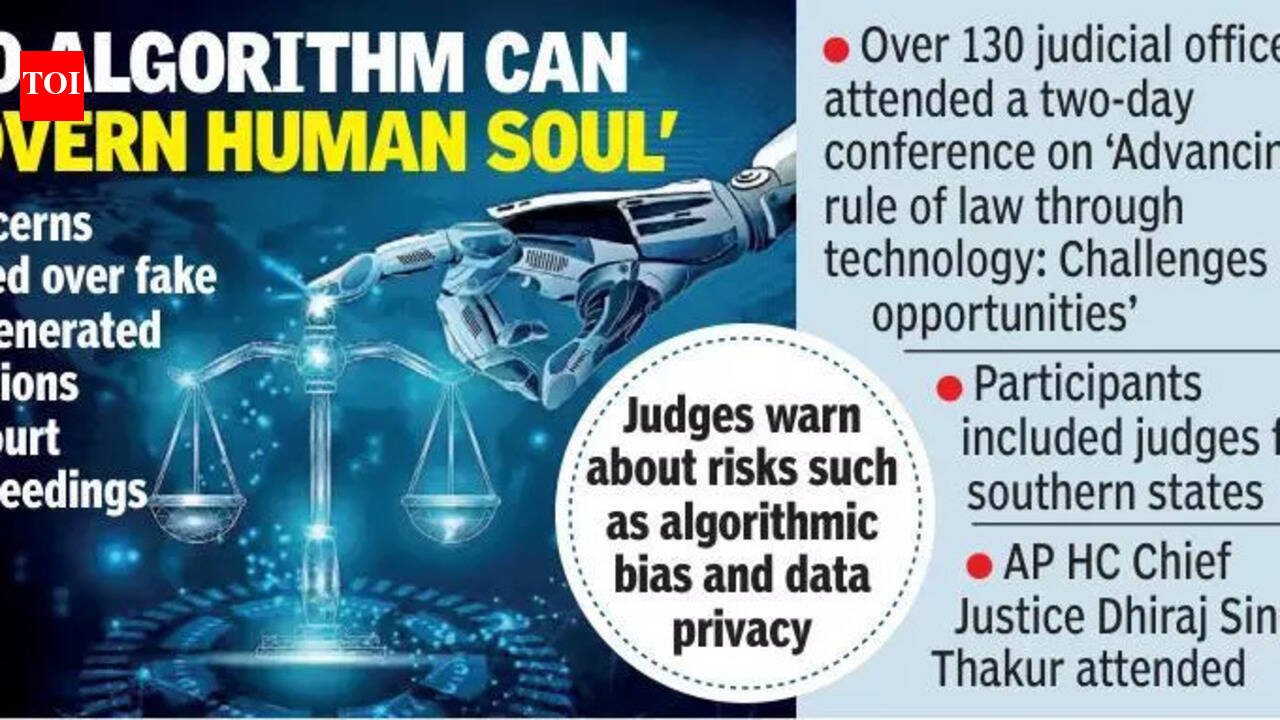
Hyderabad: The south zone II regional conference on ‘Advancing rule of law through technology: Challenges and opportunities’ called for the justice delivery system to adapt to rapidly evolving technologies such as artificial intelligence, blockchain, digital evidence and cyber forensics, while remaining firmly rooted in constitutional values.Participants stressed that technology should assist the judiciary but must never replace human reasoning and ethical judgment. Justice Vikram Nath of Supreme Court said the judiciary must neither reject technology merely because it is new nor accept it blindly because it is efficient. Instead, its use must be evaluated through the lens of constitutional values. On artificial intelligence, he said it should be treated like other digital tools already in use. While AI can organise information and summarise documents, it must never replace the “trained mind of a lawyer” or the “disciplined judgment of a judge.”He also cautioned about fake AI-generated citations that have surfaced even in Supreme Court proceedings. While AI may assist in drafting notes, it cannot be allowed to “invent law” or mislead courts. Rather than shunning technology, he said the judiciary must focus on informed use, ethical discipline and stronger institutional capacity to deal with digital complexities. Justice Satish Chandra Sharma of Supreme Court noted that technology should remain an aid and not a substitute for judicial decision-making, warning about challenges such as algorithmic bias and the protection of confidential judicial data. “Technology provides powerful tools, but the judiciary gives the rule of law. Technology may even transform courtrooms, but no algorithm can govern a human soul,” added Justice Sharma. Digital platformsTelangana high court Chief Justice Aparesh Kumar Singh said the law must continuously evolve with changing realities. Speaking on the growing role of technology in dispute resolution and administration of justice, Justice Singh said alternate dispute resolution mechanisms were increasingly being supported by online dispute resolution platforms that enable remote mediation, digital documentation and virtual settlements. More than 130 judicial officers from southern states attended the two-day conference in the city. The event was attended by Chief Justice Dhiraj Singh Thakur of Andhra Pradesh high court, Chief Justice A Muhamed Mustaque of Sikkim high court and judges from neighbouring high courts. It was jointly organised by Telangana high court, National Judicial Academy and the Telangana Judicial Academy.


