


For all the disruption of the past decade, one part of education stayed stubbornly unchanged. Content moved online, classrooms went hybrid, delivery was reinvented — but assessment, the act of judging what a student knows, stayed largely manual. Scripts are still marked by hand, feedback still takes days, and the same answer can earn different scores from different reviewers. As cohorts grow and expectations rise, that quiet inefficiency has become education’s real bottleneck.
The pressure is not to test more, but to evaluate well, at scale. Institutions must now assess a wider range of skills — writing, speaking, applied reasoning — for more students, faster, and more consistently than manual marking can sustain.
This is where artificial intelligence begins to matter — though not as the headlines suggest. The shift is not that machines can grade multiple-choice questions; they have for years. It is that AI can now evaluate descriptive and spoken answers against defined criteria, with accuracy that, in benchmarks, approaches experienced human reviewers. The value lies less in speed than in consistency and feedback: every student held to the same standard, and told specifically how to improve.
Yet technology is only half the story. The institutions getting this right do not hand judgment to a black box. They keep teachers in the loop, anchor scoring to their own rubrics, and treat AI as an instrument that must earn trust. The real constraint is not how powerful the model is, but how accountable and consistent it can be.
When evaluation becomes instant and consistent, the feedback loop finally closes. Students receive specific, criteria-linked guidance instead of a lone number; teachers reclaim hours lost to marking; and institutions can spot struggling learners early enough to act. Assessment shifts from a verdict delivered too late to a continuous signal that shapes learning as it happens.
For India, the stakes are high. Large cohorts, a fast-growing study-abroad pipeline, and rising expectations mean institutions must assess to global standards while serving learners at national scale. The coming years will separate those that bolt AI onto old processes from those that redesign evaluation around it.
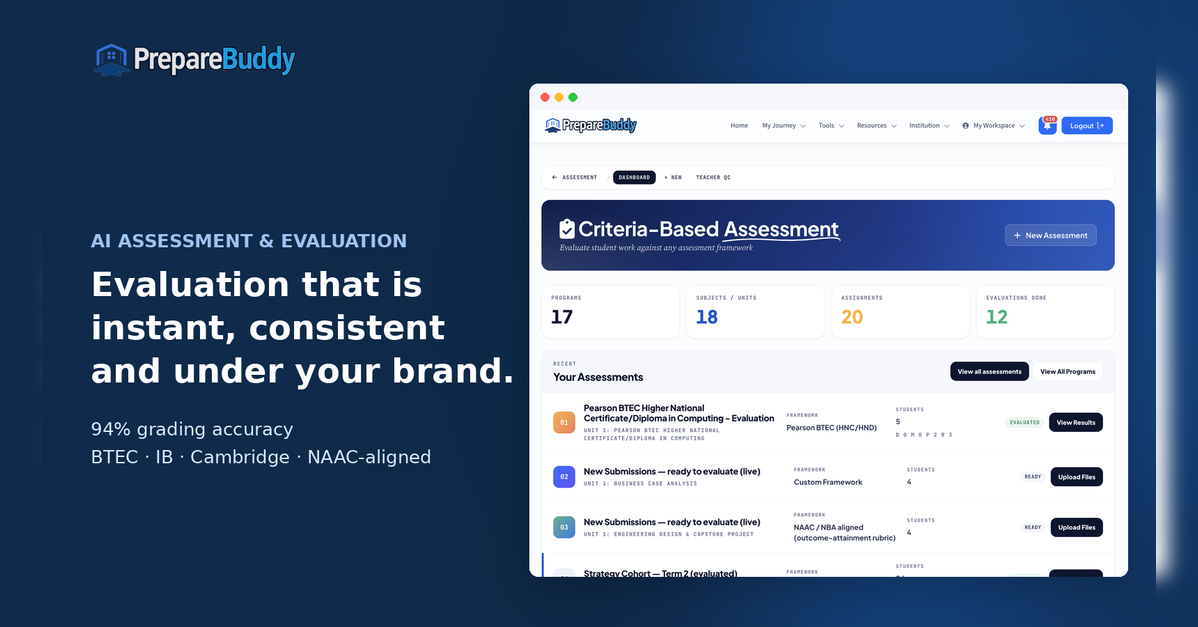
That redesign is the problem we set out to solve at PrepareBuddy. Founded in 2025 and bootstrapped by a team with over a decade in technology and edtech, it was built on a simple conviction: rigorous evaluation and meaningful feedback should not be a privilege of the best-funded institutions. Its mission is to give every school, college and university instant, consistent, criteria-based assessment — under their own brand.
It now supports institutions across four continents and is trusted by 25 universities worldwide, recognised by the AWS Education Equity Initiative, NVIDIA Inception and Startup India. In practice, it has meant teachers reclaiming close to eighteen hours a week and students receiving guidance rather than just a grade. As Abhinav Mittal, CEO of Singapore’s LINC Education, which runs it across its university partners, says: “The accuracy matches our human reviewers, but at a fraction of the time and cost.”
The ambition is larger than software: a future where evaluation is instant and fair by default, and teachers are freed from marking to do the work only they can — teach. Assessment may have been the last part of education to change; handled well, it could prove the most consequential. The institutions that treat AI as an instrument of fairness and feedback, not mere efficiency, will help define what learning looks like next.
