



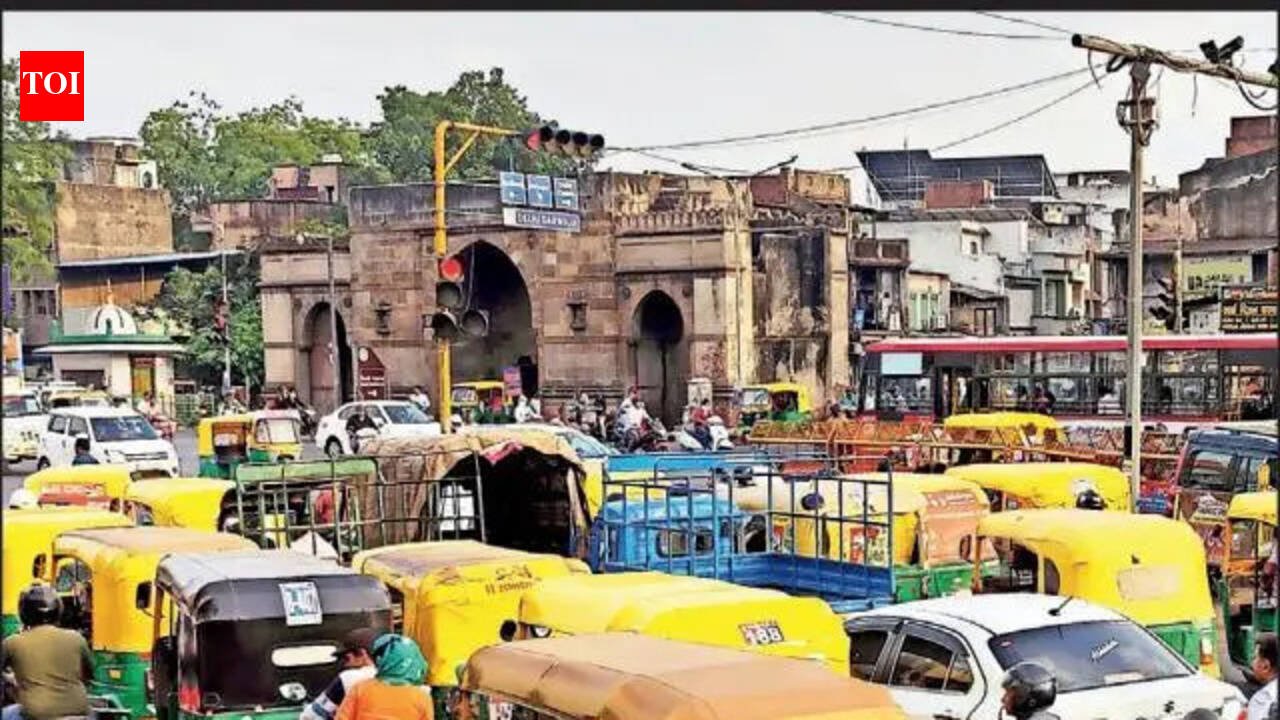
Ahmedabad: For thousands of commuters inching their way through Delhi Darwaza, Memco or Paldi each morning, the gridlock is frustrating. The slow crawl, the seemingly never-ending countdown timer on traffic signals and mounting delays reflect an unforeseen traffic surge.A series of surveys by the CSIR-Central Road Research Institute (CRRI) reveals that traffic density at five of Ahmedabad’s most busiest junctions — Shyamal, Mansi Circle, Delhi Darwaza, Memco, and Paldi — has exploded far beyond official forecasts. Using 2012 as the base year, CRRI had projected traffic levels for 2017 and 2022 after surveying 34 junctions across the city. But by 2025, actual vehicle volumes at the five junctions were found to be three to four times more than predicted.“The numbers do indicate what commuters have been experiencing daily,” said a senior Ahmedabad Municipal Corporation (AMC) official. At the Delhi Darwaza junction, traffic density in 2012 was 18,862 passenger car units (PCUs) and projected to rise to 26,149 in 2017 and 37,330 in 2022. Instead, a fresh CRRI survey in 2025 recorded 1,23,605 PCUs, more than three times the forecast,” an AMC official said.A PCU is a simple way to measure traffic by converting all vehicles into the equivalent of passenger cars. Since different vehicles take up different amounts of road space and affect traffic differently, PCU expresses their impact relative to one car, which is taken as 1 PCU. “PCU tells us how heavy traffic really is, not just how many vehicles are on the road,” the official added.The surge at Memco crossroads is even more glaring. From 8,143 PCUs in 2012, traffic was expected to reach 15,861 PCUs by 2022. The 2025 survey, however, found a density of 1,42,481 PCUs, described as “six to eight times higher than expected”. Similar overruns were recorded at Shyamal, Mansi Circle and Paldi, each logging densities “five to six times higher than predicted”.These growth levels have translated into longer travel times, jammed junctions and rising commuter fatigue. Although flyovers and underpasses were suggested when the CRRI conducted its 2012 survey, several junctions remained untouched even as traffic multiplied over the past 14 years. This gap has now prompted a new CRRI survey covering 25 junctions.Delhi Darwaza remains the most complicated case. A flyover proposed there in 2012 was not built due to the presence of the BRTS corridor. That constraint was removed in Sep 2025 with the corridor from Delhi Darwaza to Prem Darwaza being demolished, paving the way for renewed planning. The flyover, officials say, was a priority in 2012 and remains so even now. In all, Ahmedabad today has 101 flyovers and underpasses, with work underway on 17 more and 12 new bridges planned.


