



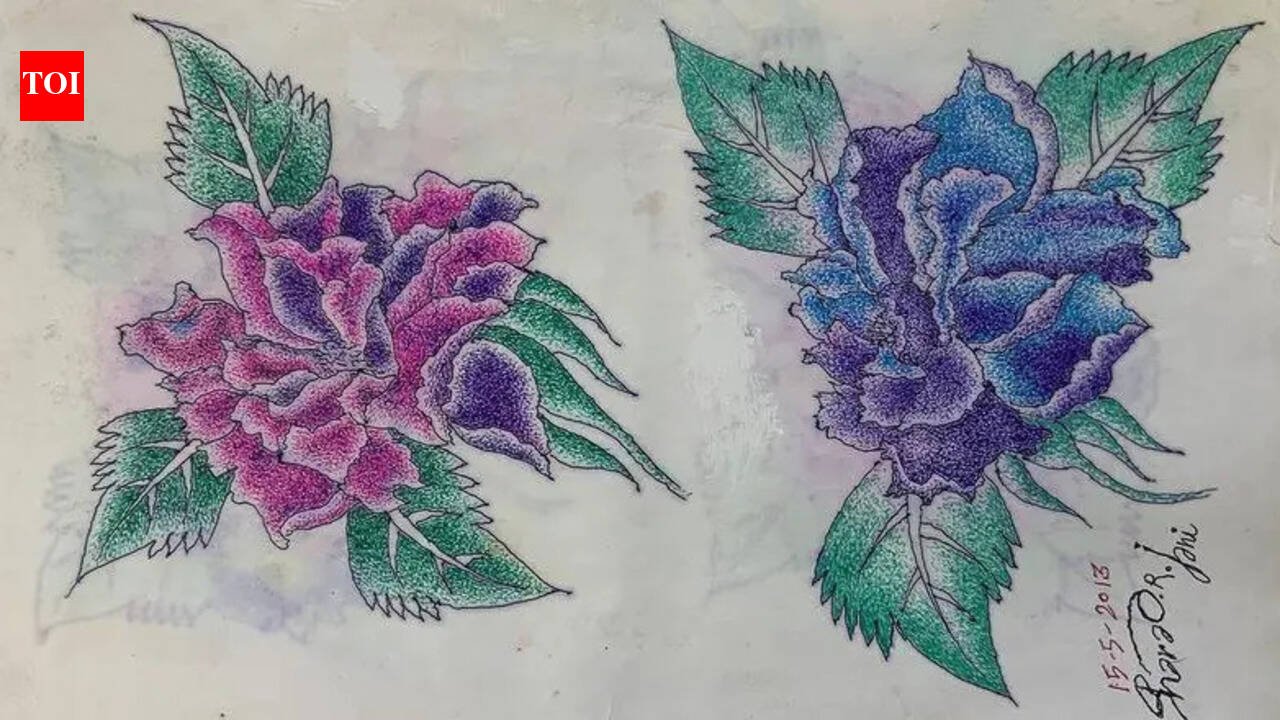
Ahmedabad: During the city’s textile mills boom, Sharad Rasiklal Jani’s designs did more than sell — they endured. As a young textile artist, Sharad Jani was celebrated for his “growing flowers” compositions and intricate saree pallav patterns. Jani started his career at Rajnagar Mill and later moved to Ambika Mills, his craft earning him a basic salary of Rs 150 with annual increments of Rs 10, an enviable sum back in 1962.Today, at 85, the once sought-after man lives in near anonymity on the terrace of a Gheekanta building, with his trusted companions — two stray dogs whom he cares for despite his meagre means. This terrace has been his home for almost three decades; its walls, a canvas for his engravings. Commissions have dried up, leaving the hands that once awed Parisians with their magic, to take up small works. A climb to Jani’s world feels like stepping back in time. An old iron bed supports a makeshift tent offering little protection from searing summers or rains. Belongings are strewn across the concrete. The two dogs erupt in barks, then fall silent at a soft yet authoritative word from their master. “These animals are my only family now,” Jani says, his voice fragile yet firm. Once he cared for 12; only two remain. “I can’t leave them behind to go anywhere else. Their trust is my only real earning.”A floor below is the shadow of his professional life. Once a bustling studio, it was ravaged by a fire years ago. The charred rooms now hold a few surviving works: meticulous engravings and paintings awaiting a buyer who may never arrive.Jani began working at 12, juggling two part-time textile design jobs, earning Rs 80 for each. In 1962, his close friend and noted artist Vinod Parul, guided him to mainstream mills. While others repeated static motifs, Jani’s flowers appeared to grow and flow along a saree’s length, keeping his designs in print for years. “I trained under Chandrakant Bhavsar and later, the legendary Rasiklal Parikh,” he recalls.Later, he moved to Mumbai to work for Textile Corporation of Marathwada. A new opportunity beckoned. “The French Embassy was right across the street from my office. I got a visa and left for Paris.” During the five years in the French capital, Jani did jobs and also sold his works. “I was in Paris from 1984 to 1989. One day, I saw a board outside an office named SLO, written in French. SLO wanted a textile artist. They looked at my work samples and gave me the job. I worked there for six months creating designs that could be embossed onto jackets.” After returning to Ahmedabad, Jani wrote a column for a Gujarati newspaper on patchwork, design, embroidery, and fashion. He also started experimenting with engraving, and soon came to be known as a master engraver on glass, granite and brass — a rare skill in Gujarat. His finesse brought him commissions from various clients, including Sabarmati Ashram authorities.“Earlier, my work was my identity. Today, it’s these dogs,” he says. Jani gets by on the meagre monthly interest from his small savings. He spends Rs 100 each day on meals for his pets — milk, rotis and fruits. His own diet? “Often, bananas and a bowl of moriya (barnyard millet),” he says. Local police teams often climb three floors to check on the frail artist, who has chosen not to live with his wife or his two daughters in the city’s affluent outskirts, and continues to go about life on his own. “It’s painful to see a man of his stature spend every rupee feeding the strays while he eats once a day. He is a magnificent artist and mentor,” says Trikam Purohit, a trader in the building, and who has known Jani since 1998.


