



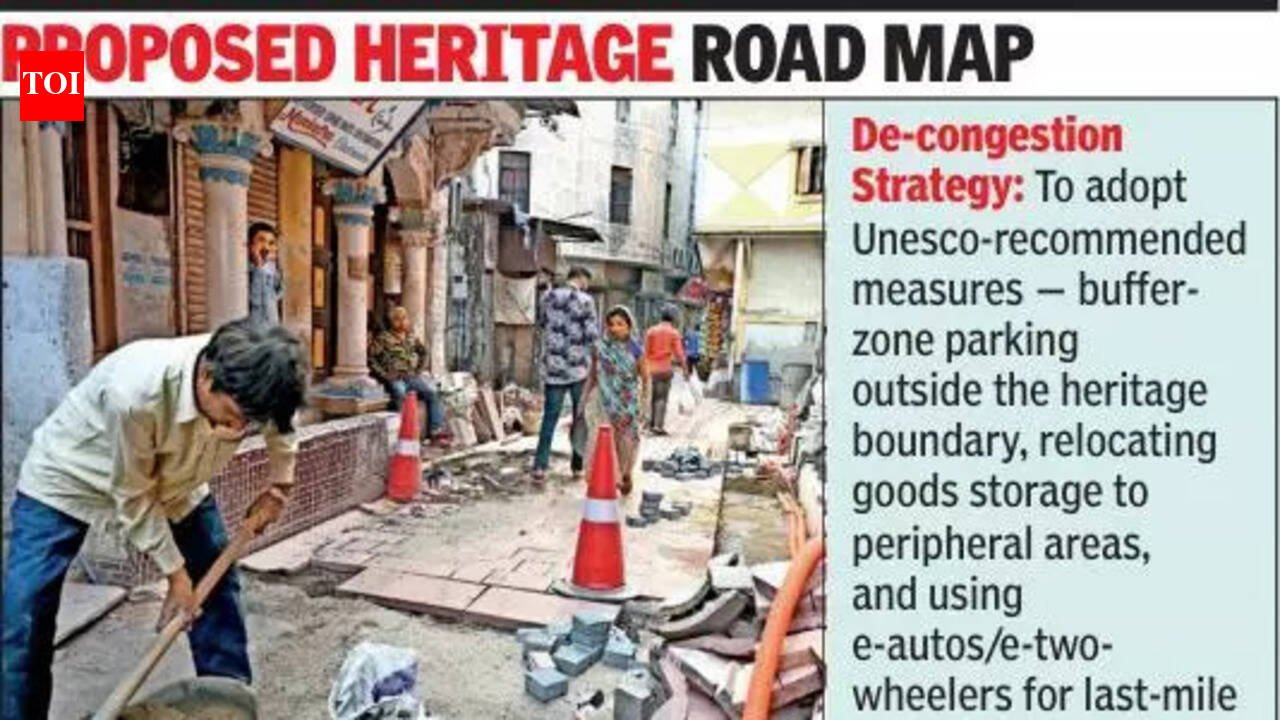
Ahmedabad: As Ahmedabad prepares for an Unesco heritage review on March 18, a city-level heritage seminar homed in on a sharp set of proposals to strengthen the Walled City’s management.The seminar, held last week, brought together AMC officials, planners, conservation experts, and community representatives. Urban Management Centre (UMC) director and founder Manvita Baradi urged authorities to move beyond viewing heritage as monuments. “Heritage is a framework,” she said, calling Ahmedabad a “Living City” whose historical layers must be linked to current planning. UMC’s Anurag Anthony presented the 3D “digital twin” of the Walled City, prepared through drone and total-station surveys. He outlined Unesco’s four priority areas for the revised Zonal Plan: zonal improvements, public space design, timber policy, and decongestion. The exercise produced an estimate of Rs 685 crore for timber-structure restoration over 10 years. A senior AMC assistant commissioner acknowledged delays in restoration permissions and announced a new committee to fast-track approvals to six-eight months. He proposed “tri-party agreements between homeowners, developers and the govt” to ensure “quicker benefits” and noted that “GDCR reforms are underway.” Municipal commissioner Banchha Nidhi Pani said the city’s future development “must stand on the philosophy of development as well as heritage.” Mobility expert Shivanand Swamy pushed for micro-buses in narrow streets and warned that poor walkability and low green cover directly raise surface temperatures. He also pressed for moving warehouses to buffer zones to “decouple trade from storage.” Speakers highlighted gaps in conservation practice. City-based historian Rizwan Kadri recalled the city’s historical “sahkar” and its food heritage. Development professional Bhavna Ramrakhiani recalled the success of a women’s craft collective at Sarkhej Roja that translated historical stone designs into crochet souvenirs.


