



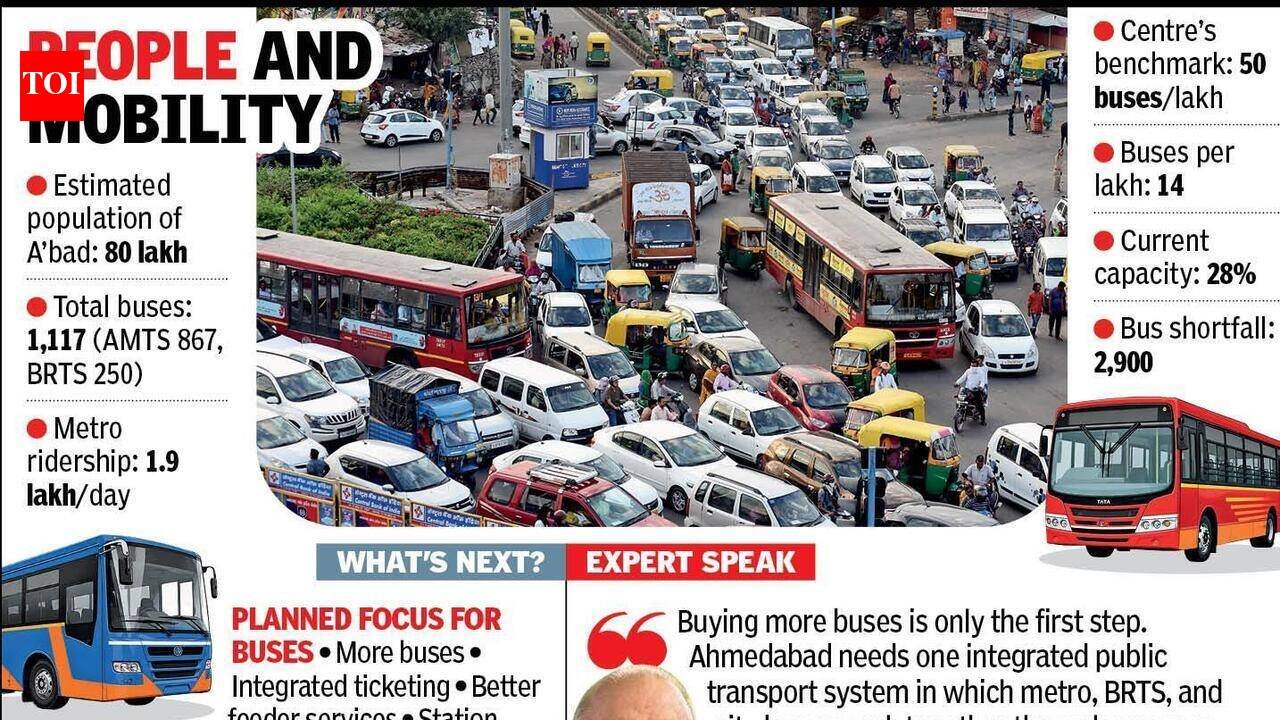
Ahmedabad: Ahmedabad has only 28% of public buses it needs to meet Union govt’s urban transport benchmark, leaving the city nearly 2,900 buses short as it prepares to host 2030 Commonwealth Games (CWG).The figures are in RTI replies accessed by TOI.For Ahmedabad’s population of 80 lakh, the Centre’s service-level benchmark calls for 4,000 buses. However, RTI replies from Ahmedabad Municipal Transport Service (AMTS) and Ahmedabad Janmarg Ltd (AJL) show the city currently operates only 1,117 buses.RTI replies indicate that only 125 of AMTS’s 867 buses are owned by AMC, while 742 are privately owned.AJL has stated that none of the 250 BRTS buses are owned by AMC, with operations outsourced to four private operators.According to RTI responses, Ahmedabad had 867 AMTS buses and 250 BRTS buses as of Nov 30, 2025. This works out to about 14 buses per lakh population. Centre’s service-level benchmark is 50 buses per lakh for cities with a population exceeding 20 lakh.International transit planning benchmarks for high-capacity urban bus systems generally range between 100 and 120 buses per lakh population.The shortfall assumes significance as Ahmedabad prepares for Commonwealth Games, with improving air quality emerging as one of the city’s main objectives ahead of the event.The civic body has begun developing thematic precincts, standardising footpaths and expanding urban greening to make neighbourhoods more walkable, while encouraging a shift from private vehicles to public transport as part of its cleaner mobility strategy.While the city has invested heavily in rail-based transport, RTI data suggests buses remain the weakest link in Ahmedabad’s mobility network.“The discussion should not be limited to whether Ahmedabad has enough buses,” said Prof H M Shivanand Swamy, urban mobility expert and professor emeritus at CEPT University.Swamy said, “The city is already planning a major fleet expansion, with a target of around 3,500 buses by 2030. The larger challenge is integration.”He added that metro, BRTS, and city buses must operate as one network with coordinated schedules, seamless physical connectivity and common ticketing.“If commuters can complete an entire journey conveniently, public transport becomes a genuine alternative to private vehicles,” Swamy went on to say.Ahmedabad’s metro currently spans 40km, operates 297 trips daily, and records an average ridership of 1.9 lakh passengers. The network has recorded a steady rise in patronage since operations began in 2022, when it carried around 35,000 passengers a day.“The city’s investment in metro rail alone will not solve its mobility challenge. Metro works best when it is supported by a dense, high-frequency bus network that provides first- and last-mile connectivity,” said Mahesh Pandya, an environmentalist.He added, “Without significantly expanding the bus fleet, it will be difficult to persuade commuters to shift away from private vehicles. The shift is essential if Ahmedabad is serious about improving air quality ahead of the Games.”Based on current ridership, Ahmedabad metro carries about 4,700 passengers per route-km each day. International metro benchmarking studies indicate that established metro systems generally record substantially higher passenger densities per route-km.Urban transport planners say robust feeder bus services, seamless physical integration and reliable schedules are critical to increasing metro patronage.“The approved Gandhinagar-GIFT City and airport metro extensions, along with proposed routes awaiting clearance, will significantly expand the network,” a metro official said. “Improving feeder connectivity, station access, and commuter facilities such as parking will further strengthen metro usage.”Photo Quotes:“Buying more buses is only the first step. Ahmedabad needs one integrated public transport system in which metro, BRTS, and city buses work together through common ticketing, coordinated schedules and seamless interchange.” Prof Shivanand Swamy, professor emeritus, CEPT University“Every commuter who chooses a bus over a private vehicle helps improve the city’s air. Expanding bus services is one of the fastest and most effective ways to reduce transport-related pollution.” Mahesh Pandya, Environmentalist===Metro statsNetwork and trips/day40km | 297Box: People and mobility· Estimated A’bad population: 80 lakh· Total buses: 1,117 (AMTS 867, BRTS 250)· Metro ridership: 1.9 lakh/day· Buses per lakh: 14· Centre’s benchmark: 50 buses/lakh· Current capacity: 28%· Bus shortfall: 2,900What’s next?Metro· GIFT City and airport extension approvedProposed corridors· SP Ring Road-Sanathal· Shilaj-Sanand via Godhavi· 132-ft Ring Road circular corridor· RTO–Naroda–Narol–Jivraj Park–Thaltej corridor· Walled City corridorPlanned focus· More buses· Integrated ticketing· Better feeder services· Station area developmentParking management


