



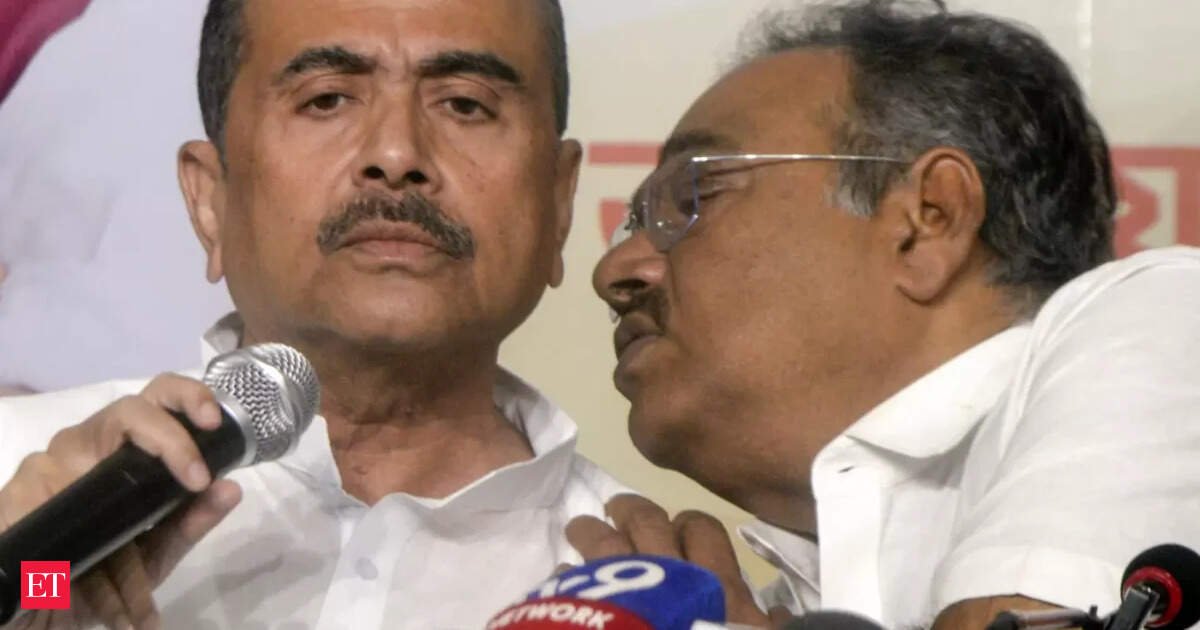
In an interview with PTI, Bhattacharya cast this month’s election not merely as a contest between the BJP and the ruling TMC, but as a decisive civilisation battle for the “existence of Bengali Hindus” and also of what he called “nationalist, rational Muslims”.
Also Read: West Bengal Assembly Elections 2026: Congress veteran Adhir Ranjan Chowdhury alleges attack by TMC workers
The BJP leader linked his party’s political pitch to the fallout of the recent developments in Bangladesh, the “changing demography” of West Bengal’s border districts, the SIR exercise, and the TMC’s policy of “minority appeasement”.
“I have also said that this is the last election not only for Bengali Hindus but also for nationalist, rational Muslims (if the TMC returns to power in the state),” Bhattacharya said.
“Because of the fanaticism we have seen in Bangladesh — Hindus were killed, Hindu women were abducted and converted, but Sunni Muslims were also killed,” he said, drawing a parallel between political developments in Bangladesh and the situation in West Bengal.
When asked directly whether the BJP, if voted to power in West Bengal, would stop what he described as ‘Love Jihad’ and ‘Land Jihad’, Bhattacharya replied without hesitation: “Yes. That is our duty and responsibility. We will end ‘Love Jihad’ and ‘Land Jihad’ in the state.” When it was pointed out that such a campaign could invite allegations of communal politics, Bhattacharya was unapologetic.
“Let them call us communal, we are not bothered. Who is carrying out ‘Love Jihad’ and ‘Land Jihad’ in West Bengal?” he said.
Also Read: EC approves 4,660 auxiliary polling stations in West Bengal
Explaining what he meant by the term, Bhattacharya said, “Love Jihad means that someone introduces himself as a Hindu, pretending to be, say ‘Jhontu’, enters into a relationship with a girl, and only then reveals his religion when she gets involved.”
The remarks are significant because they indicate that the BJP is preparing to make identity and infiltration central themes of its campaign in West Bengal, much as it did in Assam and in parts of North India.
Bhattacharya claimed that the recent electoral performance of Jamaat-e-Islami in districts of Bangladesh bordering India had reinforced the BJP’s concerns.
“It is alarming and dangerous. The demography of all our border districts has changed. Using West Bengal as a base, its land has been used to change the demography of the forest belt areas of West Bengal, Jharkhand and Bihar,” he alleged.
He then connected what he called ‘Love Jihad’ and ‘Land Jihad’ to the alleged demographic change.
“Along with ‘Love Jihad’, ‘Land Jihad’ has also begun. Bangladeshis are marrying tribal girls and taking control of their land. Using Murshidabad in West Bengal as a base, Bangladeshi infiltrators have spread to different places,” he claimed.
Bhattacharya sought to stitch together a chain of disparate incidents into a broader political narrative of infiltration and demographic change.
“If everything we are saying is wrong, then why did Noida and Gurugram suddenly empty out overnight when the SIR exercise started? Why are people suddenly unable to find domestic workers?” he said.
He also referred to the recent fire in a slum cluster near Rajarhat and Salt Lake, suggesting it revealed a larger pattern.
“Take the case of the slum fire near Rajarhat. So many people disappeared after the fire. Where did they go? Why did they go?” he said.
For Bhattacharya, however, the issue goes beyond Hindu-Muslim politics and is, in his words, part of a global struggle against extremism.
“So, the issue is religious fanaticism and radicalisation, which is a curse for human civilisation. Europe is affected, part of America is affected, Canada has practically surrendered,” he said.
“Even among Islamic states, there is conflict. So today, the real religion is democracy and the real politics is the fight against extremism and fundamentalism,” he added.
Bhattacharya said the BJP would continue to foreground these issues despite criticism.
“Everything we are saying is visible. But whenever we raise it in Parliament, nobody has any answer. And we will continue to raise it. We do not care what others say about us,” he said.
Seeking to place the BJP’s politics within a longer ideological trajectory, Bhattacharya said, “We have been indulging in politics on this issue since the 1950s. Every political party has opposed us.”
Then, invoking an unlikely figure, the BJP leader cited former chief minister Jyoti Basu.
“I am reminded of something Jyoti Basu once said: when everyone opposes you together, it means you are saying the right thing and walking on the right path. Despite all the opposition, look where we are today,” he said.
Bhattacharya also strongly defended the Special Intensive Revision of electoral rolls, which has emerged as one of the most contentious issues in the run-up to the polls, with opposition parties alleging that genuine voters are being harassed and excluded.
“The nation comes first. Whether we win or lose is not the bigger issue. SIR is an issue to have clean and correct voter rolls. That is the purpose and it will be achieved,” he said when asked whether the exercise would politically help or hurt the BJP.
Assembly polls will be held in two phases on April 23 and April 29. Votes will be counted on May 4.


