



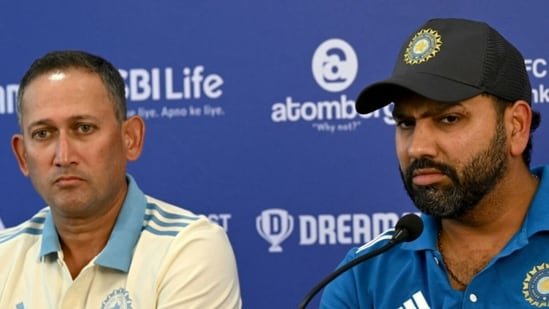
Reports emerging from the Indian cricket team’s tour of England suggested that the third ODI at Lord’s on 19 July could be Rohit Sharma‘s final appearance for India. The BCCI selection committee has reportedly informed the 39-year-old that he does not feature in their plans for the 2027 World Cup, effectively handing him a retirement ultimatum.
While jarring, this development follows a long-standing pattern. The Indian cricket administration has consistently struggled to manage the twilight phases of its most celebrated players. Instead of smooth transitions, senior players are often stripped of captaincies, sidelined, or forced to retire to avoid the indignity of being dropped outright. Here is how some of India’s biggest cricket stars went out the ugly way.
1. Rohit Sharma (2025–2026)
The transition began in early 2025, when a humbling 3-1 series loss to Australia in the Border-Gavaskar Trophy saw Rohit drop himself for the fifth Test. His poor showing saw him call time on his Test career a month (alongside Virat Kohli) before the summer tour of England. Despite winning the Champions Trophy in 2025, he was removed as India’s ODI captain and replaced by Shubman Gill. The intention was for Gill (and vice-captains KL Rahul and Shreyas Iyer) to lean on Rohit and Kohli and grow into their leadership roles.
Now, two years on from leading India to the 2024 T20 World Cup title, Rohit is being pushed out after a lean run of form to accommodate younger openers like Yashasvi Jaiswal. Despite scoring a century at Lord’s and addressing all that’s transpired as nothing but ‘outside noise’, Rohit seems to have bought himself time, but for how long? Having worked extensively on his fitness and lost weight, Rohit has been told by selectors that the ball is in his court. For one of Indian cricket’s most successful openers and captains, the looming forced exit is a bitter end.
2. Virat Kohli (2021)
Before Kohli reluctantly exited Test cricket alongside Sharma in May 2025, he was at the centre of one of modern Indian cricket’s most controversial administrative clashes. The fallout began in late 2021, when Kohli stepped down as T20I captain, explicitly stating his intent to continue leading in the longer formats.
Weeks later, the BCCI abruptly sacked him as ODI captain. Kohli revealed he was informed of his ODI sacking just 90 minutes before a selection meeting. In a press conference, he directly contradicted then-BCCI President Sourav Ganguly’s claim that he was asked to reconsider his T20I resignation. The controversy eventually saw Kohli resign from the Test captaincy too, in early 2022, unexpectedly ending India’s most successful leadership era.
3. Gautam Gambhir (2012–2016)
Long before he became the head coach managing Rohit’s current transition, Gautam Gambhir experienced the board’s poor man-management firsthand. His exit stemmed from the controversial rotation policy introduced during the 2012 Tri-Series with Australia and Sri Lanka. Then-captain MS Dhoni and the management publicly targeted Gambhir, Virender Sehwag, and Sachin Tendulkar, claiming the veterans were too slow in the field to play together. This public demotion severely fractured the dressing room and stalled Gambhir’s momentum, with him being rested/dropped after consecutive scores of 92 and 91.
That marked the beginning of the end. Gambhir was subjected to a frustrating cycle of being dropped and recalled, and, starved of consistent backing, his international appearances dried up entirely after a final Test in 2016.
4. Sourav Ganguly (2005–2008)
Ganguly’s 2005 downfall during the stint of head coach Greg Chappell remains a remarkably dark chapter for Indian cricket. As the captain who fundamentally transformed the team into an aggressive overseas competitor, Ganguly commanded immense respect. However, his tenure ended suddenly. A disagreement with Chappell over batting positions rapidly escalated into a bitter power struggle.
Chappell eventually emailed the BCCI, declaring Ganguly physically and mentally unfit to lead the side. The board sided with the coach, stripping Ganguly of his captaincy and dropping him from the national squad altogether. Ganguly did fight his way back as a pure batter and ultimately retired on his own terms in 2008, but the ugly nature of his initial sacking exposed the power struggles and flaws of the selectorial system.
5. Sachin Tendulkar (2012–2013)
Even the sport’s most prolific run-scorer was subjected to the BCCI’s administrative mechanics. The first major slight occurred in 1997 during his initial stint as captain. Despite carrying the batting line-up, Tendulkar was sacked from the leadership role without a courtesy phone call, learning of his dismissal through the media.
By 2012, as his century count stalled and his reflexes naturally slowed in the twilight of his playing career, the board grew impatient. Former chief selector Sandeep Patil later admitted that the selection committee had drafted a concrete plan to drop Tendulkar from the ODI squad if he did not pre-emptively announce his retirement. Facing an ultimatum that threatened to tarnish the legacy of Indian cricket’s most famous son, Tendulkar finally bowed out of white-ball cricket just before he was pushed.
6. Kapil Dev (1994)
The template for forcing out national heroes was set by Kapil Dev’s final chapter. The all-rounder who lifted the 1983 World Cup was an untouchable icon, but by the early 1990s, he had lost his lethal pace. Rather than stepping away gracefully, Kapil pushed his ageing body to the limit simply to surpass Richard Hadlee’s world record of 431 Test wickets. The board watched closely as a past-prime version of their greatest fast bowler dragged himself through matches just to reach the milestone.
Once Kapil broke the record in early 1994, the management’s fleeting patience evaporated. Selectors Gundappa Viswanath and Ajit Wadekar issued a non-negotiable ultimatum, firmly instructing him to announce his retirement to avoid what would have been an unprecedented humiliation of being dropped.
7. VVS Laxman (2012)
Indian cricket witnessed one of its most unexpected retirements on August 18, 2012, when VVS Laxman announced at a press conference that he was done playing for India just a week before the start of a home Test series against New Zealand. The timing alone made it a huge story. Laxman had already been drafted into the squad, but there was a belief that he was hurt by suggestions from some selectors that he was holding up a youngster’s place in the team.
Not that Laxman had performed poorly. Barring the 2011 tours of England and Australia, where almost every Indian batter struggled, his average hovered close to 50. Still, the feeling that the selectors, in a way, no longer believed in him pinched. Not a single bad word was uttered. Laxman simply dropped a bombshell and moved on.


