






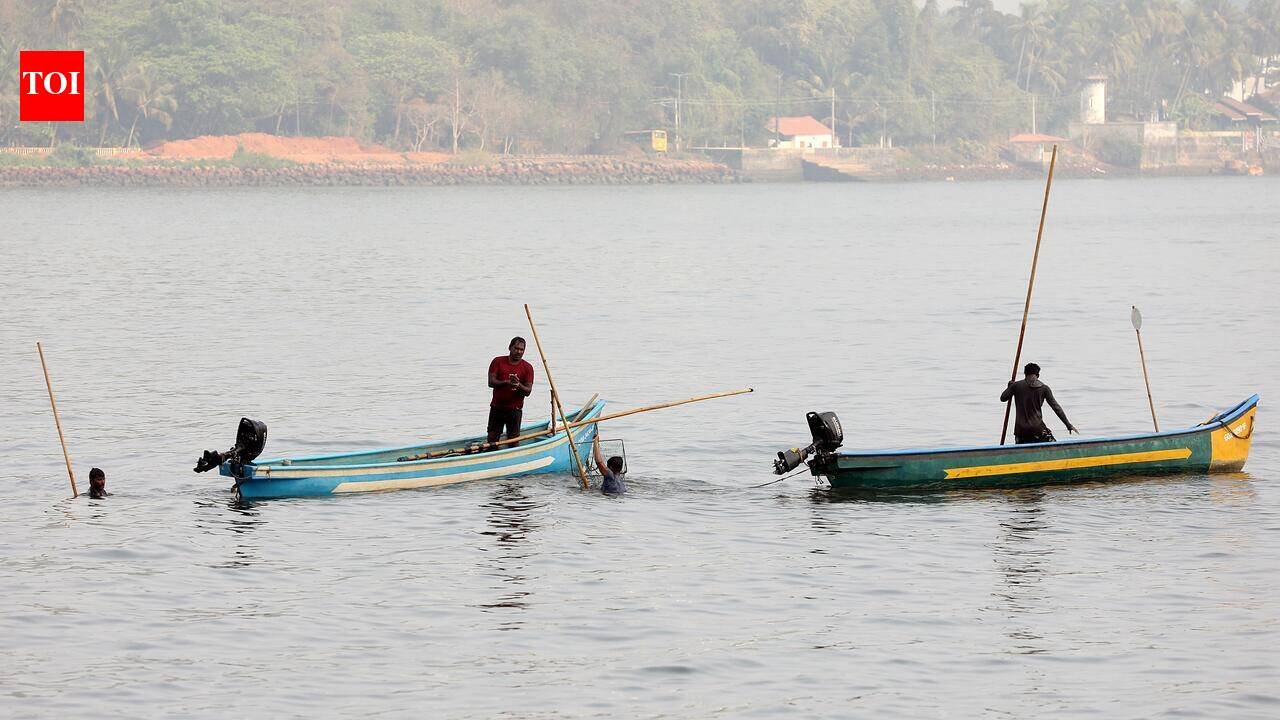
Panaji: A small fishing community at Campal alternates between dangerous deep dives for clams in Mandovi river and odd jobs during the off-season to survive. Yet, despite their precarious livelihood, the fishers have voluntarily stopped clam (tisreo) fishing for two months to allow the shellfish resources to regenerate.On Aug 1, they suspended clam fishing for the first time, responding to chief minister’s emphasis on sustainability. “We stopped it for the first time, paying respect to the chief minister’s talk about the importance of sustainability,” fisherman Vicky Fernandes said.Operating 25 canoes along the shoreline from Dempo House to Miramar, the fishers dive about six metres to the riverbed, scooping clams into a koblem, a net worn around the neck, while holding their breath. They return briefly to the surface before diving again, repeating the process until they have a good catch.Such lung-powered diving for marine resources is uncommon in Goa and carries considerable risk. While clam fishing is often done in shallow waters, Campal’s fishers say they have been forced to dive because of changes to the riverbed. “This stretch had a lot of sand that was ideal for clam growth. But after the bridges were built, it was buried under muddy layers, forcing us to resort to diving into the river for tisreo for the past two decades,” Vinod Mergeri, a fisherman, said.The fishers anchor their canoe to a seven- to eight-metre iron pipe before diving. “Then we take a deep breath and dive to the riverbed with a koblem, a net to hold clams around the neck, and a flat iron piece to scoop out the tisreo,” Vicky said.A lapse in concentration underwater can prove dangerous, but the fishers have adapted to staying submerged for short periods without equipment.The voluntary ban, however, has left many struggling for income. “A few do odd jobs, but most are facing a crisis. Fishing with kantalli, a type of net fishing, as an alternative, for instance, gives small pickings,” a fisherman said.The conservation effort has drawn praise from fisheries union leaders. “Two months to allow shellfish resources to grow will yield economic benefits to the fishers as well as sustain ecology,” Sebastian Rodrigues, general secretary of the National Federation of Small-scale Fishermen (NFSF), said.Rodrigues also criticised the harvesting of juvenile clams. “If the clams are allowed to grow, the bigger size will be rewarding in terms of good income,” he said.Fishers say pollution has also affected shellfish diversity. “About three decades ago, we harvested xinaneo, a bumper produce of green mussels, but now there is nothing,” Fernandes said.“Community conservation practices are being carried out in many places. It is best when the fishers’ community self-administers the same. But it is hoped that authorities stop the release of Panaji sewage in Mandovi river,” Rodrigues said.


