



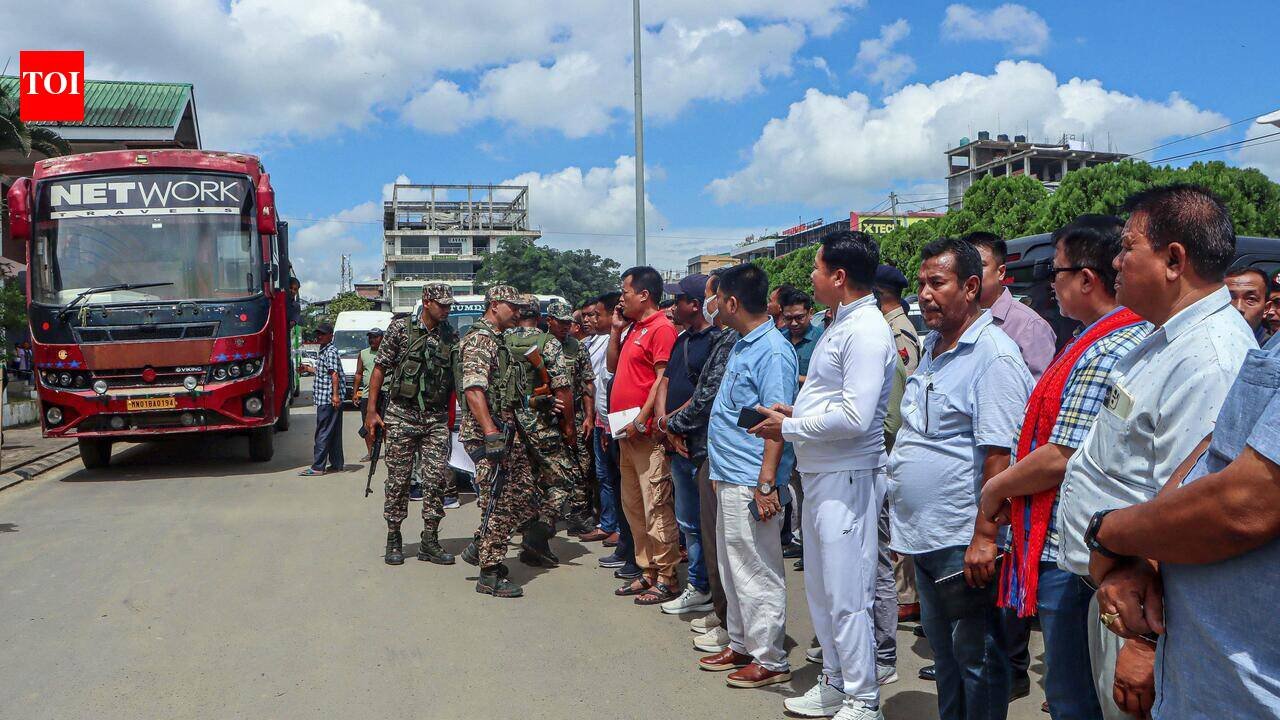
Imphal: Interstate passenger services between Imphal and Guwahati via Dimapur resumed on Friday after a gap of more than three years, marking a tentative restoration of road connectivity along a route disrupted by the ethnic conflict in Manipur, blockades and security concerns since May 2023.The CM’s office said two buses and five smaller passenger vehicles left Imphal carrying a total of 125 passengers. They travelled through Kangpokpi and Senapati before entering Nagaland en route to Guwahati.The route covers roughly 500 km. It runs north from Imphal on NH-2 through Kangpokpi and Senapati districts to the Manipur-Nagaland border, continues towards Dimapur and then heads west through Assam to Guwahati. The journey normally takes 12 to 14 hours, depending on weather, road conditions, traffic and security checks. The Imphal-Dimapur stretch is around 200 km and passes through the sensitive Kangpokpi-Senapati-Mao corridor before entering Nagaland.The resumption is significant because the route passes through Kangpokpi, a Kuki-Zo-majority district, and Senapati, a Naga-majority district, with passengers travelling from areas of the Imphal Valley.CM Yumnam Khemchand Singh had announced the planned resumption during a visit to Kangpokpi on Aug 8, saying national highways would be reopened for the free movement of people from all communities. Deputy CM Nemcha Kipgen and Saitu MLA Haokholet Kipgen were also present at the event.A traveller, Kiyam Kumarjit Singh of Thoubal district, said the service should help foster “love, peace and harmony” among communities. Another passenger, Nivedita of Khundrakpam village in Imphal East, expressed hope that the journey would contribute to peace in the state.The Imphal-Dimapur-Guwahati section is among Manipur’s important supply and passenger corridors. It is a key interstate link connecting Manipur with Nagaland and Assam and serves as an alternative connectivity route to the Imphal-Jiribam-Silchar corridor.The resumption comes amid the state govt’s efforts to project a return to normalcy after prolonged ethnic violence between Meitei and Kuki-Zo groups, which erupted in May 2023 and disrupted movement across several hill and valley areas.The route became highly sensitive after the outbreak of the violence. Inter-community distrust, attacks, security restrictions and fears of travelling through areas dominated by another community sharply reduced civilian movement. Passenger services were suspended, and many residents began relying on escorted convoys, air travel or longer routes through Jiribam and Silchar.The highway has also periodically been affected by bandh calls, economic blockades and protests over political, ethnic and administrative demands. Such disruptions have historically pushed up the prices of fuel, food and other essential commodities in the landlocked state, underlining the route’s economic importance.The CM’s office described the service as an effort to restore normal life and strengthen interstate connectivity.


