



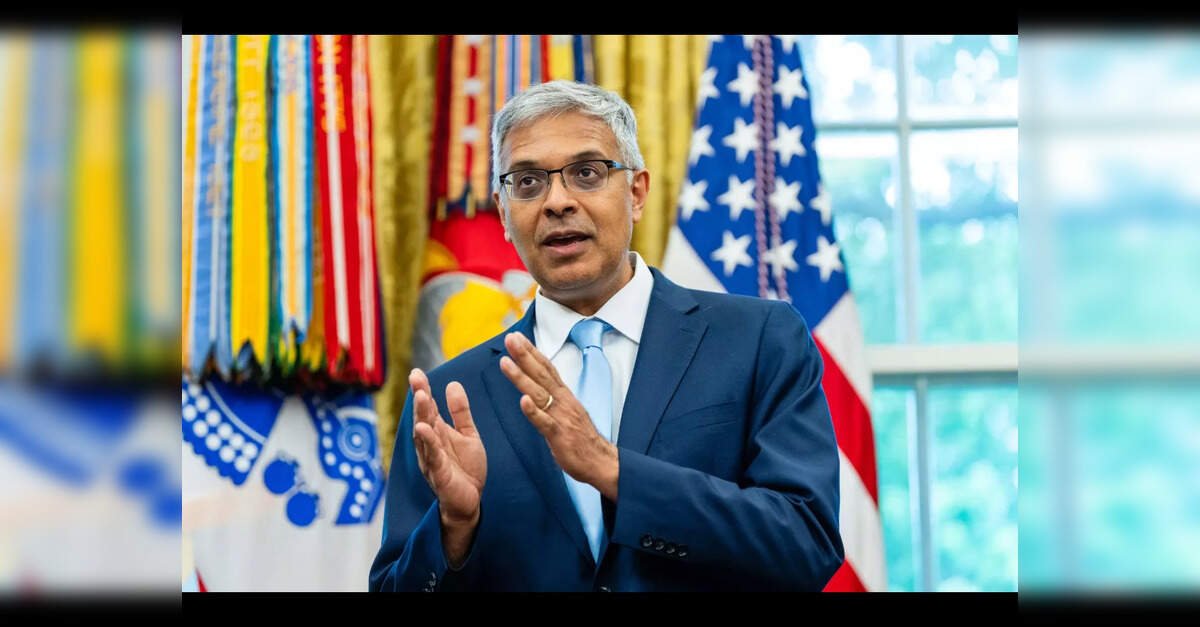
In his first week leading two of the nation’s health agencies, Dr. Jay Bhattacharya has been met with praise and gratitude from federal employees — an unexpected reception for a scientist who spent much of the past few years facing scorn from most other public health experts.
Bhattacharya, director of the National Institutes of Health, was named the acting director of the Centers for Disease Control and Prevention last week. A medical economist and former Stanford University professor, he replaced Jim O’Neill, a Silicon Valley executive with no medical training.
Like most officials in the Trump administration, Bhattacharya was staunchly opposed to mandates for COVID vaccines, but unlike many, he has not questioned the safety of childhood vaccines.
In meetings with CDC staff this week, Bhattacharya offered to publicly endorse immunizations in general and the measles vaccine in particular; extolled the importance of prevention efforts against HIV; and promised to try to extend remote work accommodations, according to several CDC employees with knowledge of the discussions. (The employees asked not to be named for fear of repercussions from the Trump administration.)
Bhattacharya, too, seemed pleased with his foray into the agency. He did not respond to a request for comment. But in the second agencywide email he has sent in five days, he said, “Quite candidly, I am even more excited to take on this role now than I was when I began.”
Andrew Nixon, a spokesperson for the Department of Health and Human Services, which oversees the CDC, said Dr. Bhattacharya “is focused on strengthening infectious disease prevention and response, promoting evidence-based science and restoring public trust in the agency.”
Bhattacharya’s comments on vaccines were the biggest cause for hope among some agency staff members who have felt stymied by the vaccine skepticism of Health Secretary Robert F. Kennedy Jr. and other officials, including President Donald Trump.
At a confirmation hearing Wednesday, Dr. Casey Means, Trump’s nominee for surgeon general, parried questions on whether parents should immunize their children against measles, saying they should consult their doctor.
Kennedy directed agency staff members to alter the CDC website to say that there was not enough evidence to claim that vaccines did not cause autism, despite decades of studies dismissing such a link. He and his appointees have also rescinded recommendations for several childhood vaccines, reducing the number of diseases that children should be routinely immunized against to 11 from 17.
The White House is said to be pivoting away from focusing on vaccines and toward healthy food as the midterm elections approach. As acting director, O’Neill authorized the newly truncated childhood vaccination schedule; he has been nominated to lead the National Science Foundation.
Dr. Ralph Abraham, the agency’s principal deputy director, stepped down within a couple of hours of Bhattacharya’s arrival at the CDC campus Monday. It’s unclear if the two events were related.
Some CDC employees noted that Bhattacharya was among the authors of the memo that had cut down the vaccination schedule, and that the agency still had a number of political appointees who share Kennedy’s views on vaccines.
But others said that after a year of being buffeted by the Trump administration’s moves, they were buoyed by Bhattacharya’s mere presence at the agency’s headquarters in Atlanta and his willingness to meet with the staff. The CDC has been without a permanent director for more than a year, and O’Neill led the agency from Washington, D.C.
Few employees had high hopes for Bhattacharya when he was appointed. During the COVID-19 pandemic, he was a fierce critic of the CDC, saying the agency had “peddled pseudoscience” in promoting the use of face masks to contain the virus.
In 2021, he criticized Dr. Anthony Fauci, the lead scientist on the nation’s COVID response, for guiding public health policies while also leading the NIH‘s infectious disease institute. As director of both the NIH and the CDC, Bhattacharya is now in that same position.
He was also one of the architects of the Great Barrington Declaration, which called for allowing the coronavirus to spread naturally among younger people to achieve herd immunity, directly contradicting the CDC’s recommendations for preventing infections.
The tone in Bhattacharya’s first email to the agency’s staff Friday was strikingly different. The loss of trust in the CDC because of policy decisions during the pandemic “is not a repudiation of your hard work,” he told them. “Your work over recent years has been heroic, courageous and essential.”
On vaccinations, Bhattacharya has diverged from Kennedy’s more equivocal stance. Kennedy has sometimes supported the use of the measles vaccine while simultaneously deriding it, falsely saying that the shot can be fatal, contains fetal debris and loses effectiveness rapidly.
In a Senate hearing this month, Bhattacharya was clearer: “I think the best way to address the measles epidemic in this country is by vaccinating your children for measles.”
This article originally appeared in The New York Times.


