






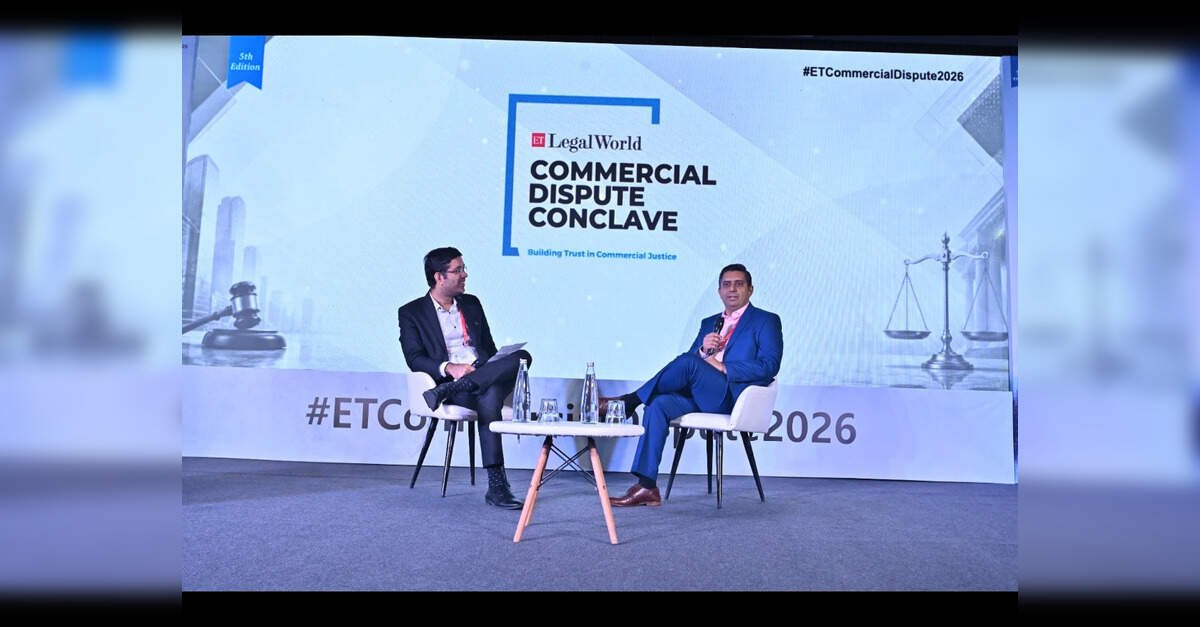
AI is increasingly capable of taking over repetitive legal work, but the responsibility for the final advice and outcome cannot be delegated to technology, Abhishek Sharma, Regional Counsel, Thomson Reuters, said at the ETLegalWorld Commercial Disputes Conclave 2026.
Speaking during the fireside chat General Counsel Playbook: Traditional Practice to AI-Enabled Legal Function, moderated by Amit Sethi, Senior Solution Consultant, Thomson Reuters, Sharma said the modern general counsel is expected to participate in business decisions from the outset rather than react after risks have materialised.
“The best dispute is a dispute that never happens,” he said, arguing that legal teams must plan upstream through clearer contracts, consistent processes and faster access to reliable information.
AI can shift lawyers towards higher-value work
Sharma said AI-enabled legal tools can absorb the first layer of manual work across contracting, research and legal operations, allowing lawyers to spend more time on judgment and strategy.
He cited NDA review as an example, where technology can generate an initial redline based on an organisation’s policies and templates rather than requiring senior lawyers to begin the process manually. Research tools, workflow platforms and external counsel management systems can similarly reduce administrative effort and improve cost management.
For legal teams, however, deploying a few general-purpose AI licences should not be confused with meaningful transformation. The real value, Sharma suggested, comes from embedding trusted technology into legal workflows.
Trust rests on source, security and simplicity
Sharma identified three considerations for legal AI adoption including source, security and simplicity.
Legal professionals need to know where information originates and must be able to trace conclusions back to credible sources. Data security is equally important, particularly where confidential information could potentially be used to train external models.
The third requirement is usability. AI tools must be simple enough to fit naturally into lawyers’ workflows rather than demanding complicated prompting or creating additional operational friction.
“Trust is the currency of a lawyer,” Sharma said, adding that the same standard must apply to technology used to support legal decisions.
Crucially, AI does not shift professional responsibility. “The accountability stops with the lawyer always. It’s never with AI,” he said.
Looking ahead, Sharma expects technology to take over more repetitive and administrative work and potentially provide better toolkits and playbooks to mediators, arbitrators and litigators. But as adoption accelerates, lawyers will continue to demand auditability, clarity over where information came from, how documents were handled and how an AI-generated conclusion was reached.
The remarks came as the fifth edition of ETLegalWorld Commercial Disputes Conclave 2026 is currently underway in New Delhi, bringing together legal professionals, policymakers, industry leaders and dispute resolution experts to discuss the evolving commercial justice ecosystem. The conclave, themed “Building Trust, Speed & Certainty in India’s Commercial Justice Ecosystem,” is examining the institutional and legal reforms needed to strengthen India’s position as a trusted destination for global business, investment and dispute resolution.


