






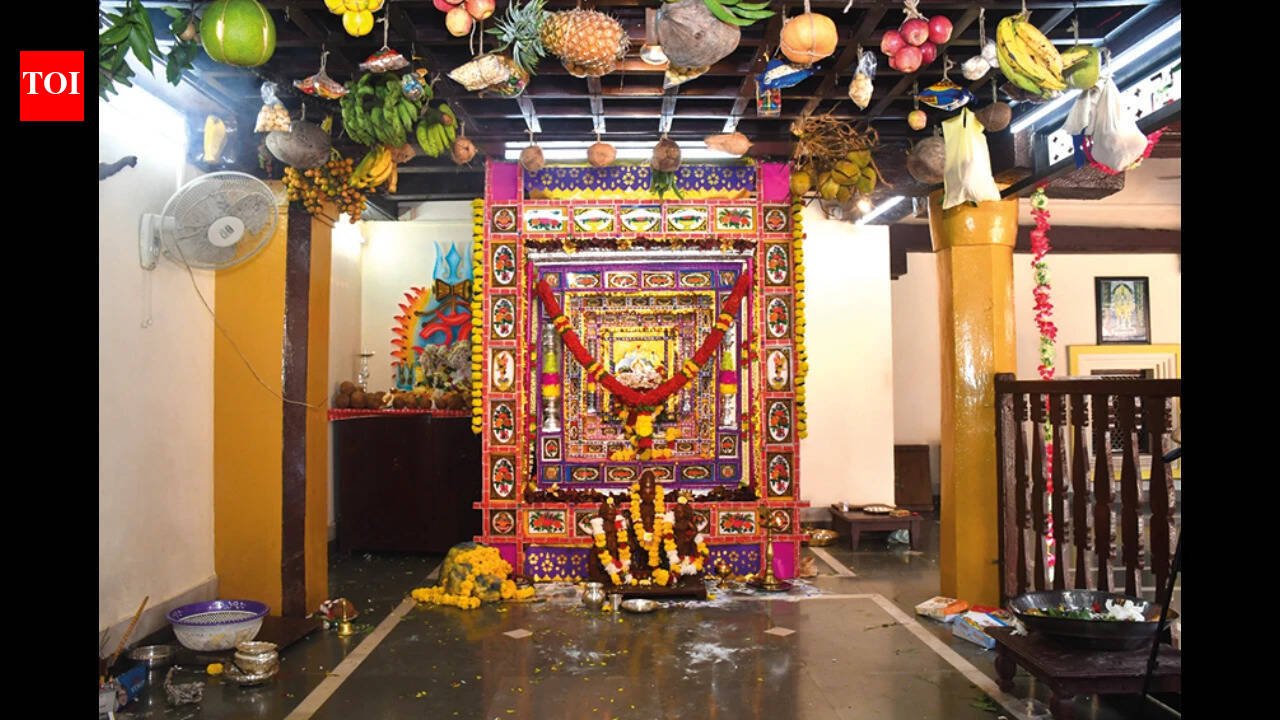
Every Ganesh Chaturthi, Goa quietly witnesses a different kind of pilgrimage. Across villages, families return not only to celebrate, but to the place where their stories began — ancestral homes that hold vows, rituals, and memories older than anyone present. In these households, Chovoth is less a date on the calendar and more a yearly gathering that keeps identity intact, generation after generation
A 500-year-old vow keeps the Raikars together
At Vaze, Shiroda, the Raikar family has observed Ganesh Chaturthi for over 500 years, spanning eight generations. The scale and structure of their celebration grew from a single promise.Once, when Ganesh Chaturthi was observed for only one-and-a-half days, a family member fell seriously ill. “The family prayed to Lord Ganesh and vowed that if the person recovered, they would worship the elephant-headed god’s idol for five days every year. The recovery came — and the practice continues,” Chandraprabha Raikar, president of the Brahma Daivadnya Vajenkar Raikar Family Trust, told TOI from Mumbai, where he has settled.Today, more than 450 members gather, and the family hires a cook to manage festival meals. Family units rotate hosting duties, supported by a common fund that covers food expenses.
One distinctive practice is their ‘kakad aarti’, held on the second day of Ganesh Chaturthi. “The aarti is specially organised for Mushik, a mouse, a constant companion and vehicle of Ganesh,” said Raikar. The celebration now extends beyond the main ancestral home, using other houses and a bhojan mandap to accommodate the crowd, he said.The Raikars also share a longstanding traditional link with Devi Kamakshi of Shiroda. Family lore says the deity stayed at their home for nine years before moving to the Kamakshi temple. During Navratri, the makhar used for Lord Ganesh is taken to the temple, and the Raikars traditionally swing it for the first four days.Sanvordekars pass responsibility from branch to branch
The Sanvordekar family’s Chovoth at Sanvordem has continued for more than 350 years through nine generations, beginning with Vithoji Sardar. About 150 to 200 members return from across the country, and the matoli is later given up in a ‘pauni’ (auction), also known as ‘gaav-pun’, with proceeds used to maintain the main ancestral house.“Our family is divided into four branches, and Chaturthi responsibility rotates from branch to branch and household to household —meaning a family’s turn comes only after several years,” said Shailesh Sinai Sanvordekar.They usually worship the idol of Lord Ganesh for one-and-a-half days, extending it to five days when a vow is taken. The family that celebrates Chaturthi also takes on responsibility for the year’s pujas until the next Chovoth.The younger generation, Sanvordekar said, keeps the festival lively with cultural programmes, and one vow-based custom remains especially personal: Couples praying for a child tie the newborn to the matoli and gently swing the baby once their wish is fulfilled.Two idols under one roof at Varkhandem
A rare tradition lives on in Ponda’s Varkhandem — the Kapdi family worships two Ganesh idols under one roof — which is believed to have continued for nearly 300 years. The family traces its roots to Loutolim before moving to Ponda, and typically observes one-and-a-half days of Chaturthi, extending it to five days when a vow is taken.Another major gathering point is Anant Chaturdashi. “For us, it is as significant as Ganesh Chaturthi. The tradition is believed to have begun when our ancestors brought home an Anant Shaligram after a pilgrimage and started observing the day on a large scale,” said Shrihari alias Ulhas Kapdi.The custom of installing two Ganesh idols began with a dispute between two ancestors who brought their respective idols home at the same time. “What could have been a one-time incident became a custom. Today, two branches of the family conduct the rituals, ensuring both lines remain connected to the same ancestral practice,” he said.
As the family expanded, property arrangements were formalised through a partition deed. In 1997, the family formed a registered trust and committee to manage tradition and organisation, he added.Kapdi said Anant Chaturdashi has become a dependable reunion point. “Even those who miss Chaturthi make it a point to return for Anant Chaturdashi. Offerings are made according to individual capacity—either monetary contributions or items for the deity,” he said.Here too, a vow for children is observed: When a couple’s wish is fulfilled, the newborn is tied to the matoli and gently swung, then placed near the feet of the Anant Shaligram during the celebration.The next day, Pournima, Kapdi said the family offers used flowers along with fresh ones to Lord Maruti at the Maruti temple in Varkhandem, where everyone gathers for prayers.A kitchen keeps tradition alive
For nearly 400 years, the Prabhudesai family’s Chaturthi at Sanguem’s Netravali has been shaped by one unwavering rule: Festival food is cooked entirely by the women of the family. Preparations begin well in advance — homemade masalas, planned ingredients, and a kitchen routine that starts early and runs late into the night.“The family keeps the Ganesh idol for five days, extending it to seven when additional seva is taken up. This year, we are observing the seven-day tradition,” said Suhas Prabhudesai.
Two daily pujas — afternoon and evening — are divided among family members. The person performing the first-day puja also takes charge of arranging materials, coordinating rituals, and staying near the idol throughout the festival. That person cannot leave the village until visarjan.The fourth day carries special weight, marked by Sahasranama — the recitation of 1,008 names of Lord Ganesha — with a durva (grass) offered for each name.At least 200 members gather over the days, and the younger generation participates in stotras, aarti, Puran readings, and cultural programmes. The family strictly follows traditional practices of cleanliness, maintaining sanctity around the space of the idol.Chimanshets turn Chaturthi into a family reunion
At Korgao, Pernem, the Chimanshet family has celebrated Chaturthi for more than 200 years over five generations. Their ancestors, Chiman Shetye and his brothers, built the original family house, with later generations adding another nearby. With relatives returning from across the world, the festival functions as a yearly reunion anchored in ritual.Ajit Nana Shetye said nearly 300 family members joined the celebration, and space became an issue. “We adopted a system: Each household prepares food at home, brings it to the main mandap as prasad, and then returns home for the meal,” said Shetye.They follow the tradition of offering ‘gharane’, a ritual prayer, to Lord Ganesha — also known as ‘Navsacho Ganapati’. “With multiple branches and 50 to 60 members in each, a family’s turn to perform puja may come only once in 15-20 years,” he said.The younger generation now leads decoration work, contributing collectively and building the festival setup together. “Each member brings matoli items as per convenience. There is no monetary contribution collected across the family during the festival; the hosting family covers expenses, while family members contribute towards the idol,” said Shetye.


