



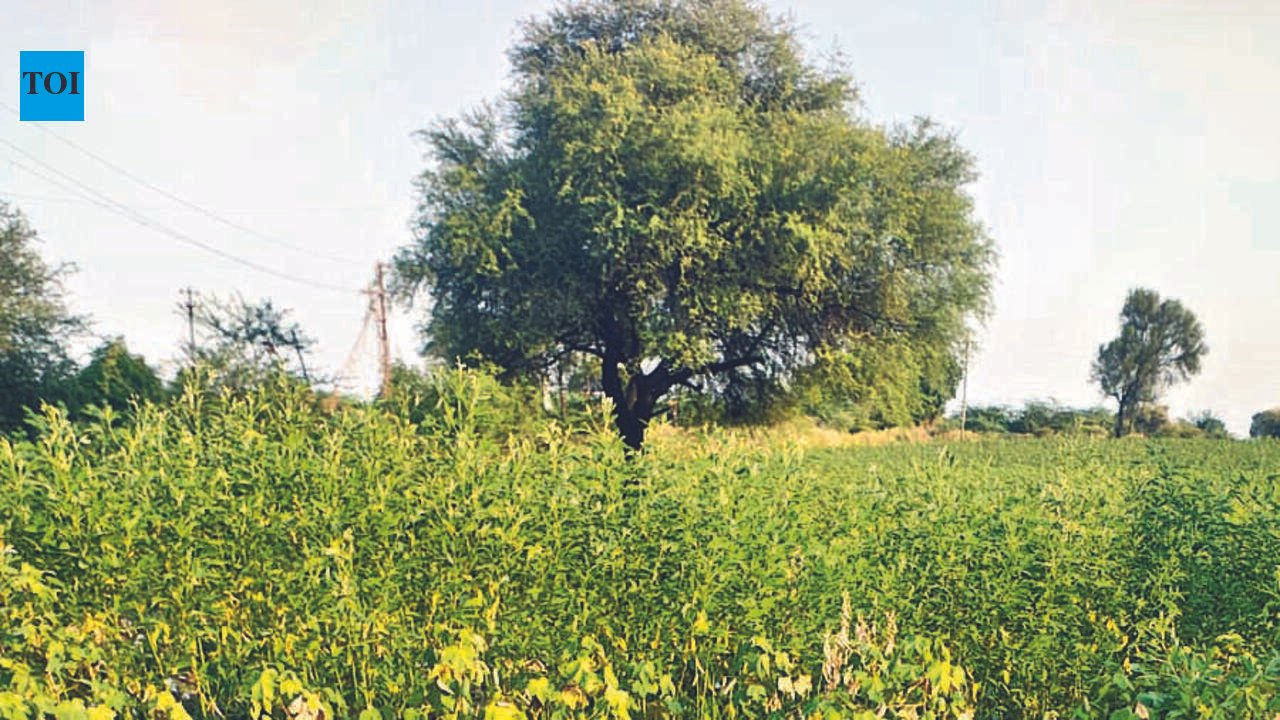
Nagpur: Cotton farmers in Akola, who fetched around Rs8,000 per quintal under the CCI rate last season and managed to get up to Rs10,000 per quintal by holding their stocks until Aug, are now staring at losses of up to 70% as a prolonged dry spell and rising temperatures have severely hit the crop.Under normal conditions, traditional cotton cultivation can yield up to 8 quintals per acre, while the high-density planting system (HDPS), or the ‘Akola model’, can produce 12 to 18 quintals per acre. Last season, higher yields and remunerative prices gave a major boost to farmers’ incomes and encouraged wider adoption of HDPS in the largely rainfed cotton-soyabean belt.This season the same fields are struggling to survive. Farmers said their cotton plants have not even reached five feet in height, while premature bursting of bolls is raising concerns over both yield and fibre quality and further reducing the value of whatever crop survives.The prolonged lack of rain has depleted soil moisture, with leaves, flowers and young bolls drying up or falling from the plants, farmers said.As per Dilip Thakre, a cotton grower from Akola and among the early adopters of HDPS, farmers may harvest only 2 to 4 quintals per acre this year. “Even the HDPS crop is not in good condition because of the prolonged dry spell. However, since the number of plants per acre is higher in the Akola model and the number of bolls is almost similar in both methods this year, HDPS is likely to give comparatively better yields,” Thakre said.Thakre claimed the situation was particularly serious in the 100% saline belt, where farmers depend heavily on cotton during the kharif season. “There has been no rain in our area for around 70 days. The crop has suffered extensive damage,” he said.Dr Purushottam Madhukar Kale of Sangvi Bazaar, Akola, cultivates cotton through the traditional method. “Due to inadequate rainfall, the crop has not developed properly. The leaves have started drying and there is very little crop material on the plants. I expect only around 2-3 quintals per acre. The condition of Akola model crop is not good either. However, it may still give comparatively better production due to more plants per acre,” Kale said.Kale said farmers had incurred expenses on harrowing, intercultivation, fertiliser application and spraying, but the dry conditions meant there was little hope of recovering the investment.The prolonged dry spell has also triggered pest attacks, forcing farmers to undertake repeated pesticide sprays and further increasing cultivation costs. “Repeated spraying has increased our cost. The biggest problem now is how to meet the family’s daily expenses,” said Dilip Patokar of Ural, Akola.Shaligram Bhagat of Andura said the crop had deteriorated rapidly as soil moisture declined and temperatures rose. “Leaves, flowers and small bolls have fallen. The money spent on the crop is also going waste,” he said.Farmers say no cultivation method can offset the impact of a prolonged rainfall deficit and severe moisture stress.
