


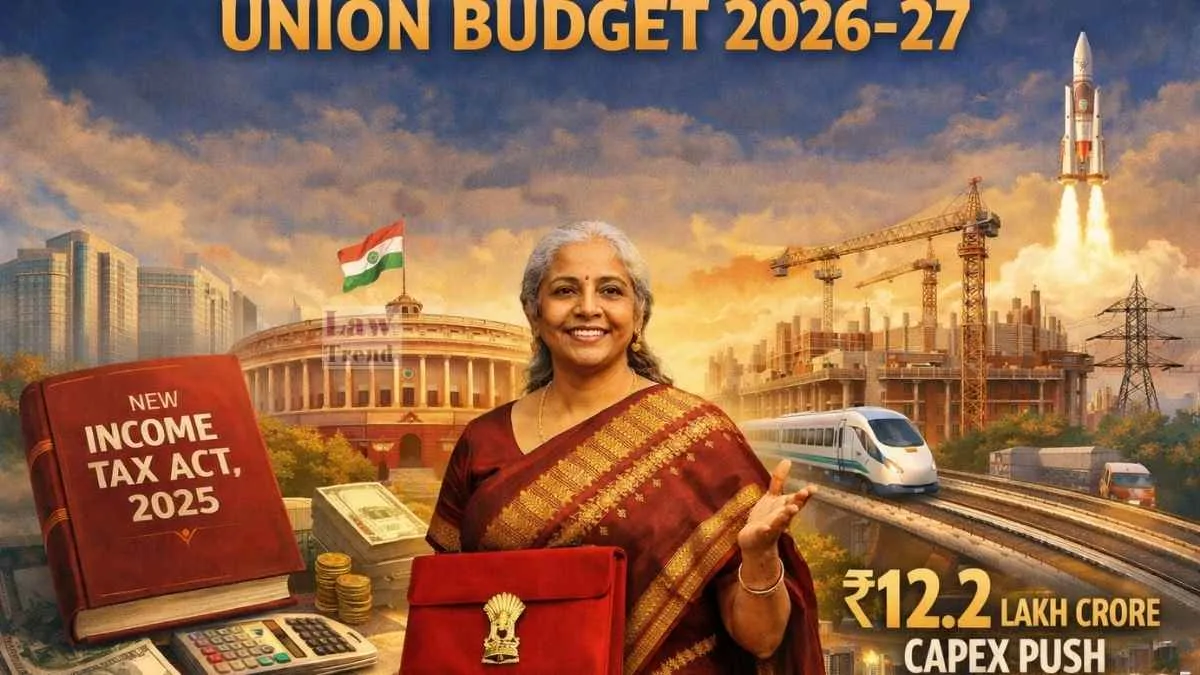
New Delhi, Feb 01: Union Finance Minister Nirmala Sitharaman today presented the Union Budget 2026–27 in Parliament, marking her ninth consecutive Budget presentation. Notably, this is the first time in history that the Budget was presented on a Sunday.
In a detailed speech reflecting India’s growth ambitions and commitment to fiscal prudence, the Finance Minister described this year’s Budget as “Yuva Shakti driven,” structured around three broad pillars, or kartavyas, with a focus on growth, capacity building, and inclusive development, aimed at steering the nation toward a Viksit Bharat. She asserted that the “reform express” of the Prime Minister Narendra Modi-led government is well on its way and will continue to maintain momentum to fulfil its duties.
The Budget, framed in the newly inaugurated Kartavya Bhawan, prioritises boosting growth and productivity, fulfilling citizens’ aspirations, and ensuring inclusive development under the ethos of Sabka Sath, Sabka Vikas. Sitharaman acknowledged global economic uncertainties and supply chain disruptions, while outlining India’s strategy to reduce dependence on imports, particularly in critical sectors, and expand domestic manufacturing.
Addressing both structural reforms and immediate developmental needs, the Budget seeks to balance long-term investment in infrastructure, manufacturing, and technology with targeted support for farmers, youth, small businesses, and service sectors. A major theme is sustained public capital expenditure to drive economic growth and job creation. Public capital expenditure (capex) is set to increase to ₹12.2 lakh crore for the upcoming financial year, up nearly 9% from last year’s allocation, signaling the government’s commitment to investment in physical and social infrastructure.
The total Budget outlay for 2026–27 stands at ₹53.5 lakh crore, with non-debt receipts estimated at ₹36.5 lakh crore and the Centre’s net tax receipts projected at ₹28.7 lakh crore. The fiscal deficit is pegged at 4.3% of GDP, a marginal improvement over the current year, while the debt-to-GDP ratio is expected to ease to 55.6%, reflecting continued fiscal consolidation. Gross market borrowings are estimated at ₹17.2 lakh crore, with net borrowings at ₹11.7 lakh crore.
Earlier, on January 29, 2026, Sitharaman tabled the Economic Survey 2025–26 in Parliament, providing a comprehensive overview of India’s macroeconomic situation and setting the stage for the Budget. The survey projected India’s economy to grow 6.8%–7.2% in FY27, highlighting resilience amid global uncertainties.
In her speech, the Finance Minister reiterated the government’s focus on bolstering India’s manufacturing base and strategic capabilities.
Under the first kartavya to accelerate and sustain economic growth, significant investments and schemes were announced across priority sectors.
A flagship initiative, Biopharma SHAKTI, with an outlay of ₹10,000 crore over five years, aims to build an ecosystem for domestic production of biologics and biosimilars, supported by upgraded research facilities and expanded clinical trial sites. Further strengthening India’s critical sectors, the government unveiled India Semiconductor Mission 2.0 to develop equipment and materials for chip production, complemented by an increased outlay of ₹40,000 crore for electronics components.
For traditional and labour‑intensive industries, large‑scale schemes were proposed, including the establishment of mega textile parks, integrated chemical parks and initiatives to modernise clusters, positioning them for global competitiveness.
Infrastructure spending remained a central pillar of this Budget. The Finance Minister announced plans for seven high‑speed rail corridors connecting major city pairs — from Mumbai–Pune to Varanasi–Siliguri — to enhance passenger mobility and economic linkages across regions.
In addition, the government proposes to operationalise 20 new National Waterways within the next five years, beginning with NW‑5 in Odisha, and establish dedicated freight corridors to support more efficient cargo movement and multimodal logistics. Urban development was also given attention with an allocation of ₹5,000 crore per City Economic Region (CER) over five years to modernise infrastructure and core services in Tier‑I and Tier‑II cities.
Under the second kartavya, which aims to fulfil aspirations and build capacity, Schemes promoting tourism, education, skills, health and sports received significant focus. The government announced the establishment of girls’ hostels in every district, a National Institute of Hospitality, and upskilling programmes for 10,000 tourist guides as part of efforts to expand job opportunities.
In a major push for the creative and digital economy, the Budget also proposes setting up AVGC (Animation, Visual Effects, Gaming, Comics) content creator labs in 15,000 schools and 500 colleges, enabling students and young professionals to develop industry-ready skills and contribute to India’s emerging digital content ecosystem.
In healthcare, upgrades to emergency and trauma care facilities were proposed, along with initiatives such as NIMHANS 2.0 in North India to strengthen mental health infrastructure. Efforts to expand agricultural productivity and rural incomes include the launch of Bharat‑VISTAAR, a multilingual AI tool aimed at integrating agricultural data services for farmers across regions and languages.
The Budget retained existing income tax slabs, with no change in rates, but announced the rollout of a New Income Tax Act, 2025, to be effective from April 1, 2026, accompanied by simplified rules and forms to ease compliance. The government cut tax collected at source (TCS) on overseas tour packages, education and medical remittances to 2%, and exempted certain interest incomes from TDS to reduce compliance burdens.
On the indirect tax front, customs duty exemptions were extended to critical sectors such as renewable energy components and nuclear power project inputs, while tariffs on personal imports were reduced from 20% to 10%. Courier exports were liberalised by removing value caps to support small businesses and e‑commerce exports.
Separately, the Union Budget maintained the states’ share in federal taxes at 41%, following recommendations of the 16th Finance Commission, a decision that drew both support and criticism from state governments.
Finance Ministry officials underscored that India’s economy remains robust, with growth projections remaining among the highest for major economies, and the Budget places a premium on strategic autonomy, infrastructure modernisation and export competitiveness against a backdrop of global uncertainty.
Delivered on a day marked by tradition and continuity, the Union Budget 2026–27 blends fiscal discipline with strong investment in infrastructure, technology and human capital. By emphasising high public investment, manufacturing and support for strategic sectors, the Budget seeks to further India’s long‑term goals of innovation, inclusion and economic resilience.
Union Budget 2026–27: At a Glance
Total Budget Outlay: ₹53.5 lakh cr
Public Capital Expenditure (Capex): ₹12.2 lakh cr (↑9% YoY)
Net Tax Receipts of Centre: ₹28.7 lakh cr
Non‑Debt Receipts: ₹36.5 lakh cr
Gross Market Borrowings: ₹17.2 lakh cr
Net Borrowings: ₹11.7 lakh cr
Fiscal Deficit: 4.3% of GDP
Debt-to-GDP Ratio: 55.6%
Key Highlights
First Kartavya – Growth & Productivity
Biopharma SHAKTI: ₹10,000 cr to make India a global biopharma hub.
India Semiconductor Mission 2.0 and ₹40,000 cr for electronics components.
Rare Earth Corridors in Odisha, Kerala, Andhra Pradesh & Tamil Nadu.
200 legacy industrial clusters to be modernised.
₹10,000 cr SME Growth Fund; ₹2,000 cr for micro-enterprises.
Public capex increased to ₹12.2 lakh cr; new freight corridors & 20 waterways.
Seven high-speed rail corridors to boost connectivity.
₹20,000 cr for carbon capture & energy security.
Second Kartavya : Aspirations & Human Capacity
AVGC labs in 15,000 schools, 500 colleges to boost creative tech skills.
Girls’ hostels in every district; 5 Regional Medical Hubs; 3 new Ayurveda institutes.
1 lakh Allied Health Professionals to be trained.
National Institute of Hospitality; upskilling for 10,000 tourist guides.
15 heritage sites and decade-long Khelo India sports mission.
Third Kartavya : Sabka Saath, Sabka Vikas
500 reservoirs & Amrit Sarovars; high-value crop promotion; Bharat-VISTAAR AI for farmers.
Divyangjan Kaushal Yojana for IT, AVGC, hospitality & F&B sectors.
NIMHANS-2 in North India; upgrades in Ranchi & Tezpur.
East Coast Industrial Corridor; 5 new Purvodaya tourism destinations; 4,000 e-buses; Buddhist Circuits in NE states.
Tax & Regulatory Measures:
Existing income tax slabs retained; simplified New Income Tax Act from April 2026
TCS on overseas remittances cut to 2%
Customs duty exemptions for renewable energy and nuclear power components
Tariffs on select personal imports reduced from 20% → 10%
States’ Share in Federal Taxes: 41%
YOU PAY LESS:
Everyday & Personal Use
Imported goods for personal use
(Customs duty cut from 20% to 10%)
Medicines and drugs
(17 medicines exempted; more rare-disease drugs duty-free)
Travel, Health & Education Payments
Overseas tour packages
(TCS reduced to 2%)
Foreign remittances for education and medical treatment
(TCS reduced to 2%)
Housing & Legal Compensation
Motor accident compensation interest
(Fully exempt from income tax; no TDS)
Electronics & Manufacturing
Microwave ovens
(Lower customs duty on components)
Aircraft parts (civil & defence)
(Customs duty exemption)
Clean Energy & Infrastructure
Lithium-ion battery equipment
Solar glass manufacturing inputs
Nuclear power project imports
(All receive customs duty exemptions)
Exports & Small Businesses
Courier exports (₹10 lakh cap removed)
Seafood, leather and footwear exporters
(Lower input costs)
YOU PAY MORE:
Stock Market Investors
Futures trading
(STT rlaised from 0.02% to 0.05%)
Options trading
(Higher STT on premium and exercise)
Corporate Promoters
Share buybacks
(Additional tax; higher effective rate for promoters)
Direct Tax Proposals
- New Income Tax Framework
New Income Tax Act, 2025 to come into effect from April 2026.
Simplified income tax rules and redesigned return forms for easier compliance.
- Ease of Living for Taxpayers
Interest from Motor Accident Claims Tribunals fully exempt; TDS removed.
Single-window filing of Form 15G/15H for dividends and interest.
Time limit for revising returns extended to 31 March (from 31 December) with nominal fee.
Staggered timelines introduced for filing income tax returns.
PAN-based challan replaces TAN for NRI property purchases.
One-time six-month foreign asset disclosure scheme for small taxpayers.
- TDS & TCS Rationalisation
TCS on overseas tour packages reduced to 2%.
TCS on LRS remittances for education and medical purposes reduced to 2%.
Simplified TDS for manpower supply to benefit labour-intensive sectors.
Automated system for obtaining lower or nil TDS certificates for small taxpayers.
- Penalty & Prosecution Reforms
Integrated assessment and penalty orders to reduce litigation.
Taxpayers can update returns post-reassessment by paying additional 10% tax.
Immunity from penalty for misreporting income after additional tax payment.
Decriminalisation of non-production of books and minor TDS defaults.
Retrospective immunity for non-disclosure of non-immovable foreign assets below ₹20 lakh.
- Cooperatives
Tax deduction for cooperatives supplying cattle feed and cotton seed.
Deduction for inter-cooperative dividends distributed to members.
Three-year dividend tax exemption for national cooperative federations on notified investments.
- Boost to IT & Digital Services
IT, ITES, KPO, and software-related R&D merged into single category: Information Technology Services.
Uniform safe harbour margin of 15.5%; threshold raised from ₹300 crore to ₹2,000 crore.
Fast-tracked APA process with target of two years.
- Attracting Global Investment
Tax holiday until 2047 for foreign companies providing cloud services using Indian data centres.
15% cost-based safe harbour for related-party data centre services.
Five-year income tax exemption for non-resident experts under notified schemes.
Exemption from MAT for non-residents paying tax on presumptive basis.
- Other Key Measures
Buybacks taxed as capital gains for all shareholders; higher effective tax on promoters.
TCS on alcoholic liquor, scrap, minerals rationalised to 2%; tendu leaves TCS reduced to 2%.
STT increased on futures and options.
MAT reduced to 14% from April 2026; becomes final tax with limited set-off of existing MAT credit.
Indirect Tax Proposals
- Customs Duty & Tariff Simplification
Duty-free import limit for seafood processing inputs raised to 3% of FOB value.
Duty-free imports extended for leather and synthetic footwear exports.
- Energy Transition & Strategic Sectors
Customs duty exemption for capital goods in lithium-ion battery manufacturing.
Exemption for sodium antimonate used in solar glass production.
Duty exemption extended for nuclear power project imports till 2035.
Duty exemption on capital goods for critical mineral processing.
- Civil, Defence & Electronics Manufacturing
Duty exemption on components/parts for civilian and defence aircraft manufacturing & MRO.
Exemption on specified parts for microwave oven production.
- Special Economic Zones (SEZs)
One-time concessional duty window for eligible SEZ manufacturing units selling into Domestic Tariff Area (DTA), subject to limits.
- Ease of Living for Citizens & MSMEs
Customs duty on personal imports reduced from 20% to 10%.
Customs duty exemption on 17 medicines.
Duty-free import of drugs/food for seven additional rare diseases.
- Customs Process Reforms
Shift to minimal-intervention, trust-based customs clearance.
Single digital clearance window for all regulatory agencies by FY 2026.
Expansion of non-intrusive scanning using AI-based risk assessment.
Customs Integrated System (CIS) to be rolled out as unified platform.
- Trusted Trade Facilitation
Duty deferral period for Tier-2 & Tier-3 AEOs extended to 30 days.
Advance rulings validity extended from 3 to 5 years.
Warehouse operator-centric customs framework with self-declaration & risk-based audits.


