



There is a moment near the end of Baz Luhrmann’s EPiC: Elvis Presley in Concert, released in February, in which Bono’s voice arrives over the closing credits like a man leaning in to settle something.
He isn’t singing. He is doing what he does at his best and his worst: declaiming.
The poem is American David, written by Bono, a lifelong fan, in 1995. In its EPiC incarnation, it runs to less than a minute. “Elvis / white trash,” it begins. “Elvis / the Memphis flash.” What follows is a catalogue of contradictions: a man shooting televisions and reading Corinthians, a man who was godlike and broken, electric and earthbound.
The original poem had problems (including a racial slur and offensive slang) that the film wisely edits around. What remains is something unexpectedly affecting: a rockstar’s tribute to the great original, delivered not through melody but through the speaking voice.
This, in retrospect, is a very old tradition.
Talk-singing — that slippery mode in which the voice refuses to fully commit to melody, preferring instead the rhythms and inflections of speech — is one of the most distinctive and enduring strands in popular music, and is currently in rude health.
Baxter Dury’s ninth album, Allbarone, released last year, pushed the mode into sleeker, more orchestrated territory without sacrificing its essential seediness. Manchester’s Antony Szmierek, an English teacher-turned-poet-provocateur, has been on a UK headline tour, releasing new material that confirms him as the style’s most emotionally direct contemporary proponent. (“You’ve been lost deep in Orion’s Belt loop again, haven’t you? / Tangled up, procrastinating with eons left to travel / In a bedroom full of shrapnel,” goes Rock and a Calm Place; 2023)
The lineage of spoken-word song is long and gloriously disreputable. One could start with Baxter Dury’s father, Ian Dury, the great democratiser of talk-singing in British rock. Reasons to Be Cheerful (1979) and Hit Me with Your Rhythm Stick (1978) were not songs one sang so much as dispatches one received, bulletins from a parallel England of jellied eels and council flats and big, defiant vitality. Baxter absorbed this inheritance and relocated it: in the same city, but with a different postcode (and possibly more expensive wine).
There is a moment in his Slumlord (2020) where he uses a kind of polished drawl, embellished with cigarette smoke and sneering tenderness, to narrate a world of grotesque London privilege with the detachment of a man who has seen everything and is mildly disgusted by much of it.
EASIER SAID THAN SUNG
The current template was likely originally French.
Serge Gainsbourg made an entire career out of the understanding that the speaking voice, correctly used, is more intimate than any tenor. His later work, the reggae provocations and the whispered duets with Jane Birkin, operated entirely on proximity and implication. One wasn’t being serenaded; on was being confided in, and the confidences were often unsolicited and faintly alarming.
Jacques Brel added the theatrical dimension: the talk-sing monologue, voice breaking from speech into near-aria and back again within a single verse (listen to Ne Me Quitte Pas, or Don’t Leave Me).
Brel was a major influence on Leonard Cohen and Lou Reed. Reed stripped all that Continental glamour away and replaced it with the grit of mid-’60s and ’70s New York. The Velvet Underground’s great achievement was to demonstrate that a vocal could be inexpressive and devastating at the same time.
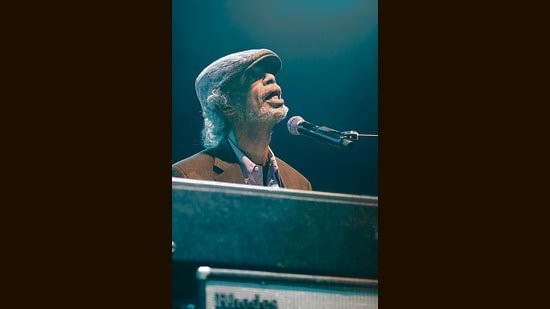
Gil Scott-Heron, who is too often omitted from this lineage, belongs near the top of it. His spoken-word records of the early 1970s — the withering political diagnostics, against the jazz-funk backdrop — established the form’s possibilities as social witness.
Where Scott-Heron was propulsive and accusatory (“You will not be able to stay home, brother / You will not be able to plug in, turn on and cop out”; from The Revolution Will Not Be Televised, 1971), Cohen was deliberate and funereal. Here was a voice that had given up on pitch entirely and found, in giving it up, a gravity that few conventional singers could touch.
Britain had its parallel traditions in the mid-’70s. Pulp’s Jarvis Cocker remains the supreme British practitioner of the conversational vocal: theatrical where Dury was deadpan, angular where Reed was flat, but sharing that essential quality of a voice that seems to be telling you something it isn’t telling anyone else.
Nick Cave, particularly in his late mode — the Murder Ballads drawl, the quiet devastation of Skeleton Tree — has turned talk-singing into something approaching prayer.
The current British cohort, in fact, is considerable. Yard Act have built a career on James Smith’s verbose, satirical spoken delivery — part Cocker, part parody, part true rage. (“I’m shaking up my eight ball ‘cause I’m trying to see / What tomorrow’s world has got in store for me,” goes The Overload; 2022.)
Sleaford Mods take the form to its abrasive extreme: Jason Williamson’s vocals are so stripped of conventional musicality that they constitute a kind of anti-singing, all the more powerful for the melody they refuse to give you.
Dry Cleaning’s Florence Shaw introduced a new register: female, deadpan to the point of surrealism, delivering absurdist non-sequiturs over post-punk guitars with the affectation of a cross between a bank teller and an anti-art Dadaist.
What unites all of these artists, across decades and subgenres, is a shared conviction that language matters more than note-holding. Talk-singing is, at its core, an act of literary ambition sporting a musical disguise.
Ian Dury smuggled Cockney wit onto the charts. Gainsbourg snuck eroticism and philosophical provocation onto French radio. Baxter Dury channels the grotesque and tender in equal, inextricable measure. Szmierek melds his work with sincerity, which can be the most subversive cargo of all.
And then there is Bono, closing out a film about the greatest rock-and-roll voice of the 20th century, and choosing not to sing. There may be no higher tribute to the form.
(To reach out, email sanjoy.narayan@ gmail.com. The views expressed are personal)


