Thirty-six years after the forced displacement of Kashmir’s minorities—predominantly Kashmiri Pandits—in 1989–90, a troubling question endures: how did a temporary humanitarian response turn into a near-permanent settlement for thousands of citizens of a democratic republic?
Nearly three lakh people were uprooted during the insurgency that engulfed the Kashmir Valley with the rise of multiple terrorist armed groups. While many families rebuilt their lives elsewhere, a significant number—particularly the economically vulnerable—continue to live in clusters of government-built tenements around Jammu. The most visible symbol of this prolonged displacement is Jagti Township, where thousands still reside in structures originally intended as temporary relief shelters.
Today Jagti is more than a residential colony; it is a reminder of an unfinished national responsibility. Conceived as a relief measure, the township has gradually come to reflect the inertia of governance.
Governments have changed, committees have deliberated and political assurances have surfaced periodically, yet the essential condition of the displaced has altered little. What was expected to be a short transitional phase before dignified rehabilitation has stretched across nearly four decades, turning displacement into an inherited reality for a generation that has grown up knowing exile as routine life.
From Homes to Holding Areas
Before 1990, most of these families lived in homes they owned—some modest, others substantial—rooted in inheritance and memory. Displacement stripped them not only of geography but also of their economic foundations.
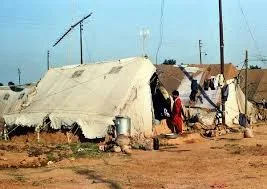
In Jammu, the earliest years of exile were spent in tents and cramped shelters with tin roofs, structures meant for emergency relief rather than dignified living. Harsh weather and inhospitable surroundings took a heavy toll; many lives were lost to extreme heat, disease and even reptile bites in areas where camps had disturbed natural habitats.
The construction of 4,224 one-room tenements in Jagti during the years of the UPA government marked a measurable improvement. Nearly twenty thousand people moved into concrete housing, signalling a shift from improvised camps to an organised township.
Yet housing alone does not make a community viable. A township requires an ecosystem—quality schools, reliable healthcare, employment opportunities, access to credit, markets and skill-development centres. Many such facilities exist in and around Jagti, but their functioning has been uneven and poorly managed. Infrastructure has therefore struggled to translate into a supportive economic and social ecosystem.
Over time, the physical structures themselves have begun to show strain. Cracked walls, damp ceilings, peeling plaster, leaking roofs, erratic electricity supply, contaminated water lines and open drains have become part of daily life. Maintenance remains sporadic and reactive. Essential services often receive attention only when residents protest, sometimes blocking the national highway in the sweltering heat of Jammu. What began as a hopeful relief initiative increasingly risks becoming a quiet monument to bureaucratic fatigue.
The Social Fracture Within
External persecution triggered the displacement, but internal responses also shaped its trajectory. One uncomfortable reality often overlooked is the uneven solidarity within the community itself. In moments of upheaval, societies are tested—some protect the vulnerable, while others reposition themselves.
During the early years of exile, there were widespread distress sales of property. Families desperate for liquidity sold ancestral assets at throwaway prices. Legal expertise within the community could have helped safeguard titles and challenge dubious transfers. Instead, middlemen—often lawyers or their agents—frequently facilitated such transactions for commissions, turning law from a shield into a conduit.
The Relief and Rehabilitation Organisation for migrants also became tainted. Some migrant employees posted there exploited both the institution and the displaced, reducing a humanitarian mechanism into a pocket of organised corruption.
Access to bureaucracy created further divides. Those with networks navigated compensation claims and employment schemes more easily; others waited in prolonged uncertainty. Professionals in medicine and education, who might have organised structured support networks within camps, did so only sporadically.
The point is not a blanket indictment but a structural observation: displacement amplifies inequalities already present in society. Some officers now cite procedural constraints to justify earlier inaction, forgetting that extraordinary circumstances demand extraordinary initiatives. When solidarity was most needed, it proved uneven.
Unequal Rehabilitation, Unequal Futures
Over time, disparities widened. Families with transferable government jobs or portable professional skills stabilised relatively quickly. Others—small traders and agriculturists—struggled to rebuild livelihoods. Informal social networks that once provided resilience in the Valley were disrupted.
Successive rehabilitation packages attempted relief through cash assistance, employment quotas and educational concessions, but these measures often lacked integration. Employment schemes leaned heavily on government absorption, with limited linkage to the private sector.
Entrepreneurship support remained modest, collateral-free credit mechanisms were weak and skill-development initiatives were insufficiently aligned with market demand. The result is the risk of intergenerational displacement.
Children born in camps grow up treating exile as normal life. Aspirations narrow when surroundings remain static, and prolonged dependency erodes initiative—particularly among youth facing limited employment opportunities.
Even relief measures sometimes carried unintended costs. Relocation to Jagti and other camps improved shelter but disrupted small businesses that migrants had developed elsewhere. The government took more than fourteen years to allot shops in the township, and even that process remains incomplete. The delay illustrates how administrative inertia can quietly undermine economic recovery.
Politics and the Perpetual Promise
Across decades, political parties have promised dignified return and comprehensive rehabilitation—assurances that frequently feature in speeches and campaign platforms, including those of the present dispensation. Rehabilitation requires long-term planning insulated from electoral cycles. Instead, attention often peaks around anniversaries or political events and fades thereafter.
Compounding this is the tendency of some within the community, seeking political visibility, to use Jagti as a stage for self-projection. Grand events are organised in the township more for personal prominence than for advancing the residents’ real concerns. Jagti thus embodies a paradox: central to rhetoric, yet peripheral in sustained administrative and societal priority.
Faith, Spectacle and Material Reality
Faith has undoubtedly sustained the displaced community. In adversity, spiritual frameworks offer meaning and cohesion. Yet Jagti’s most pressing needs remain infrastructural and economic.
Grand religious events, often supported by donations or corporate social responsibility funds, may uplift morale but cannot substitute for functioning drainage systems, reliable utilities or sustainable employment. The issue is not faith versus development. It is one of balance and sequencing. Spiritual strength can reinforce social responsibility; it cannot replace it.
Why Jagti Matters
Jagti is the largest concentrated settlement of displaced Kashmiri Pandits within a single geographic expanse. Concentration confers visibility. It becomes an accessible site for mobilisation, outreach and policy engagement. But its deeper significance lies in what it represents.
Jagti is a living archive of policy half-completion. It demonstrates how emergency relief can gradually harden into semi-permanent arrangements when review mechanisms weaken. It shows how displacement, if not accompanied by economic regeneration, risks becoming a demographic trap.
The Imperative of Responsibility
When governments falter, civil society often claims the space of intervention. Numerous organisations profess to represent the displaced community. Their engagement, however, must extend beyond symbolic assertion.
Sustainable intervention requires data-driven needs assessments, transparent fund utilisation, infrastructure audits, legal aid clinics, career counselling platforms and health services linked to referral hospitals. Equally important is the evolution of participatory leadership within Jagti itself. Accountability strengthens when residents become stakeholders rather than passive recipients.
Jagti does not seek perpetual charity. It seeks structural normalisation—utilities that function without protest, institutions that deliver services without agitation and opportunities that allow residents to rebuild dignity through work.
A Settlement That Asks Questions
Within the ageing tenements of Jagti, questions extend beyond one community. How do political assurances translate into measurable outcomes? What mechanisms ensure that displacement does not fossilise into dependency?
It is easy to commemorate loss; it is harder to engineer restoration. Jagti has waited thirty-six years—through administrations of different political hues and through repeated cycles of promise. Jagti stands as both a reminder and indictment—not of any single regime, but of a collective hesitation to complete what was begun.
Faith has endured. Memory has endured. The unanswered question is whether responsibility will endure with equal persistence. Above all, political and bureaucratic heads must listen more than they pontificate.Bottom of Form
(The author is a strategic commentator and the author of two books on Kashmir)