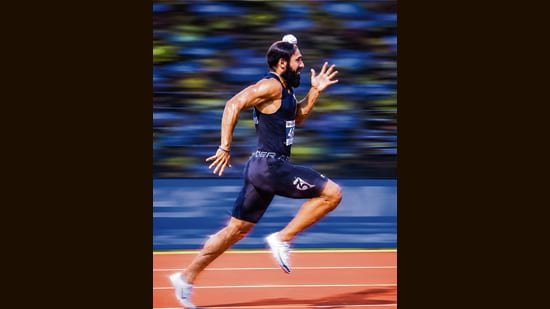
He’s the fastest man in India. There was a time, just a few years ago, when that statement wouldn’t have meant much; in fact, national records only served to highlight how far behind we were in track and field.
Gurindervir Singh is the man hopes will be riding on, in the coming years. He’s 25 and just blazed to a 10.09 finish in the 100m. (Photo: Reliance Foundation Youth Sports)
That changed somewhat, on a remarkable day for Indian athletics, when Neeraj Chopra unleashed his javelin inside an empty stadium at the Tokyo Olympics in 2021, winning India’s first-ever gold in track and field (and only second-ever individual gold at the Games; the other being shooter Abhinav Bindra’s).
Well, it looks like we’re finally moving.
Days ago, on May 23, in Ranchi, three records once thought to be out of reach for Indians were broken in the space of an hour.
Tejaswin Shankar, 27, became India’s first decathlete to cross 8000 points. Half an hour earlier, Vishal TK, 22, became the first Indian to break the 45-second barrier in the 400m. Half an hour before that, Gurindervir Singh, 25 years old and the fastest man in India, blazed to a 10.09 finish in the 100m.
Each of these performances lifts Indian track and field to a global standard, which is remarkable in a nation mired in poor infrastructure, uninformed coaching and corrupt and apathetic sporting federations.
Why is 10.09 a big deal, given that the fastest in the world have been recording sub-10-second timings for decades in the men’s 100m? Well, because it is finally a start. Because every 0.1 second improvement in the 100m can take a country 10 years or more, anywhere in the world.
And because every millisecond in a sprint marks a leap. That’s what makes Usain Bolt’s world record of 9.58 second so mindboggling.
That record was set in 2009. Despite all the improvements in shoe tech, track tech, sports science, nutrition science and recovery protocols, only two sprinters have recorded timings under 9.70 seconds since (Tyson Gay and Yohan Blake, both at 9.69).
All the top sprinters in the world, whether Olympic or world champions, hover between 9.70 and 9.80. So, 10.09 would have taken Singh through the qualifying heats at the 2024 Paris Olympics and into the semi-final (but not the final). No Indian man has ever met the qualifying standards at the Olympics, let alone been fast enough to theoretically qualify for the semis.
India has been working up to this for over 20 years. In 2005, Anil Kumar Prakash held the record with 10.30. It would be more than a decade before Amiya Kumar Mallick brought it below 10.30, with a 10.26 record set in 2016. Ten years passed before that number was brought below 10.20, when Singh reset the national record for the first time, on May 22, with 10.17. What followed was 24 hours of mayhem. Singh’s closest competitor, Animesh Kujur, lowered the record by 0.02 seconds on the same day, before Singh reset it again, to become the first Indian to go below 10.10.
Singh and Kujur are still at the beginning of their careers. Both have a decade in which to peak, push each other, and push past a barrier that would put Indian athletics firmly in the sphere of the global elite. Only 11 sprinters from Asia have breached the sub-10-second mark in the 100m. Thanks to Singh and Kujur, we are inching closer, to sub-10 and to the Olympics. Perhaps more importantly, Indian sprinters now have permission to set their sights higher, and dream a different dream.
(Email Rudraneil Sengupta on rudraneil@ gmail.com. The views expressed are personal)