


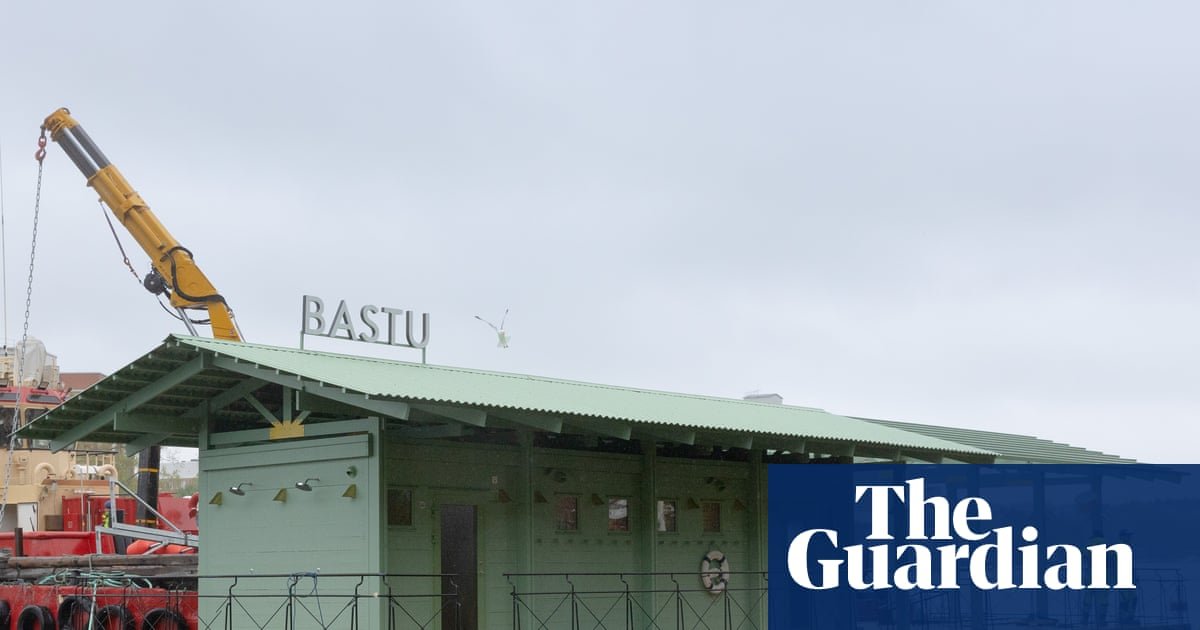
There is little doubt that Stockholm is a city of sauna-goers. All year round, from early morning to late into the night, the city’s residents can be seen emerging from wooden huts, a trail of woodsmoke coming from the chimney, and lowering themselves into the deep brackish waters of the Swedish capital’s shoreline.
But, for locals and visitors alike, getting access to one of these saunas can be a bit like getting into the world’s most exclusive private members’ clubs: the most popular waterside venues have years-long waiting lists of thousands and when new places open up they disappear in minutes. While a proportion of spots are sometimes bookable to non-members, they are difficult to come by.
In an attempt to change this, the city of Stockholm will in June open its first publicly run sauna with the mission of bringing “sauna for all”. The new facility, in Hornstull, a water-facing neighbourhood in the largely residential island of Södermalm, is a pilot project which authorities hope will be the first of many city-run, membership-free saunas.
Pia Karlsson, project manager from the City of Stockholm’s transport office, said the 5.5m Swedish kronor (£436,573) project had been born of a desire to move away from the prevailing model of “sauna for the few”. The municipality had wanted a sauna that was “100% accessible, so no membership. Accessible to the city’s residents and our guests”.
The Swedish capital has relatively clean water, the ideal geographical setup, stretched over several islands, and plenty of willing customers for bada bastu – the Swedish term for bathing and having a sauna – made internationally famous by Finland’s Eurovision entry last year, Bara Bada Bastu (Just Take a Sauna).
Despite all this, the city has been slow to capitalise on demand for accessible quayside saunas. Many are behind lock and key, privately owned by either member associations or individuals.
The scarcity is thrown into particularly sharp relief by the sauna scene in its Nordic neighbours. In the Norwegian capital, Oslo, despite a huge rise in popularity over the last decade, it is relatively easy to get a same-day sauna spot at one of the seven Oslo Sauna Association floating saunas. In Helsinki, Finland, where the ability to sauna is considered an essential part of daily life, there is an abundance of public saunas and even a waterside community-run sauna.
Stockholm’s new sauna arrived by tug boat on Tuesday. The site, which is overhung by weeping willows and where users will be able to swim, used to be home to Liljeholmsbadet, a 1930s floating public bathhouse that was removed last year after falling into disrepair. The city is also building a sauna jetty that will also be open to non-sauna-goers.
The new building, green in colour, which takes inspiration from the city’s historic painted wooden water pavilions, was designed by architect Dinell Johansson and built by Marinbastun, which also built the Oslo Sauna Association saunas.
Karlsson said: “A thought that we had with us from the political mission was sauna for all and a place for everybody. We are a public pontoon and a public space on public land. We wanted that to permeate the site.”
While they have been inspired by other countries, going on research trips to Finland and Denmark, the vision for Stockholm is part of a much broader vision, she said: “We know that we are not the first … but then we thought we could be best.”
Stockholm’s authorities say the sauna is part of a wider quay-side strategy aimed at opening up the city’s waterfronts, including new areas for swimming, walkways and seating areas.
It is also planning new guidelines requiring all sauna slots in the city centre to be fully publicly available to book.
The new booking rules have been criticised by some sauna associations, which say it could make it difficult to maintain the old membership model, which they say makes it cheaper for regular sauna users.
Karlsson believes the city and privately-run models “complement one another” and that the city’s pricing means they will not be undercutting other saunas.
But, at 150 kronor (£12) for 90 minutes, which is more expensive than guest sessions at many privately run saunas, the cost could be prohibitively expensive for some. Initially everybody will pay the same rate, but Karlsson said they would look at different pricing structures for students and pensioners once they have a sense of demand.
Mathias Leveborn, from Sthlm Sauna, which has a waiting list of 20,000 for membership across its saunas and 13,000 for one site, in nearby Vinterviken, alone, said demand for more sauna spaces was huge.
They had to wait for more than a year to get the go-ahead for a new project in Södermalm, due to open in September, he said. “It is great that Stockholm is finally starting to catch up with other Nordic countries. Basically, diversity is good,” he said.
Svante Spolander, operations manager at the Swedish Sauna Academy, said: “Interest in sauna has increased markedly in Sweden in recent years and people have to wait a long time for access to a sauna bathhouse. So it is very positive that more places are being built so that more people can benefit.”
