



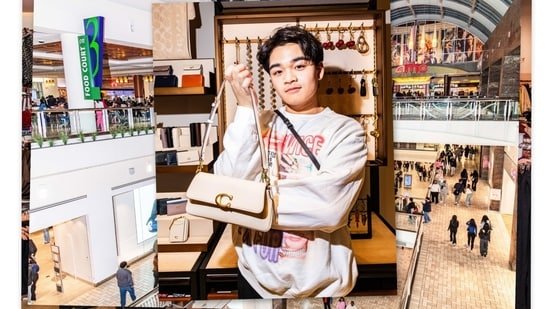
TYSONS, Va.—Savera Ghorzang scrolls through her phone all the time. But when she needed an outfit for her Valentine’s Day date, the 24-year-old went to the mall.
“I don’t really like online shopping,” she said. “I’m an instant-gratification girl. I need it now.” Ghorzang held her phone in one hand and a $29 black lace top in the other as she documented her shopping trip on Instagram.
The first digitally native generation is resurrecting an old-fashioned American pastime: Shopping at the mall.
Gen Z’s retail-spending growth is outpacing all other generations, according to data firm NielsenIQ, with the generation’s global annual retail spending expected to exceed $12 trillion by 2030. The cohort also spends a greater proportion of their discretionary dollars in physical stores than older generations, according to data firm Circana.
Younger shoppers’ mall enthusiasm is a bright spot for a business that has struggled with property closures and declining foot traffic in recent years, in part because the millennial generation never warmed to hanging out at the mall in the same way Gen X had. Gen Z has helped boost a recent recovery, with demand for mall space rising again.
Shoppers between the ages of 18 and 24 bought 62% of their total general merchandise purchases in stores last year. Shoppers ages 25 and older, by contrast, made 52% of their purchases in person, according to Circana.
For Gen Z, whose members grew up in the smartphone era and spent formative years under pandemic lockdown, buying clothes and bubble tea in person feels novel and exciting. Meeting up with friends, rubbing fabric between their fingers and the overall vibe of wandering through a bustling shopping center are experiences they can’t get online.
“Even if I don’t buy anything, just going out is really fun,” said Pranvi Yarvaneni, 14, who was shopping at Tysons Corner Center in the Washington, D.C., suburbs on a recent Saturday.
An afternoon at the mall looks far different for Gen Z, whose members span ages 14 to 29, than it did for their parents’ or even grandparents’ generations.
TikTok influencers inspire Gen Z’s in-store purchases. Young shoppers snap selfies in fitting-room mirrors. Malls are retrofitting to create social media-friendly spaces and welcoming influencers. Online retailers are opening traditional stores inside malls.
Noura Abdel-Megeed, 16, said that she prefers shopping in person so she can try clothing on, but her mall trips often start with posts she sees on Pinterest or from social-media influencers.
“I get outfit inspo from online and then I come into the stores to buy,” she said.
Mall owner Macerich, which owns more than three-dozen malls across the country including Tysons Corner Center, is courting online retailers popular with Gen Z. The company is also redesigning some of its malls’ common areas with social media in mind, painting staircases and the nooks under escalators in bright, eye-catching designs to encourage impromptu photoshoots.
“Are our malls photogenic?” Macerich Chief Executive Jack Hsieh said. “I do think that’s an opportunity for us as we think about the future of the mall.”
Edikted, a purveyor of stylish sweatpants and trendy “going out tops,” started online in 2021. It opened its first physical store two years later. The company now has 11 locations and plans to open 14 more this year.
Online buzz powers Edikted’s bricks-and-mortar success. On Valentine’s Day, promises of freebies advertised on its social-media feed drew dozens of teenagers and young women to its Tysons Corner Center store.
Edikted staff handed out roses and pink tote bags. Shoppers stopped to pose in front of an artfully arranged cart of roses parked at the store’s entrance. Inside, the music blared as customers snapped selfies with free cups of matcha and propped their phones up against stacks of clothing to film short videos.
“We’re trying to create, through social media, an exceptional experience,” said Mina Fam, Edikted’s head of retail.
Anna Littleton and Nina Cotroneo, both 20, arrived wearing outfits Edikted had sent them for free. The James Madison University roommates were recruited to be brand ambassadors last year, at a pop-up shop the company opened on campus. They receive $150 worth of clothing for each event they attend at the Tysons Corner Center store. In exchange, they post photos or videos from the events on Instagram and TikTok.
“This is such a girlhood experience,” said Littleton, who plans to enlist in the U.S. Army after graduation. “We got here a little bit early, we did our makeup in the car, we’re getting ready together, just talking about life.”
Renée Killian, 16, who said she goes to the mall every weekend, spends between $300 and $500 per shopping trip.
“I need to feel the texture before I buy it. I need to see how it looks in person,” she said. Plus, she doesn’t like paying for shipping.
Her mother, Erika Killian, is a Gen Xer who grew up when mall culture was at its apex. She spent countless hours as a teenager in the 1990s working at her family’s Chinese-food restaurant at the mall near their home and hanging out with friends. Hollywood celebrated mall culture with movies like “Mallrats” and the 1982 classic “Fast Times at Ridgemont High.”
Smartphones aside, many aspects of her daughter’s mall trips feel familiar, including the fashion trends, Erika said. “From the styles to them hanging out at the mall, it reminds me of when I was a teen,” she said.
Even though she “grew up at the mall,” Erika said these days she mostly shops online. “I don’t have to deal with the crowds and I know they’ll have my size,” she said.
Gen Z’s enthusiasm for in-person shopping is lifting some retailers’ sales and store counts. Tapestry, owner of Coach and Kate Spade, posted double-digit sales growth in stores during the quarter ended Dec. 27 due largely to enthusiasm from Gen Z shoppers, Chief Growth Officer Sandeep Seth said.
To connect with Gen Z, some salespeople have social-media feeds saved on their tablets to show shoppers how influencers are styling the brands’ luxury handbags.
“This generation isn’t averse to talking to people, but how you do it is very different,” Seth said. “They want to get information not from a salesperson, they want to talk to an influencer or a friend.”
After years of shrinking its footprint, Pacsun, a longtime mall staple that caters to younger shoppers, grew its store count last year for the first time in 18 years. The company plans to open up to 35 new stores by 2029.
“It’s because Gen Z is showing up for the mall,” said CEO Brie Olson.
Write to Kate King at kate.king@wsj.com


