






One of the world’s oldest schools has just opened its India chapter.
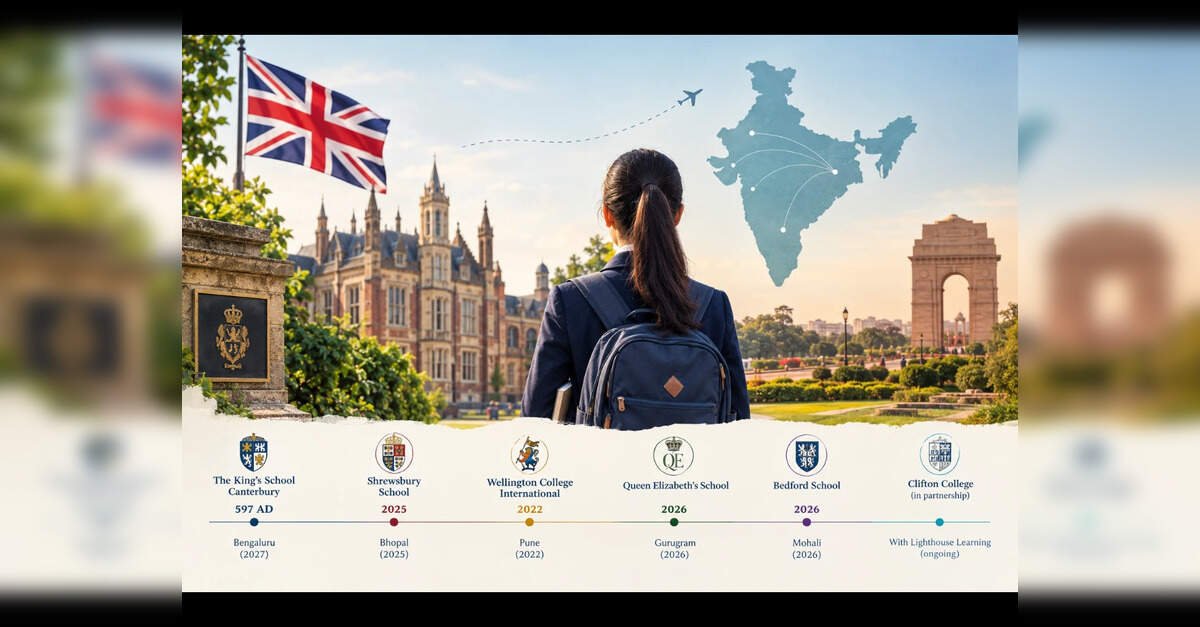
The King’s School Canterbury, whose origins date to 597 AD, formally launched its Bengaluru school last week in partnership with Vidyashilp Education Group. The first pupils are expected to join in the 2027–28 academic year, beginning with Nursery through Year 2 before the school expands progressively.
The Bengaluru launch puts into sharp focus a trend that has been building across India’s premium K-12 market: established British school institutions, many with centuries of history, are increasingly looking at India through new campuses, partnerships and international-school ventures.
But this is not the arrival of international schooling in India.
Schools such as The British School, American Embassy School and Canadian International School have been part of India’s international-school landscape for decades. Nor is every school associated with a British institution new to India: several have established long-standing operations. What is new is the recent entry of established British school institutions themselves, many with centuries of history, through new campuses and partnerships.
Bedford School Mohali is another recent example. It welcomed its first batch in April 2026 and describes itself as the first British international girls’ school and the first British-branded school in North India.
Shrewsbury School opened its Bhopal campus in 2025. Wellington College International Pune is now in its fourth year. Queen Elizabeth’s School, Barnet, opened its Gurugram branch campus in August 2026. Clifton College has entered into a partnership with Lighthouse Learning, initially without committing to a standalone Clifton campus.
The question, therefore, is not whether international schools can operate in India. It is why established British institutions are looking at India now, what has changed in the ecosystem that makes these ventures possible, and whether what they are bringing is really a British school, or something more complicated.
Why now?
The timing of the expansion is the result of changes on both sides.
British independent schools have been internationalising for years, but research on the sector identifies a newer phase of overseas expansion beginning around 2021. Markets in China, Southeast Asia and the Middle East have traditionally been more established destinations. India has been slower to attract major British independent-school institutions, but that is beginning to change.
At home, British independent schools are dealing with rising costs, regulatory pressures and questions around the sustainability of the sector. The introduction of VAT on private-school fees from January 2025 has added to those pressures, although it would be too simplistic to view international expansion as a direct response to the tax change.
For institutions such as Shrewsbury, internationalisation is part of a broader question: how can they preserve the character of independent education while making their institutions sustainable and relevant in a changing environment?
Dominic Tomalin, Founding Headmaster of Shrewsbury International School India, said British independent education is operating in a period of change, with schools having to think harder about costs, regulation and sustainability while protecting their distinctiveness.
India offers a different set of conditions.
The premium end of the Indian K-12 market has matured. Parents are more familiar with international curricula, overseas university pathways and different models of schooling. Increasingly, the demand is not simply for an international curriculum, but for a combination of academic rigour, personal development, leadership, communication, resilience and exposure to different cultures.
“There is a demand for the whole-person education that British independent schools have traditionally provided,” Tomalin said.
Nigel Fossey, Master of Wellington College International Pune, similarly said Indian families were increasingly looking for creativity, critical thinking, leadership, resilience and global citizenship alongside academic outcomes.
That creates an opportunity, but not an empty market.
India already has established international schools, domestic premium-school chains and institutions offering IB, Cambridge and other global curricula. A British school’s historic name therefore has to translate into something parents can actually experience.
The partnership advantage
There is another change that is perhaps less visible but equally important: the availability of Indian education partners capable of operating alongside established British institutions.
The recent entrants are not all building their India operations alone. King’s Canterbury is working with Vidyashilp Education Group in Bengaluru. Shrewsbury has partnered with Jagran Social Welfare Society in Bhopal. Queen Elizabeth’s Gurugram is being developed with GEDU. Clifton has partnered with Lighthouse Learning.
These are not identical arrangements, but they point to a common model.
The British institution brings educational philosophy, institutional experience, teacher-development systems, governance practices and an international network. The Indian partner brings local knowledge, operating experience, infrastructure, relationships with families and an understanding of the regulatory and commercial environment.
That lowers the barriers to entering a market that can be difficult for an overseas institution to understand on its own. It also changes the nature of what is being exported. The product is not simply a British curriculum.
What is harder to reproduce is the accumulated institutional knowledge around how a school operates: how teachers are developed, how students are supported, how academic quality is monitored, how leadership is built, how co-curricular education works and how a school creates a culture that extends beyond the classroom.
That is the institutional DNA these schools are attempting to bring to India.
Five institutions, five different models
The fact that the five institutions are entering India in different ways is significant. There is no single British-school expansion model.
Shrewsbury is building a substantial residential institution. Wellington is testing and refining an operating school. King’s Canterbury is beginning with younger children and growing progressively. Queen Elizabeth’s is using a branch-campus model. Clifton is starting with partnership and knowledge exchange rather than immediately putting its name on a standalone campus.
The differences reveal as much about the institutions as the market does.
Shrewsbury: building an institution
Shrewsbury International School India opened its first cohort in Bhopal in August 2025. Its British parent institution was founded in 1552. Tomalin’s emphasis is on creating a school that has a genuine local identity rather than simply reproducing Shrewsbury in another country. “We are not transplanting a school. We are growing one that is genuinely of India as well as of Shrewsbury,” he said.
The school has access to local knowledge through JSWS, which has operated in education for decades, while drawing on Shrewsbury’s experience in academic education, co-curricular programmes and boarding.
Teacher quality is central to the proposition. “The quality of a school can never exceed the quality of its teachers,” Tomalin said.
The institution is therefore placing emphasis on professional development and teacher practice, including through international education networks.
Its approach to boarding is also broader than accommodation. The objective is to develop students’ ability to work with others, lead and follow, build social confidence and contribute beyond themselves. Shrewsbury does not currently envisage a rapid rollout of multiple full-scale campuses. Instead, it is looking at how feeder schools could eventually introduce younger children to its educational approach before they move into the larger Bhopal institution.
Wellington: the test of an operating school
Wellington College International Pune offers a different perspective because the school is already beyond the launch stage. It is in its fourth year and has recently celebrated its first graduating examination cohort. That makes Wellington useful as a test of what happens after the announcement and the branding exercise are over.
Fossey said parents are looking for academic rigour but also a broad curriculum, pastoral care and opportunities beyond examinations. The school places emphasis on teacher development, leadership development and international collaboration, with governance and quality assurance connected to the wider Wellington network.
But the model, he said, cannot simply be copied from Britain.
International schools have to adapt to the communities in which they operate, he said, while becoming part of the local environment. India, in turn, has things to teach the institution, particularly in areas such as technology, entrepreneurship, robotics, artificial intelligence and service learning.
For Wellington, internationalisation is therefore not a one-way transfer of expertise.
King’s Canterbury: heritage meets relevance
King’s Canterbury offers perhaps the sharpest test of the question at the centre of this story. The school traces its origins to 597 AD and is widely regarded as one of the world’s oldest schools. Its Bengaluru partnership with Vidyashilp was formally launched last week. The school will initially open with Nursery, Reception, Year 1 and Year 2, with additional year groups added progressively.
Its Founding Head of Prep, Leigh Holmes-Hill, makes an unusually direct argument about what the institution’s British identity means. “The fact that it’s British actually is in many respects irrelevant,” she said. The point, she argues, is not to reproduce an English school in Bengaluru. It is to take an educational philosophy that has evolved over centuries and determine what remains relevant in a very different environment.
King’s expects a mix of British and Indian teachers and sees professional exchange as important in both directions. Its focus on younger children also reflects a deliberate strategy. Rather than launching immediately as a full K-12 institution, the Bengaluru school will grow alongside its founding pupils.
For a school with more than 1,400 years of institutional history, the experiment is not whether the brand can travel. It is whether the institution can.
Queen Elizabeth’s: India as a destination
Queen Elizabeth’s School, Barnet, founded in 1573, opened its first Indian branch campus in Gurugram in August 2026 in partnership with GEDU. Craig Cook, Founding Principal of Queen Elizabeth’s School Gurugram, sees the development as part of a wider change in India’s position in global education.
India was historically viewed largely as a country from which students travelled abroad. It is increasingly becoming a place where international institutions, pathways and expertise are being established locally.
Parents in Delhi-NCR, he said, are well travelled and informed. Their questions are increasingly about teaching quality, intellectual challenge, values and the student community rather than simply whether a school has an international curriculum. That is why the Gurugram school is being built around academic preparation, university guidance, co-curricular development and residential education.
Cook is also explicit about the limits of transplantation. “A great school cannot simply be lifted from one country and dropped into another; authentic education must always be locally grounded to enable global reach,” he said.
The immediate priority, he said, is to establish Gurugram properly before considering further expansion.
Clifton: partnership before campus
Clifton College has taken the most cautious route among the five. Its partnership with Lighthouse Learning does not currently amount to a standalone Clifton-branded campus in India.
Christopher Stevens, Executive Head of Clifton College, distinguishes between entering a market through a partner and simply placing a famous school name on a new building. Lighthouse already operates schools across different segments of India’s education market, giving Clifton access to local operating knowledge and an existing education ecosystem.
“That is a partnership rather than just, ‘put Clifton on a building and it’s going to be a great school,’ because education is by definition contextual and unless you do respond to and adapt to the context you’re in,” Stevens said.
For Clifton, the partnership is also intended to facilitate exchange between educators and school leaders. Stevens compares the approach with an “Apple skunk works” model: experiment in different settings, see what works and then decide whether it should be expanded.
The model is significant because it suggests that internationalisation does not have to begin with a large campus.
What India changes
The British institutions may be entering India with established philosophies, but none of the five suggests that the model can remain unchanged. That is where the story becomes more interesting than a simple foreign-school expansion.
Holmes-Hill sees Bengaluru’s cultural and entrepreneurial character as part of what will shape King’s. Fossey points to India’s strengths in technology, entrepreneurship and innovation. Tomalin argues that India’s own intellectual history should be part of the educational environment at Shrewsbury India.
Cook’s emphasis is on institutional context: understanding Indian families, expectations and culture.
Stevens makes the same point through partnership and experimentation. The common thread is that adaptation is not being presented as a concession.
It is part of the model. The British institution supplies its educational framework, experience and networks. The Indian side supplies local knowledge of families, the operating environment and the market. The resulting school has to be recognisably connected to the British institution while also being credible as an Indian school.
That is a much more demanding proposition than simply exporting a curriculum.
The commercial test
Heritage may help these schools enter the market, but it cannot by itself justify the fees. India’s premium-school market is already crowded. Parents can choose among international curricula, established Indian school groups and long-running international institutions.
A historic British name therefore has to translate into tangible educational value: teaching quality, distinctive pedagogy, student development, teacher training, university pathways, networks or an institutional culture that families can see and experience.
The name can open the door. It cannot run the school.
That is why the next two or three years will be more revealing than the announcements themselves.
Shrewsbury will have to demonstrate that its Bhopal institution can establish the culture and teaching quality promised by its model. Wellington will provide a longer-term view as its Pune school moves beyond its launch phase. King’s will begin building its Bengaluru culture with its founding pupils. Queen Elizabeth’s will have to establish a new branch campus while retaining the academic character associated with Barnet. Clifton will test whether partnership and exchange can create value before a conventional campus is even considered.
Bedford School Mohali and other recent British-school ventures will add to the picture. The question is no longer whether British school institutions can enter India. It is whether they can establish schools that work on Indian terms while retaining the features that made the original institutions attractive.
Britain’s historic schools have decided that India is worth entering. What matters now is what happens after the name goes on the gate.
The brand travels. The institution has to adapt.


