


France is looking to deepen its higher education partnership with India beyond student mobility, with a greater focus on joint degrees, research collaborations, industry-linked programmes and emerging sectors such as artificial intelligence and aerospace.
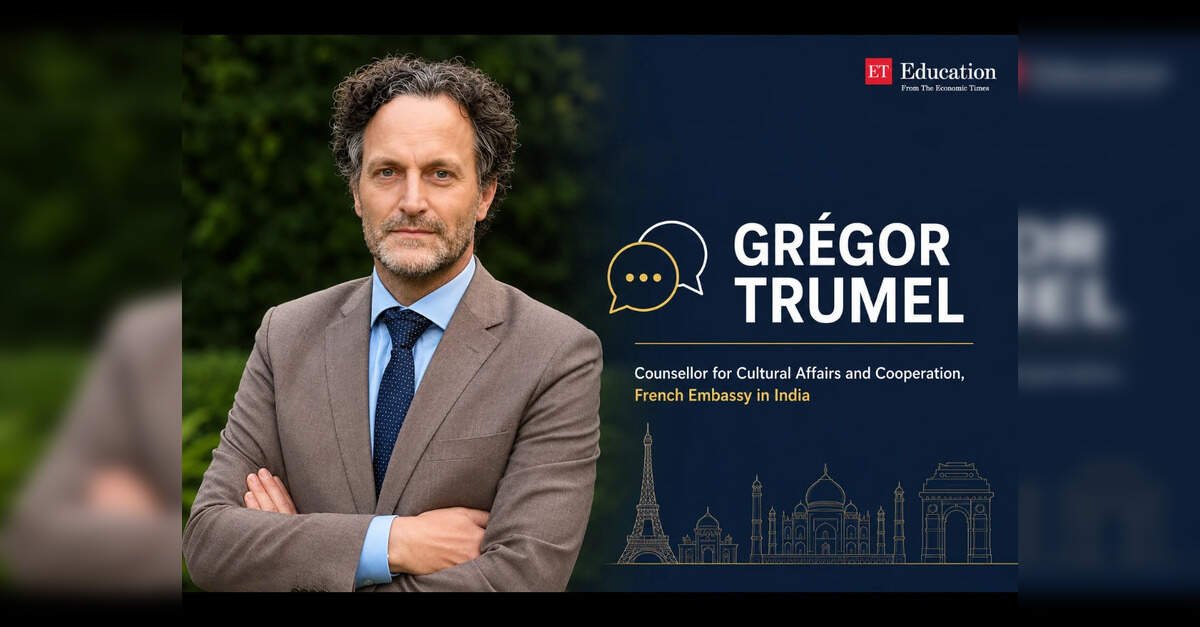
Grégor Trumel, Counsellor for Cultural Affairs and Cooperation, French Embassy in India, spoke to ETEducation about France’s evolving education strategy for India, opportunities for Indian students, institutional collaborations under NEP 2020, and the country’s efforts to strengthen academic and career pathways.
Q. France has set a target of welcoming 30,000 Indian students by 2030. What is driving this ambition and what steps are being taken to achieve it?
Grégor Trumel: The target of 30,000 Indian students in France by 2030 is not simply an aspiration. It comes from the understanding that the strong relationship between France and India requires people-to-people and society-to-society connections, beyond geopolitical and economic ties.
We are working actively through Campus France, which has a strong network in India with 10 offices across the country and dedicated teams counselling and supporting aspiring students at every stage of their application.
A key step was the Mutual Recognition of Academic Qualifications Agreement signed between India and France in 2018, which is being renewed and further strengthened. This helps create greater clarity and mobility for students. Since 2021, Indian students with a French master’s degree have been eligible for a one-year renewable post-study permit, allowing them to seek employment or start a business in France.
Another important initiative is Classes Internationales, announced during President Emmanuel Macron’s visit to India in 2024. It is a foundation-year pathway that helps students learn the French language, academic methods and skills before entering bachelor’s or integrated programmes in France.
Campus France also provides free counselling and guidance to students, helping them understand programmes and align their aspirations with opportunities in France.
Q. With destinations such as the US, UK, Canada and Australia already popular among Indian students, what makes France different?
Grégor Trumel: France is a new frontier for Indian students. Certain English-speaking countries do have strong global recognition, but more students are now exploring France as a study destination.
France offers academic excellence and access to a wider European ecosystem. Students studying in France can also benefit from opportunities across Europe through programmes such as Erasmus+, a European Union’s flagship mobility programme, and once enrolled at a French institution you can spend a semester or a full year studying or interning at a partner university in another European country, usually with a grant to support it and with the credits counting towards your French degree.
French higher education combines strong theoretical foundations with practical learning. The degrees are globally recognised, and students have opportunities in sectors in which France has strong expertise, including engineering, artificial intelligence, aerospace, luxury, hospitality, mathematics and international business.
The strong strategic partnership between India and France also creates more opportunities for students and professionals. France’s student visa process is known for its stability and transparency, with high approval rates for genuine applicants and a clear, predictable pathway through Campus France.
Q. Which courses and emerging sectors are seeing increasing interest from Indian students?
Grégor Trumel: Business and management remain very popular among Indian students. Around 80% of Indian students going to France choose business school and management education programmes.
France has globally recognised institutions in this space, including grandes écoles and leading management schools.
At the same time, we are seeing growing interest in aerospace, AI, data science, sustainability and engineering. These areas reflect the strengths of the French economic and research ecosystem.
Aerospace is particularly important because of the strong India-France industrial relationship, with companies such as Airbus, Safran, Dassault and Thales. There are also opportunities in health sciences, life sciences, hospitality, fashion, luxury, and design.
Q. Language, affordability and post-study opportunities remain key concerns for students. How is France addressing these challenges?
Grégor Trumel: France is working constantly to make students’ journeys smoother. There are around 1,500 programmes in France that are fully taught in English. At the same time, learning French is encouraged because it’s helpful for students in everyday life.
Students can learn French through the Alliance Française network and other institutions in India. Affordability is another important aspect. French higher education is excellent, plus supported through government funding, which makes it more accessible.
For example, university cafeterias in France provide subsidised meals for students, including vegetarian options. For employability, Indian students with a master’s degree from France can access a post-study pathway to work or start a business. French degrees are recognised across Europe, India, and globally.
Q. India is allowing foreign universities to establish campuses under NEP 2020. Is France exploring greater institutional presence in India?
Grégor Trumel: Absolutely. France is keenly exploring the opportunities created by NEP 2020. There are two approaches: foreign institutions establishing campuses in India, and increasing joint and dual-degree programmes between Indian and French institutions.
By way of example, we already have premier French business school ESSEC in Mumbai, and several collaborations in engineering and management.
French institutions are also exploring more partnerships with Indian universities. Public universities often focus more on joint degrees and academic collaborations, while private institutions may have greater flexibility for establishing campuses. The objective is to deepen institutional ties and create more opportunities for students in both countries.
Q. What kinds of academic collaborations are gaining momentum between India and France?
Grégor Trumel: Dual degrees are becoming a major area of growth, along with joint PhDs and joint bachelor programmes. Several Indian institutions, including IITs, IISERs and BITS Pilani, are actively building partnerships with French institutions.
For example, Sorbonne University and IIT Delhi are launching a dual-degree programme, which will be the first international dual degree offered by IIT Delhi. Another important initiative is the Franco-Indian Campus for Life Sciences in Health, which brings together more than 20 French and Indian institutions.
Institutions such as École Normale Supérieure are also collaborating with IISERs on doctoral research partnerships. The future will see more joint degrees, research collaborations and academic exchanges.
Q. What are the biggest challenges in scaling India-France education ties?
Grégor Trumel: The main challenges are awareness, information, and perceptions around language. The India-France relationship is already very strong. The focus now is making students and families more aware of the opportunities available.
Campus France regularly conducts webinars, counselling sessions and outreach programmes across India. Through Choose France tours, university visits, and interactions with students, we are working to spread information about French higher education.
The perception that language is a barrier also needs to change. While French is important, students can study in English, and learning some French helps them broaden and enjoy their experience in France.
Q. What is your message for Indian students considering France?
Grégor Trumel: Indian students are very motivated and adaptable. They already know multiple languages and can learn French quickly. France offers excellent academic opportunities, global exposure, and strong career pathways.
Students should connect with Campus France offices, where they can receive free guidance and counselling to understand programmes, opportunities, and the right pathway for their future.
We would be very happy to welcome 30,000 excellent and motivated Indian students in France by 2030, or even earlier.
