



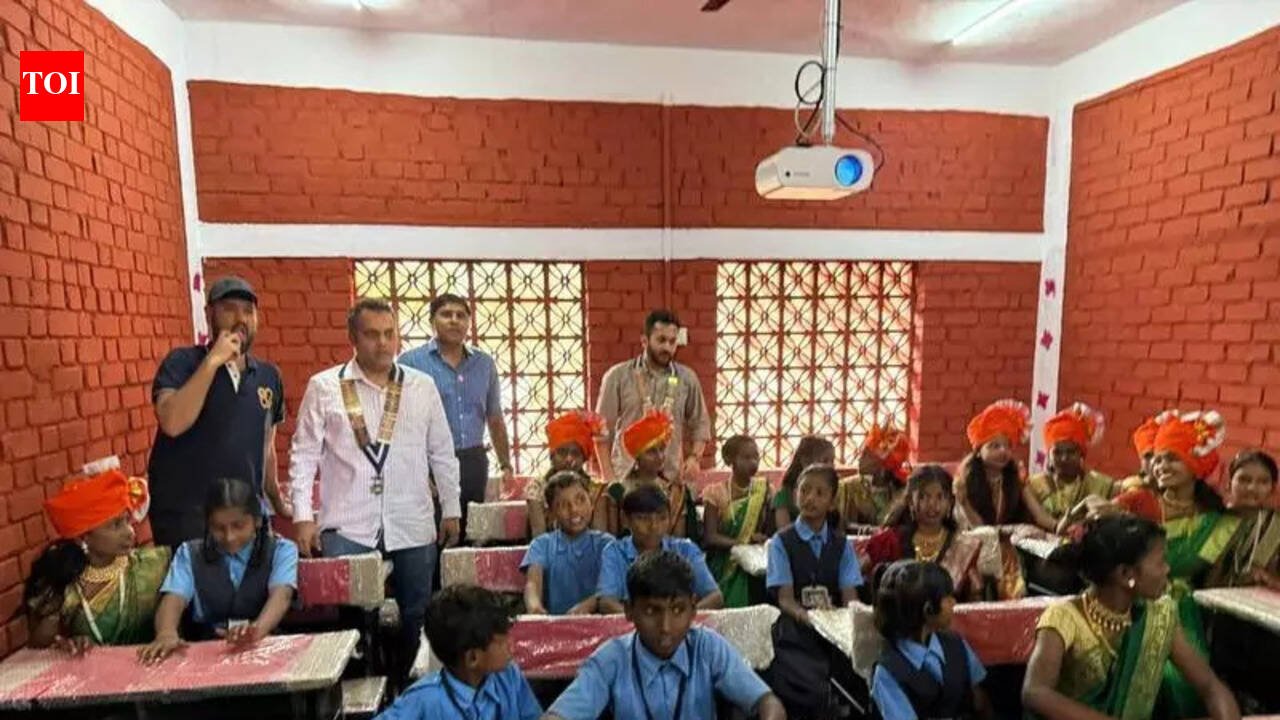
Until recently, the Zilla Parishad school in Nagazari, a tribal village in Hingna taluka on the outskirts of Nagpur, functioned from an ageing structure that had become unsafe and inadequate for children. Basic expectations—sturdy classrooms, clean washrooms, and space to play—felt out of reach for families who depend on the school as the village’s primary gateway to learning. That has changed with the construction of a new school building led by Nagpur Round Table 83 (NRT-83), a volunteer-driven chapter of Round Table India. The old building was demolished and replaced with a safer, redesigned facility that now serves nearly 200 students, bringing the kind of learning environment typically associated with better-resourced schools closer to home for children in the village.The newly-constructed facility includes three well-furnished classrooms equipped with modern desks and learning spaces. Separate washrooms for boys and girls were built within the premises to address sanitation concerns that long affected the school. A dedicated play area for children was also developed, and the building design allows for future expansion as enrolment grows.The structure emphasises natural ventilation, safety, and improved learning conditions for students in the tribal village.Prateek Minocha, chairman of NRT-83, said the project reflects the broader vision of Round Table India. “Ours is a non-political and non-sectarian organisation of young professionals committed to service, fellowship, and goodwill. Education for underprivileged children remains our primary focus, and projects like Nagazari reaffirm our commitment to creating long-term impact,” he said.NRT-83 operates largely through volunteers and worked on several rural school projects around Nagpur. It primarily focuses on repairing deteriorating school structures, rebuilding unsafe buildings, improving playground facilities, and organising medical camps. Nearly 60 volunteers work in multiple teams that coordinate fundraising, planning, and on-ground execution. According to Saurabh Taori, vice-chairman of the trust, the organisation already assisted approximately 20 govt schools in rural areas around the city. He added that many of these institutions approached the organisation because they lacked adequate resources or access to funding.Nearly 60 volunteers participate in the group’s initiatives, working through multiple teams that coordinate fundraising, planning, and on-ground execution of projects. The organisation primarily focuses on repairing deteriorating school structures, rebuilding unsafe buildings, improving playground facilities, and organising medical camps for students.“Many of these schools are located far from the city and often do not receive the attention or funding they require. When we get requests from such schools, we assess the situation and take up renovation or development work,” treasurer Nischay Sinha said.Projects are frequently carried out in coordination with local administrative bodies, including the Zilla Parishad and village gram panchayats. Sinha said that such collaboration often helps in resolving logistical challenges and facilitating approvals.Funding typically comes from a combination of community donations, crowdfunding campaigns, and contributions under corporate social responsibility initiatives. “We are a registered trust, so people can donate to us. We also do crowdfunding and are eligible to receive CSR contributions,” he said.The organisation also works with educational partners who conduct academic support programmes for students. These include classes, teacher training sessions, and personality development activities aimed at improving learning outcomes.“One foundation associated with us focuses mainly on the educational side. They conduct classes, teacher training programmes, and personality development sessions for students,” secretary Dhruv Sharma said.He added that rebuilding schools often requires long-term planning and coordination. In the case of Nagazari, the dilapidated building had to be completely demolished before a new structure could be designed and constructed.“Our mandate is clear — to build infrastructure where it is needed. In 1 project, we demolished the old building and constructed a new school building with a redesigned structure. The entire process took around 2 years,” he said.Following the completion of the Nagazari school building, the organisation began surveying nearby villages to identify other govt schools requiring urgent infrastructure upgrades. Discussions with local authorities are underway to explore future collaborations that could extend similar facilities to more rural students.


