






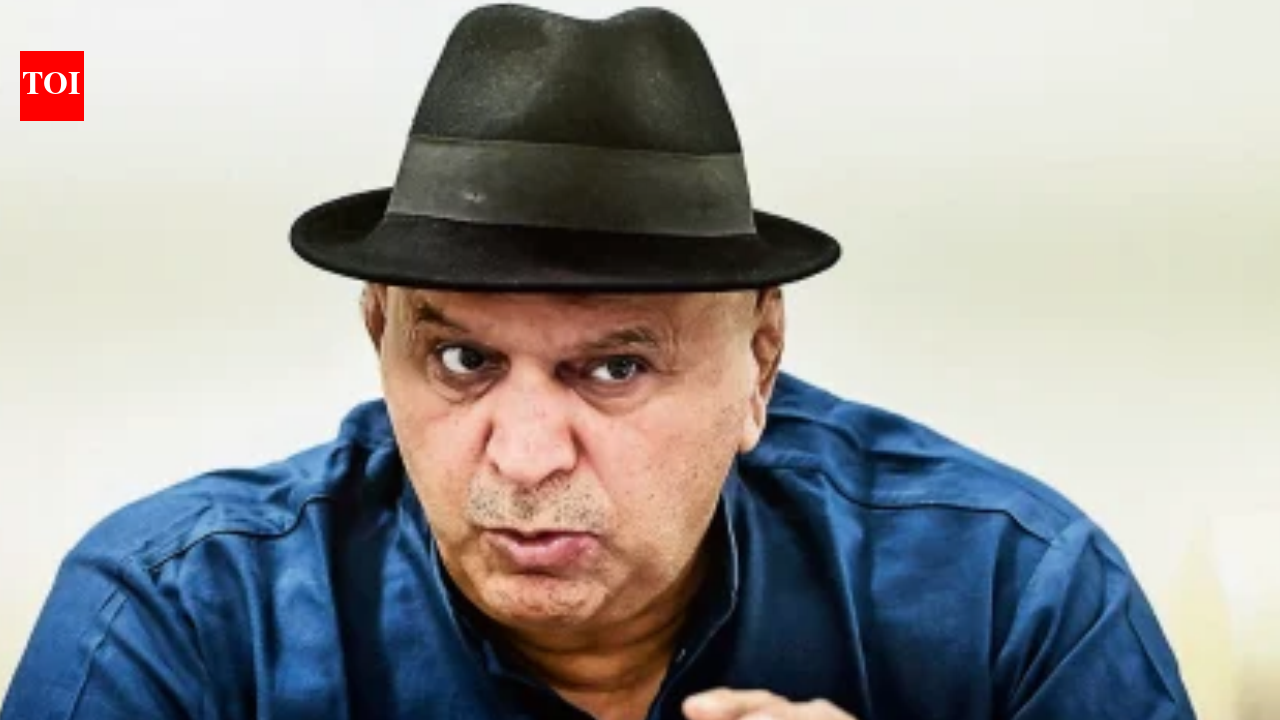
Renowned wrestler-coach Satpal recalls the time he would participate in dangals near the Jama Masjid area and how he came to own a collection of 80 hats“Whom do you want to meet?” asks the watchman at the upscale neighbourhood in Rohini’s Sector-23, looking up from his mobile. Our answer, “Pahelwan-ji”, neither illuminates nor satisfies him. “Which Pahelwan-ji?” he shoots back, reeling out three-four names. But the name “Satpal” changes his tone.“Pahelwan to bahut hain, par mahabali to ek hi hai (There are many wrestlers, but only one mighty wrestler),” he says with reverence.We wait for Satpal in a sitting room that’s bigger than a badminton court, a golden mace glowing in a corner. He appears shortly, wearing a blue kurta and lungi — and a black fedora. “I was gifted my first hat by a fencing official during the 2008 Beijing Olympics,” he says.Over the years, hats have become Satpal’s signature. His collection of 80 includes some from Australia, England, Indonesia and countries he doesn’t recollect.Professionally, however, Satpal has primarily worn two hats: of wrestler and coach. As a wrestler, he won multiple medals for India. As a coach, he has trained the likes of Yogeshwar Dutt, Bajrang Punia, Sushil Kumar (also his son-in-law), Ravi Dahiya and Aman Sehrawat, all Olympic medal-winners. “I have invested my life in wrestling,” he says.At 71, the venerated coach still cuts an imposing figure. It’s hard to believe that he was once a skinny boy who was roughed up by fellow students in Class 5. “When my father, a wrestler himself, heard about the incident, he ordered me to the village akhara,” Satpal recalls. The young boy was asked to grapple with other kids. Everyone felt he was a natural at the sport.Like most parents, Satpal’s, too, wanted him to be an engineer or a doctor. But the Bawana-born had already been bitten by the wrestling bug. After much persuasion, his father agreed to send him to Guru Hanuman’s akhara, but he set one condition: “Don’t leave your pursuit midway, else you will be grazing cattle.”It was the late Sixties. The akhara, near Amba cinema in north Delhi, had only three full-time students, Satpal recalls. One was Sudesh Kumar, who had finished sixth in the 1968 Mexico Olympics. “There was no electricity and no tap water. I used the toilets made for the labourers at the nearby Birla Mills. To avoid the queue, I would go at 4am,” he remembers.For the fledgling grappler, it was a lonely life. He would go to sleep under a sheesham (rosewood) tree and often weep. “I felt better after making friends with the children of sweepers and workers,” he says. Every month, Satpal would receive Rs 10 for provisions. And, every day, he would collect milk sent from home at Ghanta Ghar, he says. Apart from exercising and training, his morning regime included cleaning and watering the akhara.“I loved it. I believe in what Guru ji (Hanuman) used to say: ‘Agar akhaare ki sewa karoge, to tumhe phal milega (You’ll reap the rewards if you serve the akhara.)’”At 13, Satpal started appearing for the weekly dangals near Jama Masjid, which drew lively crowds. “On the first day, I won all four bouts and received Rs 10 as prize money, which improved my finances,” he says.“I must have fought over 500 bouts there. I was given the title ‘Nausherwan’, after winning on nine consecutive Sundays,” he recalls. He also remembers BJP leader Atal Bihari Vajpayee bringing a sack of almonds for the wrestlers.Satpal’s rise was meteoric. Experts recognised him as a special young talent following his impressive displays at School Games and National Championships. The 17-year-old was selected for the 1972 Munich Olympics in the men’s freestyle 62 kgs category. “I was the youngest in the contingent,” he says. He has vivid memories of the terror strike in the Games village by pro-Palestine group Black September, which left 11 Israeli athletes and coaches dead.“The Israelis were staying in flats behind ours. The attack shook everyone,” he says.Satpal also participated in the Montreal 1976 and Moscow 1980 Olympics. “During a bout in Moscow with a Czechoslovakian, I received a cut above my right eye. The repair took 16 sutures,” he says, showing the scar.The wrestler’s finest moment came at the 1982 New Delhi Asian Games, the day India lost 7-1 to Pakistan in hockey. Under the open skies, the local boy defeated his Mongolian opponent 4-0 on points before PM Indira Gandhi, sending the packed Ambedkar Stadium into raptures. “A year earlier, I had suffered a ligament tear in my right knee. I didn’t allow my rival to take advantage of that,” he remembers.The wrestler received a flat in Shalimar Bagh and about Rs 8 lakh in cash, roughly Rs 1.7 crore today.In his prime, Satpal was a synonym for box-office in rural and small-town Maharashtra. Ticketed contests in towns like Kolhapur, Belgaum, Hubli and Poona were attended by thousands who loved his famous ‘hathi chingharh daav’ (screaming elephant move). Satpal would be mobbed by adoring spectators and adorned with currency garlands, and was later crowned ‘Rustom-e-Hind’.Satpal, who served as a senior sports officer for the Delhi govt, continues to train wrestlers at the Chhatrasal Stadium. A recipient of the Arjuna and Dronacharya awards as well as the Padma Bhushan, he believes that Tokyo Asian Games gold medal winners Sujeet Kalkal and Aman Sherawat are good bets for the 2028 Los Angeles Olympics.Not many know that the wrestling guru also played the lead in a hit Haryanvi film, ‘Premi Ramphal’, in 1985. “I got more acting offers. But if I had accepted them, the Olympic medals (of my wards) may not have come,” he says.Satpal knows which hat suits him most.


