






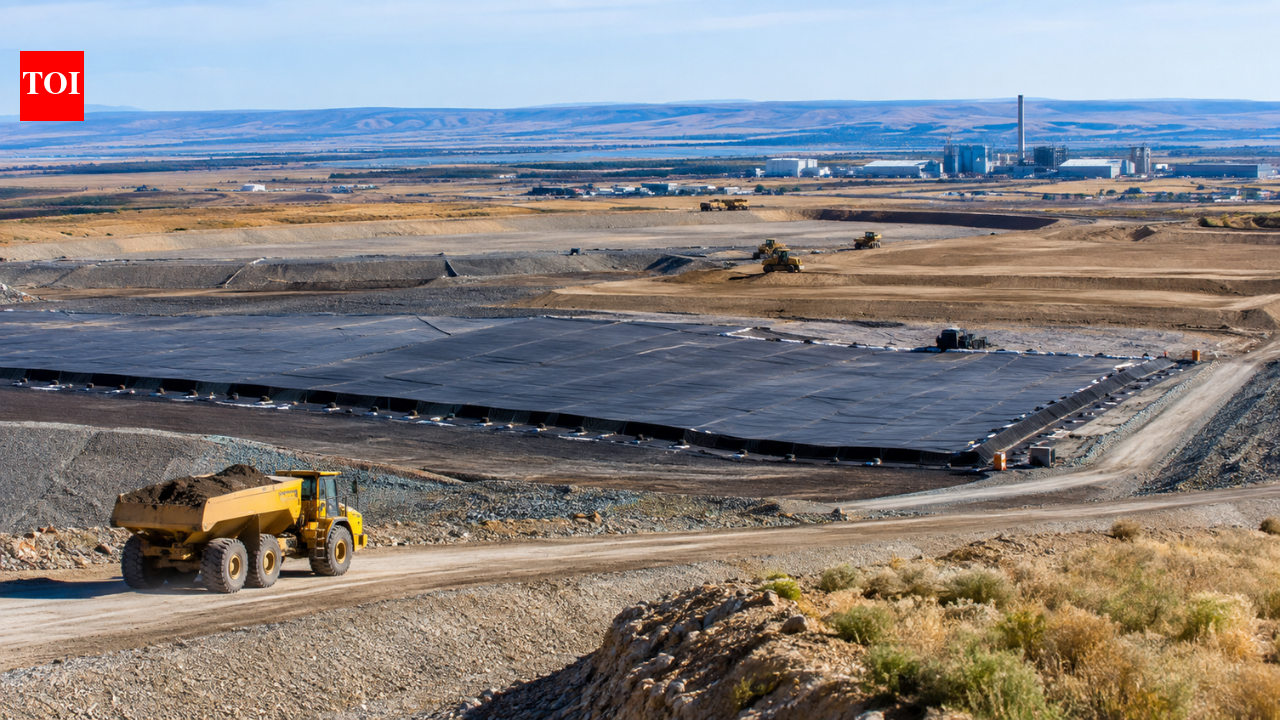
At the centre of Washington state’s sprawling Hanford Site, an enormous engineered landfill is being made larger as one of the United States’ biggest environmental cleanup programmes continues. According to the US Department of Energy (DOE), the Environmental Restoration Disposal Facility (ERDF) has been receiving waste since 1996. Over that time, 20 million tons of material from cleanup operations have been placed there, including low-level radioactive and hazardous waste. Now, workers have finished excavating another section of the landfill. The new disposal cell is 80 feet deep and covers an area roughly 500 feet wide and 1,000 feet long. Once its protective liner is installed, it will provide another 2.8 million cubic yards of capacity.
How ERDF handles waste from Hanford’s cleanup work
ERDF sits on the Central Plateau, close to the middle of the 580-square-mile Hanford Site. It was opened in 1996 to give crews carrying out environmental restoration somewhere to take certain solid wastes removed during the cleanup.Its contents are not limited to one type of material. The facility receives low-level radioactive waste, hazardous waste and mixed solid waste produced by Hanford cleanup projects. Contaminated soil, debris from demolished structures and material removed from old waste sites are among the types of waste that can be handled there.The distinction matters because Hanford has several different waste-management systems. Waste from the site’s underground tanks, for example, follows separate storage, treatment and disposal routes. ERDF has a more specific job: dealing with qualifying solid material generated as contaminated areas and ageing facilities are cleaned up.
PC: DOE
20 million tons have gone through the facility
Approximately 20 million tons of cleanup waste have been disposed of at ERDF, according to information from the US Department of Energy.As reported by Hanford Communities, that material has come from work involving more than 800 demolished facilities and about 1,300 waste sites. Moving it has also required a huge amount of transportation. Trucks supporting ERDF operations have travelled more than 30 million miles, a distance DOE describes as roughly equivalent to making 1,200 trips around the Earth.The landfill has not remained the same size throughout that period. Its capacity has been increased several times as cleanup work generated more material requiring disposal. Earlier expansions were completed in 1999, 2003, 2007 and 2011.
Hanford’s Super Cell 11 adds 2.8 million cubic yards of space
Reportedly, the newest addition is being referred to as Super Cell 11. The description reflects its scale: the cell is about twice the size of the original disposal cells at the facility. Excavation began during the summer, eventually producing a cavity about 80 feet deep. Across the surface, it stretches approximately 500 feet from side to side and 1,000 feet in length. The completed cell is expected to provide around 2.8 million cubic yards of additional disposal space.That is capacity intended for future cleanup rather than a one-off project. DOE has said the expansion is expected to support the Hanford mission through at least 2040, giving contractors somewhere to manage qualifying solid waste as work continues across the site.
How ERDF is designed to contain water from the landfill
Finishing the excavation does not mean the disposal cell is ready to receive waste. Contractors with the Central Plateau Cleanup Company (CPCCo) are due to complete the project by installing an engineered liner.Kelly Ebert, director for the Projects and Facilities Division with the US The Department of Energy Office of Environmental Management’s Hanford Field Office said, “ERDF has been a cornerstone of our waste disposal strategy for nearly 30 years, and this expansion is essential to provide uninterrupted, efficient and safe disposal for years to come.”The liner forms part of the system intended to keep potentially contaminated water from reaching the underlying environment. Rainfall, snowmelt and water used to control dust can enter the disposal area, so the engineered system is designed to collect that water and direct it towards holding tanks for treatment.
The landfill helping crews tackle Hanford’s legacy waste
Hanford’s cleanup involves removing material from a site that was heavily used for nuclear weapons production during the 20th century. Much of the current work involves dealing with the physical remains of that history, including contaminated ground, old buildings and waste sites.ERDF gives those projects a central disposal point for waste that meets the facility’s acceptance requirements. Instead of leaving contaminated soil or demolition material at the individual locations where it was found, cleanup teams can transport it to the engineered landfill.The scale of the facility reflects the scale of the wider operation. Its 107-acre footprint has already accommodated millions of tons of waste, while further cleanup work is expected to continue for years.


