



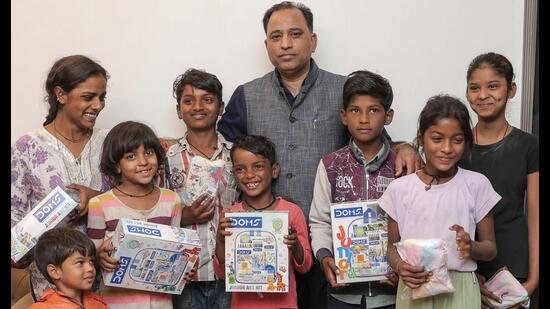
In a city often criticised for poor sanitation and waste management, an unlikely force of change is emerging from its most overlooked corners. Underprivileged children – many from labour settlements and slum clusters – are being groomed not just for education and survival, but to become ambassadors of cleanliness and awareness.


At the centre of this effort is 47-year-old Vijay Ram Rattan, a resident of Golf Course Road, who is quietly reshaping lives and mindsets across communities. Every Sunday, Rattan steps away from the pace of urban life to spend time with nearly 60 children he supports. His initiative began with funding education and ensuring children from marginalised backgrounds could attend school and even pursue higher studies. But over time, it evolved into something far more comprehensive.
Rattan’s work directly addresses one of Gurugram’s biggest civic challenges—waste management. In slum areas, he teaches children the basics of waste segregation and hygiene. These children, in turn, clean their neighbourhoods twice a week and actively encourage residents not to dump garbage on roadsides or in vacant plots.
“They are not just learning—they are leading change,” Rattan says. “When awareness comes from within the community, it lasts longer.”
Environmental sustainability remains deeply embedded in his work. Through plantation drives across Gurugram, Sohna and Rajasthan, thousands of trees have been planted, with children actively participating as environmental ambassadors.
His efforts also extend to healthcare and basic sustenance. From funding medical treatment for the needy to organising food distribution drives at labour sites, he ensures no family is left behind in times of crisis. In Rajasthan’s Naugaon , he has constructed schools and hospitals and later handed them over to the government, ensuring long-term access for local communities.
At construction sites where families often live without access to structured learning, Rattan hired teachers, created informal classrooms and helped children transition into formal education. He has supported 600 students to date, many of whom are employed in private companies and government agencies.
What distinguishes his work is the integration of values with opportunity. Children begin their sessions by reciting the national anthem and the Gayatri Mantra. “If you build values early, everything else follows,” Rattan says.
In a state known for its contribution to the Olympic medal tally, he has also made sports an essential part of the programme. Every child is required to take up at least one sport. Over the past year, structured coaching – three times a week – has been introduced in cricket, wrestling, boxing, badminton and running. Children training in sports are also provided with protein-rich diets to support their physical development.
“I want them to think beyond limitations. Haryana has produced champions, and these children can be next if given the right platform,” he says, expressing hope that many will soon compete in open nationals across Haryana and Delhi.
Women’s empowerment is another key pillar of his vision. He supports basic education for women who could not study earlier, helping them read, write and gain confidence. “Education gives dignity. No woman should feel dependent because she cannot read or write,” he says.
In a city battling civic challenges, Rattan’s model stands out—not just for what it gives, but for what it builds. By empowering children to become agents of change, he is not just addressing problems but creating solutions that sustain themselves.
Vijay Ram Rattan is a resident of Golf Course Road and chairman of Ram Rattan Group


