



For thousands of Indian students aspiring to become doctors, studying medicine abroad has evolved from being an alternative option to a well-considered career pathway. Countries across Europe, Central Asia, and the Caucasus are attracting growing interest, offering internationally recognised medical programs, modern infrastructure, and comparatively affordable tuition.
However, with more choices available than ever before, selecting the right university requires looking beyond rankings, campus facilities, or tuition fees. The real question students and parents should ask is: Will this education prepare graduates to succeed as doctors, whether in India or anywhere else in the world?
One of the strongest indicators is graduate outcomes. For Indian students, this is often reflected in performance in the Foreign Medical Graduate Examination (FMGE), which serves as a benchmark for assessing whether graduates possess the knowledge and competencies required to practise medicine in India.
Universities that consistently produce successful FMGE results generally share common characteristics: a rigorous curriculum, strong clinical exposure, experienced faculty, and teaching methods that prioritise practical learning over rote memorisation.
This shift reflects a broader transformation taking place in medical education worldwide. Today’s healthcare systems expect graduates to think critically, make clinical decisions confidently, communicate effectively with patients, and adapt to rapidly evolving medical technologies. As a result, medical schools are increasingly adopting integrated curricula, simulation-based learning, and early clinical exposure to bridge the gap between classroom learning and real-world practice.
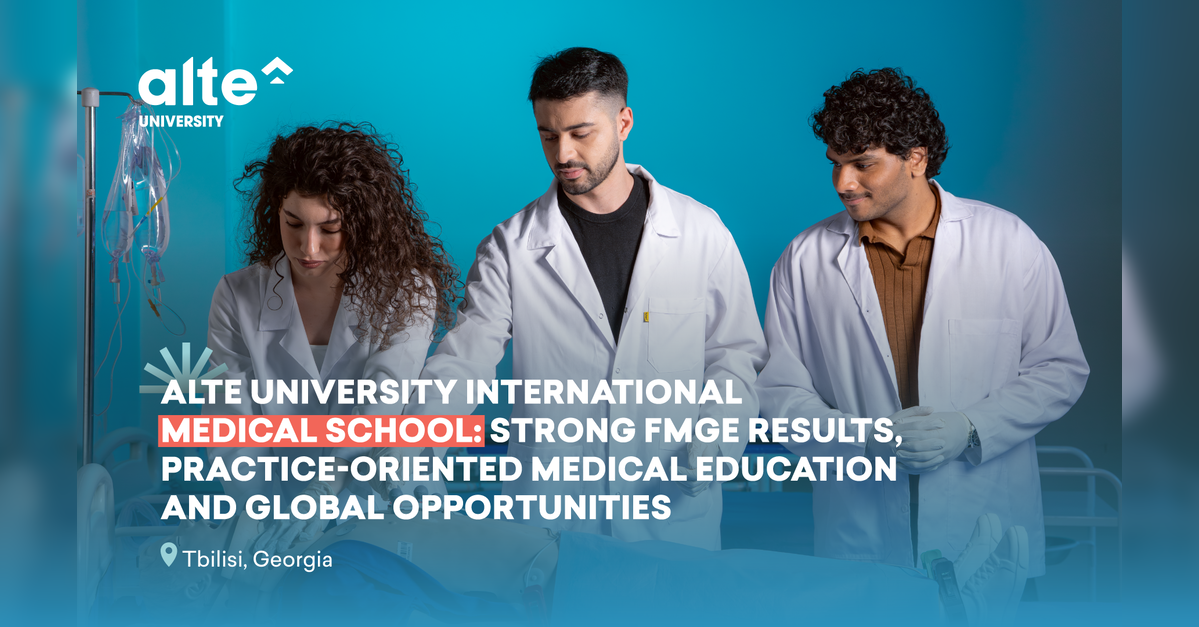
One institution reflecting this approach is Alte University in Georgia, whose International Medical School has attracted students from more than 50 countries. The university combines international academic standards with a practice-oriented learning model designed to prepare graduates for global medical careers.
For Indian students, Alte University’s recent FMGE performance offers an encouraging indicator. In 2025, graduates of the International Medical School recorded a 48.77% FMGE pass rate, more than double India’s national average of approximately 23%. The results also showed steady improvement during the year, rising from 40% in the June session to nearly 49% in December.
While examination performance is only one measure of educational quality, it reflects the effectiveness of the institution’s academic framework and student preparation.
A key reason behind such outcomes lies in how medical education is delivered. Rather than relying solely on traditional lectures, Alte University’s curriculum integrates classroom instruction with practical learning from the early years of study. Students are exposed to Problem-Based Learning (PBL), simulation-based training, virtual reality-assisted education, clinical case discussions, bedside teaching, and collaborative learning methods that mirror real healthcare environments.
An important component of this ecosystem is the university’s advanced Simulation Centre, equipped with AI-enabled technologies and high-fidelity medical simulators. These facilities allow students to develop diagnostic reasoning, procedural competence, teamwork, and patient communication skills in a controlled setting before interacting with patients in hospitals.
Clinical exposure remains another defining element of quality medical education. Recognising this, Alte University has partnered exclusively with VIAN Hospitals, Georgia’s largest hospital network, where students undertake clinical rotations across multiple specialties. Working alongside experienced healthcare professionals provides valuable hands-on experience and enables students to understand the realities of modern patient care.
As healthcare becomes increasingly global, international recognition has also become a significant consideration for aspiring doctors. Medical graduates today often pursue postgraduate education, licensing examinations, or professional opportunities across multiple countries. Institutions whose programs align with internationally accepted academic standards provide greater flexibility for such aspirations.
Alte University’s medical program is aligned with the educational requirements of the National Medical Commission (NMC), the UK’s General Medical Council (GMC), and the standards established by the World Federation for Medical Education (WFME). The university is also recognised by organisations including the World Health Organization (WHO) and actively participates in international academic associations such as the Association for Medical Education in Europe (AMEE), SESAM, and ADEE.
The university further supports students interested in global careers through USMLE preparation courses, research opportunities, scientific conferences, Erasmus+ mobility programs, and collaborations with more than 100 international partner universities and organisations.
Equally important is the learning environment itself. Medical education is demanding, making academic support and student wellbeing increasingly valuable. With nearly 3,000 students representing around 50 countries, Alte University offers a multicultural campus where students develop cross-cultural communication skills alongside their academic training. Student clubs, cultural initiatives, research activities, and a dedicated Student Wellbeing and Success Mentor Service contribute to both personal and professional development.
Although medicine remains one of its flagship disciplines, Alte University also offers English-taught undergraduate programs in Business Administration, Artificial Intelligence and Data Analytics, and Computer Science. These programs combine industry-oriented learning with international collaborations and certification opportunities through partners such as AWS, Cisco, and SAP Academies.
As international medical education continues to evolve, students are becoming more discerning about the institutions they choose. Increasingly, the focus is shifting from simply earning a medical degree abroad to selecting a university that provides strong clinical exposure, internationally aligned education, measurable graduate outcomes, and opportunities to build a truly global career.
For aspiring doctors, these are the factors that can ultimately shape not only their university experience but also their long-term success in the medical profession.
Learn more about the Alte university program and apply from here.
Application Form – click here


