



Mumbai: For nearly four years now, the English cricket team’s image has been characterised by an individual sitting in the front seat of the dressing room balcony; his feet up, cross-legged, his grinning face and dark glasses masking his true emotions. No matter the state of the game, his demeanor remains unchanged. It’s not often that a head coach’s persona is overarching, certainly not in cricket. But with Brendon McCullum and England, you get that impression.
McCullum, of course, until a year and a half back, was just coaching the Test team. And there too, he had a strong on-field leader in Ben Stokes. But the entire idea of playing Test cricket without fearing defeat became such a strong sell that England’s white-ball setup, which had won a T20 World Cup in 2022 around the time McCullum entered the scene, got lost in the margins, along with their priorities.
Ultimately, it was inevitable that McCullum took charge of the white-ball teams too. So far, in red ball, pink ball, or white ball cricket, England hasn’t won any competition of substance under the free-spirited Kiwi. By the end of this week, it could change. England, at least, have given themselves a chance.
Bazball was initially paraphrased as playing to entertain and although McCullum never owned up to this coinage of his coaching style, he played along. That’s until the results began to go downhill and the big-stakes series started going wrong; it was re-morphed to be called Bazball with brains. Other such wordplays have been used. But Ashes defeats usually come with consequences, and we are yet to hear if McCullum and his methods have a future with England’s Test cricket.
Uncanny are the ways of these high-profile jobs, a white-ball title could sway opinion about McCullum’s overall coaching style. A similar scenario could also play out here, at home. No wonder, the upcoming India-England semi-final has more riding on it than meets the eye.
Baz has almost pushed himself to the background in this T20 World Cup. He has been able to achieve this because his young captain Harry Brook has stood up in more ways than one. Fronting up regularly for media communication, Brook has backed it up with a couple of innings that only he can play in the game today. Pakistan would not dispute, England had no business winning on that Pallekele turner, in the Super 8s, if not for Brook’s outstanding 51-ball 100.
The innings followed the decision to promote Brook to No 3 from 5, a move that the England captain said was “all Baz”. So while McCullum has been speaking less, he has been masterminding strategy behind the scenes, helping Brook out, while he learns on the job.
England have had a far from perfect tournament, but they have almost always found ways to win, even in different conditions. They began badly in Mumbai, almost slipping up at the start against Nepal, and they lost to the West Indies. England did nothing spectacular, just enough in Kolkata against Scotland and Italy. They showed true resilience against Pakistan and New Zealand on slower Sri Lankan pitches.
With such mixed results, it is really difficult to give their ways a name – it’s certainly not Bazball-like. But McCullum doesn’t seem to mind. In fact, he may have actively worked towards being fluid in strategy based on conditions and opposition. That’s quite simply the only way to have a chance in a tournament being played on pitches with such a high degree of variance.
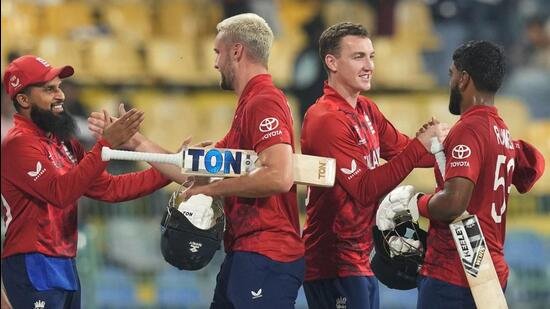
A key contributor to England’s wins has been their lower middle-order lynchpin Will Jacks, who has had an equally good tournament with bat and ball. His 191 runs and 7 wickets wouldn’t fully convey how vital his contributions have been. It is better understood by how the adjudicators found it fit to award Jacks as Man of the Match in four of England’s seven outings so far.
For a man who began the tournament only answering queries around his blonde hair-do, Jacks quietly became the calming hand to take his team over the ropes with the bat, while doubling up duties with his effective off-spin.
Choosing Jacks over a lower-order powerhitting all-rounder like a Liam Livingstone was a move Brook had conviction in.
“I think a lot of lower-order batters come out and they block it or they try and hit a wild swing, but he’s a proper batter,” Brook said about Jacks, after his 18-ball 32 got them over the line against New Zealand in an improbable run chase. “He’s got first-class hundreds, he’s played Test cricket, and as we’ve seen, he’s got immense power as well.”
Jacks’ selection had its roots in the last Ashes, where the top-order white-ball batter was trusted to adapt lower down the order, primarily because he could do a fair job as a spinner. One such move wasn’t going to bridge the gap in the Ashes. But in the ongoing World Cup, this conditions-applied selection has almost become a defining feature of England under Brook and McCullum, unshackled from the overt bravado of Bazball.
Returning to Mumbai for the semi-final, given England has as many spinners to choose from as India, conditions could challenge them to return to their original bat-big template. They have adapted well so far. If pushed to revert to an all-out attack approach, some of those withheld Bazball instincts might come in handy.


