






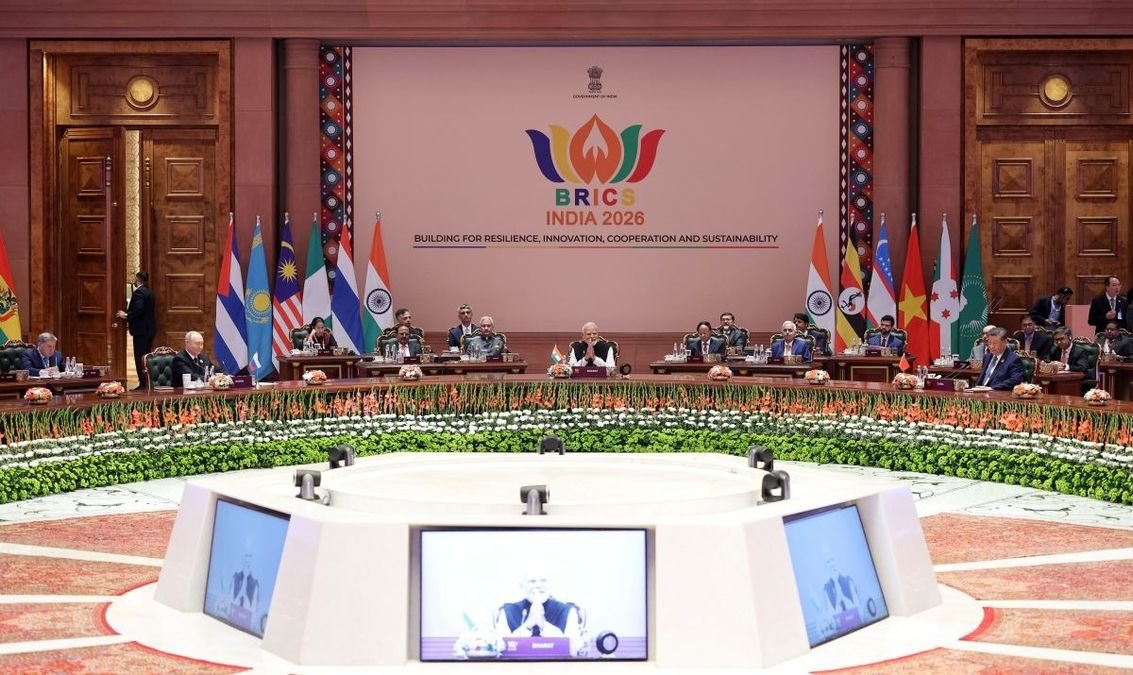
The rise of BRICS is one of the clearest manifestations of this changing reality. What began as an economic grouping of emerging economies has gradually acquired a much larger geopolitical significance, bringing together countries that collectively represent a substantial share of the world’s population and economic strength. Its expansion into West Asia, Africa and Southeast Asia has further enlarged its reach and given it a voice that the established centres of global power can no longer ignore. The question, therefore, is not simply whether BRICS has emerged as a challenge to Western dominance; the more important question is what kind of challenge it represents—and, within that evolving equation, whether the adoption of the New Delhi Declaration can be regarded as a diplomatic victory for India.
There is certainly a basis for viewing BRICS as one of the instruments through which the old distribution of global power is being questioned. For decades, the international political and economic system was shaped disproportionately by the United States and its Western allies. Institutions such as the International Monetary Fund and the World Bank, the dollar-centred financial system and several important mechanisms of international governance reflected the realities of a world that emerged after the Second World War.
But the economic and strategic landscape has changed dramatically since then. China has become a major economic and technological power, India has emerged as one of the world’s most consequential economies, the influence of the Gulf countries has expanded, and countries across Africa, Asia and Latin America are demanding a greater role in determining the rules by which the international system operates. BRICS is therefore not an isolated phenomenon; it is an institutional expression of this broader redistribution of economic and political weight.
Yet to describe BRICS merely as an anti-Western bloc would be an oversimplification. Its members do not share an identical foreign-policy outlook, nor do they have the same relationship with the United States and Europe. India, for instance, maintains deep strategic, economic and technological engagement with the West while simultaneously playing an active role in BRICS and maintaining important relations with Russia and other emerging powers.
The Gulf members have extensive commercial and security relationships with Western countries, while Brazil has traditionally followed an independent diplomatic path. China and Russia, on the other hand, have adopted much more assertive positions towards aspects of the existing Western-led order. What unites these countries, therefore, is not a common ideology against the West but a common interest in greater strategic autonomy, greater representation and a more balanced distribution of power in global governance.
This distinction is crucial to understanding India’s approach. New Delhi has little interest in replacing one rigid bloc with another. Its diplomatic preference has increasingly been for a multipolar world in which countries can cooperate across geopolitical divisions without surrendering their independent choices. From this perspective, BRICS becomes valuable not because it can defeat the West, but because it can create additional centres of economic and political influence.
The discussion over increasing the use of national currencies in trade, strengthening cross-border payment systems and developing alternative mechanisms of financial cooperation illustrates this gradual approach. It does not mean that the dollar is about to disappear from international finance; such a conclusion would be unrealistic. Rather, it indicates a desire among emerging economies to reduce excessive dependence on any single financial system and to acquire greater freedom in conducting their economic affairs.
The same aspiration is visible in the demand for reform of global institutions. The countries of the Global South have long argued that the institutions created in the middle of the twentieth century do not adequately reflect the economic and demographic realities of the twenty-first century. India, with its enormous population, growing economy and expanding international influence, has a particularly strong interest in this reform. Its demand for a greater role in global decision-making, including permanent membership of a reformed United Nations Security Council, is therefore not merely a matter of national prestige; it forms part of a much larger argument about the legitimacy and representativeness of the international system.
It is against this wider background that the New Delhi Declaration assumes importance. India’s BRICS presidency came at a particularly difficult moment, when geopolitical tensions were already dividing the international community. The expansion of BRICS has made consensus more complicated because the grouping now contains countries with competing strategic interests and sometimes sharply divergent positions on major international questions.
The situation in West Asia presented one of the most difficult challenges during negotiations, with Iran, Saudi Arabia and the United Arab Emirates bringing different regional calculations to the table. That a common declaration was eventually adopted after prolonged negotiations is therefore not an insignificant accomplishment. India’s success was not in eliminating disagreements among the members; it was in ensuring that those disagreements did not prevent them from finding sufficient common ground.
This is perhaps where the New Delhi Declaration can legitimately be described as a diplomatic victory for India. Diplomacy is rarely about persuading every participant to accept one country’s position in its entirety. Its more sophisticated form lies in reconciling competing interests without allowing the larger objective to collapse. India appears to have performed precisely that balancing act. It succeeded in keeping BRICS focused on multilateralism, development, economic cooperation, financial reform and greater representation of emerging economies rather than allowing the grouping to be defined exclusively by geopolitical confrontation with the West.
That achievement is particularly important because an explicitly anti-Western BRICS would ultimately limit India’s own diplomatic space. India’s interests do not lie in a world divided permanently into opposing camps. Its strength comes from its ability to maintain relationships with multiple centres of power while pursuing an independent national interest. New Delhi’s simultaneous engagement with Washington, Moscow, Beijing, European capitals and countries across the Global South is not necessarily a contradiction; it is an expression of strategic autonomy. The New Delhi Declaration, viewed in this context, reflects an attempt to strengthen the collective voice of emerging economies without transforming BRICS into another rigid alliance.
The economic provisions of the declaration reinforce this pragmatic character. Greater cooperation in cross-border payments, local-currency transactions and financial mechanisms could gradually reduce some of the vulnerabilities associated with excessive dependence on existing financial channels. But the more significant point is that BRICS is attempting to create choices rather than proclaiming an immediate revolution in the global financial system. Alternatives, once established and made credible, can themselves alter the balance of power. The challenge to the existing order therefore need not come through its sudden destruction; it can emerge through the gradual creation of parallel possibilities.
For India, another significant dimension of the declaration is the recognition of its larger aspirations in global governance. Support from major BRICS members for India’s greater role in international institutions strengthens New Delhi’s longstanding argument that global governance must reflect present realities rather than remain frozen in the political circumstances of the mid-twentieth century. Such diplomatic support may not by itself alter the structure of the United Nations, but it strengthens India’s position in the continuing debate over reform and representation.
India’s achievement, however, should not be exaggerated. The New Delhi Declaration is not proof that BRICS has become a cohesive geopolitical power capable of replacing the Western-led order. The grouping continues to face serious internal contradictions. India and China have unresolved strategic differences; Russia’s relationship with the West is fundamentally different from India’s; the Gulf countries have their own regional priorities; and the expanding membership brings an even wider range of political and economic interests into the organisation. BRICS has no common foreign policy, no collective defence arrangement and no single geopolitical doctrine. Its ability to translate declarations into sustained practical cooperation will ultimately determine whether its growing influence is durable.
This is why the significance of the New Delhi Declaration should be judged not merely by the language contained in the document but by what follows from it. Can BRICS make financial cooperation more effective? Can it increase trade and investment among developing economies? Can it strengthen South-South cooperation in technology, health, infrastructure and sustainable development? Can its members continue to find common ground despite their geopolitical differences? And can India maintain the delicate balance between strengthening BRICS and preserving its constructive engagement with the Western world? These are the questions that will determine whether the New Delhi Summit becomes a landmark in the evolution of global politics or remains another entry in the long catalogue of summit declarations.
Nevertheless, the broader diplomatic message from New Delhi is difficult to overlook. India demonstrated that its growing influence does not necessarily depend upon choosing one geopolitical camp against another. Its diplomatic strength increasingly lies in its ability to engage with competing centres of power, articulate the concerns of the Global South and still retain enough credibility to bring diverse countries towards a common position. In that sense, India’s success was less about imposing its will than about creating consensus where consensus appeared difficult.
The emergence of BRICS should therefore be understood neither as the beginning of the end of the West nor as an inevitable replacement of one hegemonic system by another. The West remains enormously powerful, and the United States continues to possess unmatched military, technological and financial capabilities. The dollar remains deeply embedded in international finance, while Western economies and institutions retain enormous global influence. But what is changing is the ability of any one centre of power to assume that its preferences will automatically constitute the global consensus. That is the deeper significance of BRICS—and perhaps the more enduring significance of India’s role within it.
The New Delhi Declaration represents a moment in which India demonstrated that diplomacy in the twenty-first century may increasingly be about building bridges between different power centres rather than choosing one side of the divide. It did not erase disagreements within BRICS; it managed them. It did not declare war on the existing global order; it demanded that the order become more representative. It did not seek to replace Western dominance with another dominance; it strengthened the case for a world with multiple centres of influence.
If that vision succeeds, the real transformation will not be the victory of East over West or South over North. It will be the gradual emergence of a world in which no single power or group of powers can claim to speak for the entire international community.
And in helping move that transition forward, the New Delhi Declaration can indeed be counted as a significant diplomatic moment for India.
(The author is RK columnist and can be reached at: [email protected])


