



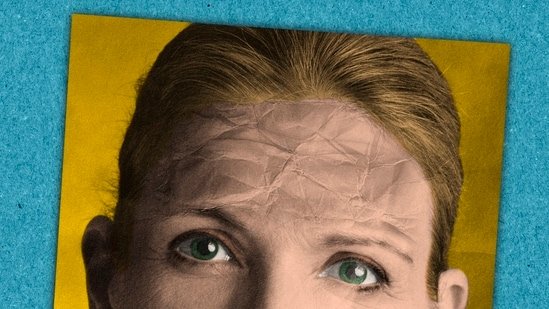
After years battling her forehead wrinkles with Botox injections, Stephanie Abend realized something surprising: She wanted some of them back.
She felt like the smooth, shiny skin she had worked so hard to achieve was giving the wrong message—that, at 45, she was trying to look younger than her age. “When you’re in your 40s, it’s like you’re pointing an arrow at your head,” Abend said, as if daring those around you to speculate about whether you get work done.
Today, Abend continues getting Botox injections, as well as fillers, elsewhere on her face. But she keeps some of her forehead wrinkles for an “elevated” look that doesn’t feel overdone, she says.
Abend, a family office executive in New York, is one of many who are reconsidering their fight against forehead lines. Since Botox was approved to temporarily reduce the appearance of wrinkles in 2002, cosmetic neurotoxins that relax muscles in the face have become so popular—and widely accessible—that a totally smooth countenance has lost some of its aspirational cachet.
Now, some clients 30 and older are seeking out dermatologists and aestheticians with nursing degrees who can help them maintain a slight patina of wrinkles—at least enough for furrowing and raising the brows.
Dr. Anthony Rossi, associate professor of dermatology at Weill Cornell Medicine in New York and founder of the skin-care brand Dr. Rossi, calls the trend “strategic wrinkling.” Of the clients that seek it out, Rossi said: “It gives them a little bit of character.”
In addition to helping clients achieve elegantly lined foreheads, Rossi said he works with an increasing number of people who want to keep some wrinkles around their eyes. Many of them still use Botox and fillers, which help smooth and restore volume in the face, but a lot less. In many cases, they add other treatments to their regimen. Those treatments may help with a more subtle look, but can still cost thousands each year.
Anetta Reszko, a New York dermatologist, said that those treatments include “skin boosting” injectables like Skinvive by Juvederm, which delivers hyaluronic acid under the skin for a smoothing effect. Another is radio-frequency microneedling, which combines tiny punctures with heat to reduce the appearance of lines.
Costs for both can vary, Reszko says, but at her practice, Skinvive costs around $800 to $1,200 per treatment and is recommended twice a year, while radio-frequency microneedling costs $1,000 to $2,500 per session. Reszko often recommends that her clients have an initial series of two to three radio-frequency microneedling sessions, followed by one annually after that.
Other popular treatments include fractional laser resurfacing, which is meant to stimulate collagen production, as well as surgical procedures that remove fat from other parts of the body to inject into the face.
According to the latest data from the trade group American Society of Plastic Surgeons, published in 2024, fractional laser resurfacing cost on average some $1,800 per session, while fat-removal-and-injection procedures cost between $3,000 and $5,500.
Neurotoxin injections, including Botox, Galderma’s Dysport, Merz Aesthetics’ Xeomin, Evolus’ Jeuveau and Revance’s Daxxify, are still the most popular minimally invasive procedure in cosmetics, according to the American Society of Plastic Surgeons. The number of procedures increased 4% to 9.88 million in 2024 from the year prior, according to the group.
Lacey Harris, 40, an orthodontist in Friendswood, Texas, still uses Botox throughout her face, including in her forehead and around the mouth, but said that she has started asking for fewer units recently. “I’d rather be able to look a little surprised and have natural movement,” she said.
Other clients have moved away from Botox because they felt neurotoxin injections created problems for them.
In general, the injections work by temporarily blocking nerve signals to facial muscles, particularly in the mid-forehead and around the brows. Too much product (or product placed incorrectly) can create drooping in unwanted places.
One common complaint from older clients is a “parenthesis” effect, said Reszko, which is when newly formed curved wrinkles appear above the brows after too much neurotoxin injection.
Doris Day, a New York-based dermatologist, tells her patients and social media followers to swap frequent forehead Botox appointments for facial exercises. She said that her “Ear Lift”—an exercise she practices in which she squeezes the jaw muscles around her ears—helps decrease brow-furrowing with lateral movements. “I try to teach people authentic good facial posture,” she said.
Rossi, the New York dermatologist, used to get Botox injections to avoid forehead wrinkles but has stopped. Letting the top half of his face move more allows him to look more trusted and convey years of medical expertise, he said.
Though he still makes use of cosmetic procedures, he prefers to leave the smile lines around his eyes intact, taking the advice he often gives to his patients. “I keep my wrinkles as well,” he said.


