



Srinagar, Sep 20: The school bell in Jammu and Kashmir may ring as late as 4:30 pm, but the school year itself is considerably shorter than in several other parts of the country. That contrast sits at the centre of a debate now reaching the J&K Legislative Assembly: if children are already under academic pressure, should they spend one less day a week in school?
National Conference (NC) MLA Hasnain Masoodi has proposed a five-day working week for schools, with Saturdays and Sundays as holidays, saying students are burdened by studies and need time for rest and recreation. Education Minister Sakina Itoo has said the proposal will be examined by the concerned education authorities.
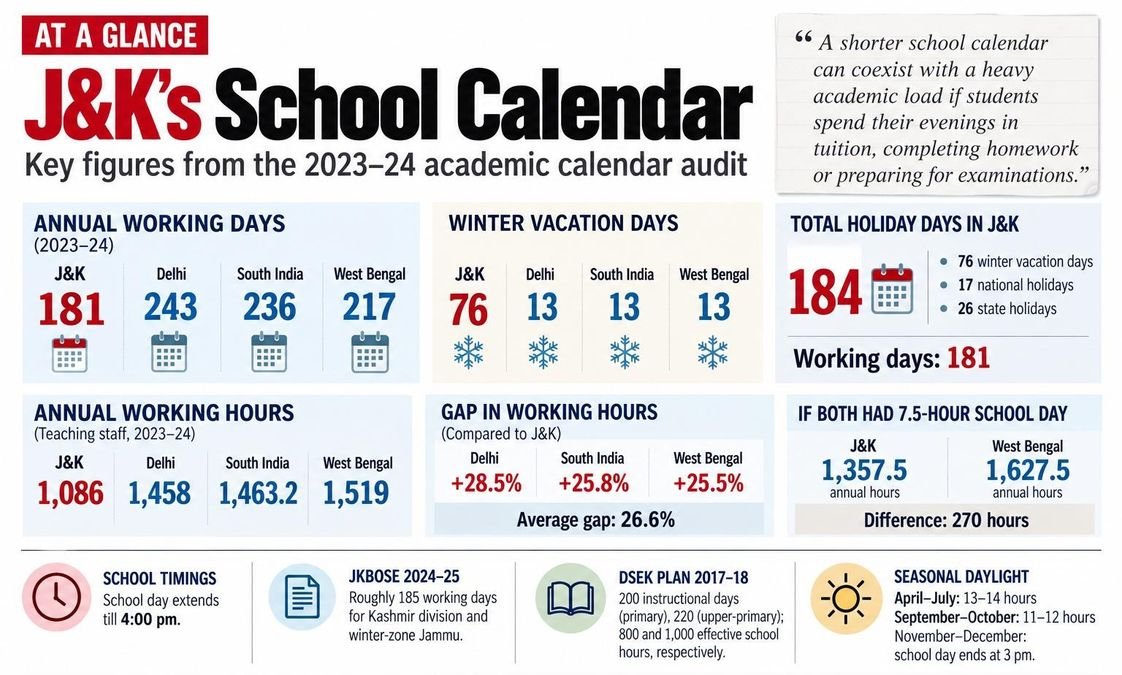
A report titled “Working Hours Parity Report: An Objective Audit of the Jammu & Kashmir Academic Calendar”, records 181 working days for J&K. Its comparison gives Delhi 243 working days, the South India category 236 and West Bengal 217.
In other words, the difference between J&K and the three comparison regions is not measured in a handful of days. It is 36 days against West Bengal, 55 against the South India comparison and 62 against Delhi.
The report points to one conspicuous reason: the winter break. It records a 76-day winter vacation in J&K, against 13 days in each of the three comparison regions. Overall, it records 184 holiday days in J&K, including 17 national holidays and 26 state holidays, leaving 181 working days.
And yet, on a day-to-day basis, J&K can appear to have a demanding school schedule. The report notes the extension of the school day to 4:30 pm and calls the resulting perception the “4:30 PM illusion”, the sense that a late closing bell necessarily means a longer academic year.
The report puts annual working hours for J&K at 1,086, against 1,458 in Delhi, 1,463.2 in the South India comparison and 1,519 in West Bengal. It calculates the gap between 25.5 per cent and 28.5 per cent, averaging 26.6 per cent across the three comparisons.
There is a qualification that matters: these are working-hour figures for teaching staff and the academic calendar, not a direct measure of the hours individual students spend learning. The report therefore cannot establish that a J&K student receives only 1,086 hours of classroom instruction in a year.
But it does establish something relevant to the present debate: J&K’s formal school calendar has fewer working days than the three regions against which the report compares it.
The report offers another way of looking at the issue. It applies a common 7.5-hour working day to J&K and West Bengal, removing the difference in daily schedules from the calculation. J&K would still have 1,357.5 annual hours against West Bengal’s 1,627.5, a 270-hour difference, because the number of working days is different.
The comparison becomes even more striking against private-school benchmarks cited in the report. It puts annual hours at 1,498 for private schools in Delhi, 1,536 in West Bengal and 1,711 in its South India comparison, against 1,086 for J&K, with reported gaps ranging from 27.5 per cent to 36.5 per cent.
None of these figures, however, answers Masoodi’s central contention that children are “burnt out” by academic pressure. That is a different proposition, and it requires different evidence.
Nor does the report establish that J&K should have more working days. Its purpose is comparative: to show how the distribution of the academic year differs across the regions examined. Its own figures show that the 76-day winter closure is doing much of the work in producing the annual gap.
The calendar data also needs to be read against J&K’s existing academic schedule. The JKBOSE 2024-25 academic calendar separately provided roughly 185 working days for the Kashmir division and winter-zone Jammu. That figure comes from a different academic year and calendar dataset from the 181 working days cited in the institutional audit.
J&K’s academic calendar has also changed over time. An earlier DSEK academic planner for 2017-18 prescribed 200 instructional days and 800 effective school hours for primary classes, while upper-primary classes were prescribed 220 instructional days and 1,000 effective school hours.
The report also examines the effect of the daily timetable across seasons. It puts peak daylight at roughly 13-14 hours between April and July, when the school day may run to 4:30 pm. For September and October, it puts daylight at about 11-12 hours, while during November and December the school day ends at 3 pm. The report describes these as approximate seasonal daylight figures.
Itoo has said the proposal will be taken up with the Directorate of School Education Kashmir, Directorate of School Education Jammu and the Director of Colleges for examination.
