



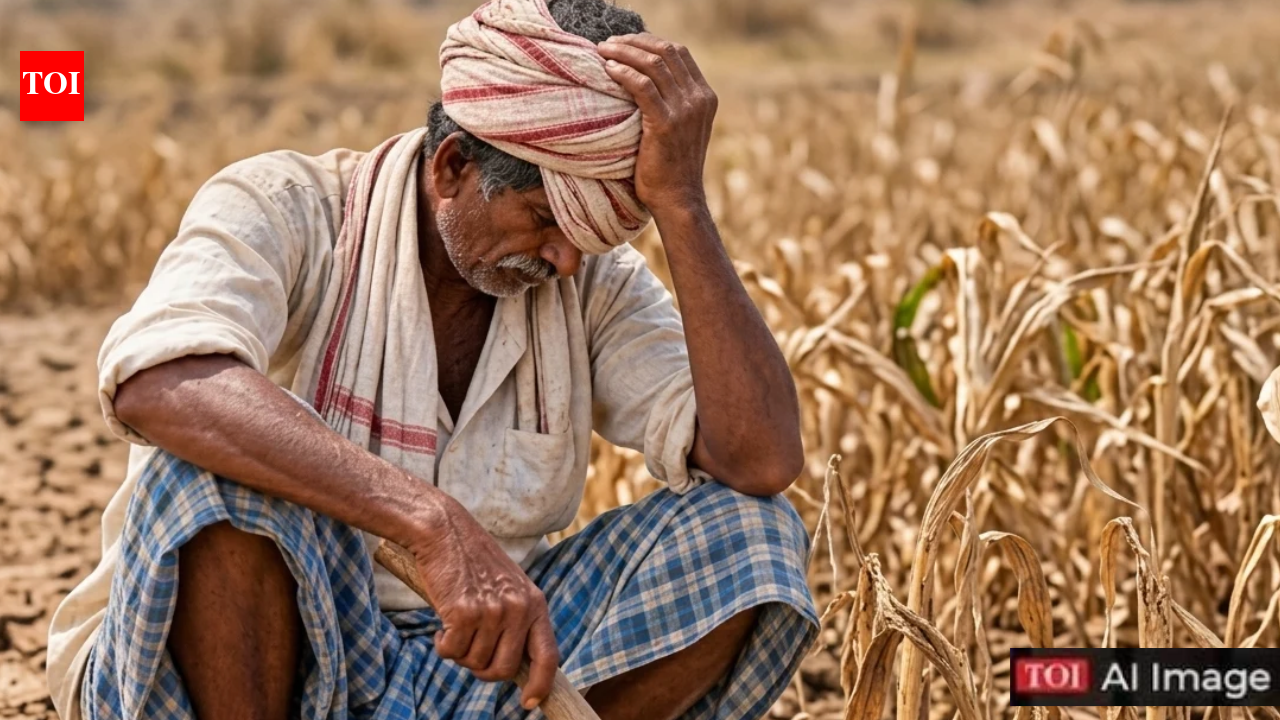
This year, for the 17th time in the past quarter century, Karnataka has declared drought, prompting experts and bureaucrats to again flag the state’s persistent vulnerability to water stress and the need for long-term measures instead of relying primarily on short-term relief.Yet, much like a stuck record, the govt continues with the same policies. While successive govts have sought central assistance, loan moratoriums and grants in drought years, experts say the recurring nature of the crisis points to deeper structural problems, including changing rainfall patterns, urbanisation, loss of vegetation, conventional irrigation practices and inadequate water management.
Karnataka’s water challenge
GS Srinivas Reddy, former director, Karnataka State Disaster Management Centre, who has tracked droughts in Karnataka since 1990, said the state’s biggest challenge is its reluctance to adapt to changing climate and inconsistent rainfall.“Prior to 2000, drought was accepted as part of the weather cycle and people adapted to it,” he said. “Instead of paddy, farmers looked to plant millets. However, with an increase in social security and welfare schemes and subsidies, people have refused to conserve water and appear set in their ways.”Reddy, who co-authored the 2017-18 paper ‘Drought vulnerability assessment in Karnataka: Through composite climatic index’, identified 176 of the state’s 239 taluks as drought-prone. He said many of these taluks have repeatedly appeared in the drought-hit list over the past 17 years.
Same parched taluks
Professor MN Thimmegowda of University of Agricultural Sciences said at least 80% of drought-prone taluks remain the same during successive drought cycles.“Sixteen of the 24 most drought-prone districts in the country listed in a study by National Rainfed Area Authority are in Karnataka,” said Thimmegowda, which he said is suggestive of a crisis.Both Thimmegowda and Reddy attributed the state’s recurring drought vulnerability in part to its topography and physiography.“Karnataka has a spatial distribution of anywhere between 6,000mm to 450mm of annual rainfall,” said the two experts. “Coastal areas get about 3,000mm while Western Ghats areas act as a natural barrier for rain-bearing clouds to reach the plains. As a result, these areas get about 600mm of rain in a good year.”Thimmegowda said the impact of climate change has become increasingly evident in recent years, with declining vegetation and rising pollution affecting rainfall patterns.“On paper, our forest cover is 22%, but vegetation is only 16%. This has affected atmospheric pressure which has further hit rainfall,” he said.He also said Karnataka’s position as an upper riparian state posed another challenge, as water tends to flow downstream rather than being retained in the soil.Beyond natural factors, experts say inadequate water management has compounded the state’s drought vulnerability, especially the high dependence of agriculture and horticulture on rainfall.“Karnataka is estimated to have about 450tmc of ground water and as much as 1,300tmc of surface water,” said Reddy. “But the 450tmc helps irrigate 54% of cultivable land while surface water helps irrigate the rest. There is huge misuse of surface water.”Govt officials say besides placing huge pressure on groundwater, drought years also affect state finances as electricity consumption for irrigation increases.“For the current year, the finance department estimates the power subsidy bill to climb to a staggering Rs 28,000 crore as opposed to the budgeted Rs 21,000 crore. In 2023-24, another drought year, allocation increased by Rs 6,000 to Rs 7,000 crore,” said an official.Reddy also pointed to what he described as “artificial drought”, arguing that social security schemes could also be contributing to an increasing number of agricultural fields being left fallow, especially in north interior Karnataka.“Small and marginal farmers hold 80% of agricultural land in the state with most of these farmers holding less than half-an-acre. Cultivating them often makes very little economic sense,” Reddy said. “As a result, many from farming families in north Karnataka district are migrating in search of jobs. The very young and old subsist on social security schemes.”Thimmegowda cited a recent study which, he said, found that 94% of farmers would prefer to leave farming if an alternative employment opportunity was available.
Micro-irrigation needs push
Experts say the state needs a long-term strategy to address recurring droughts, while the govt faces the twin challenge of maintaining food production and ensuring economic security for farmers.LK Atheeq, financial adviser to chief minister DK Shivakumar, said greater emphasis could be placed on micro-irrigation to improve water-use efficiency and potentially expand the area covered by irrigation without increasing water availability.Maharashtra, he said, collects significantly higher water-use charges from farmers vis-a-vis Karnataka and uses the fund to maintain irrigation canals and pipelines.He also said the govt is working towards rejuvenating and reviving lakes and tanks across the state to improve surface-water availability and support groundwater recharge.
