



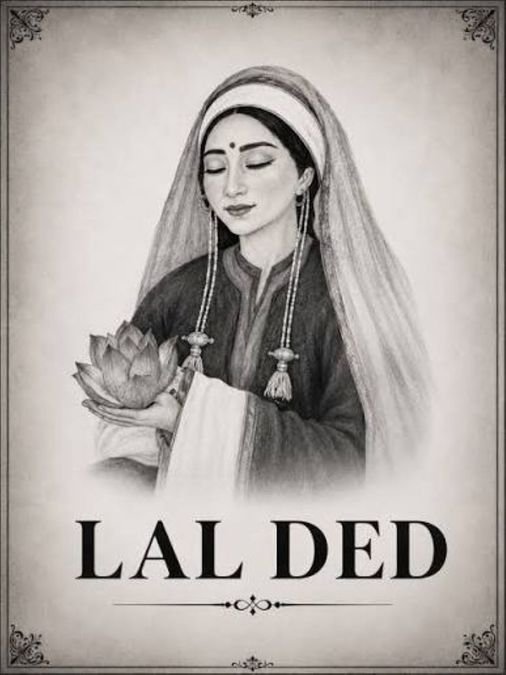
There are civilizational figures whose lives belong to history, and there are those whose words continue to live in the consciousness of a people. Lal Ded—Lalleshwari, Lalla Yogeshwari—is one of Kashmir’s most enduring spiritual voices. A fourteenth-century Kashmiri mystic and yogini, she occupies a unique place in the intellectual and spiritual history of the Valley.
Her legacy cannot be reduced to that of a saint-poet. Lal Ded represents a profound tradition of inner inquiry, spiritual freedom and philosophical questioning that has long been associated with Kashmir’s intellectual culture.
Her vakhs, transmitted for generations largely through oral tradition, transformed the Kashmiri language into a vehicle for expressing difficult philosophical ideas in an accessible form. Rather than writing exclusively for scholars, Lal Ded spoke in the idiom of ordinary people. Her poetry asks the individual to turn inward, overcome the ego and seek the truth beyond external appearances.
That is perhaps why her voice has survived for centuries.
A yogini of Kashmir
Historical details about Lal Ded’s life are intertwined with legend and hagiography, and scholars caution against treating every traditional account as established historical fact. What is much more certain is the extraordinary cultural authority her name and poetry acquired in Kashmir.
She emerged in a period when Kashmir possessed a rich intellectual inheritance, particularly in the traditions of Shaiva philosophy, Sanskrit learning, tantra, yoga and mystical inquiry.
The intellectual universe associated with Kashmir Shaivism had been shaped by towering thinkers such as Abhinavagupta and earlier masters of the Trika tradition. At its heart was an insistence that ultimate reality could not be understood merely through external ritual or intellectual speculation; it had to be realised through consciousness and direct spiritual experience.
Lal Ded’s vakhs belong to this wider landscape of experiential spirituality.
She did not present philosophy as an abstract academic exercise. She made it personal. The human being, in her poetry, becomes the site of the spiritual quest.
The journey is inward.
From ritual to realisation
One of the most striking dimensions of Lal Ded’s thought is her questioning of superficial religiosity.
Her poetry repeatedly turns attention away from external forms towards inner transformation. Ritual, pilgrimage and outward religious observance have little value if the mind remains captive to ignorance, ego and attachment.
This was not a rejection of spirituality. It was a demand for authentic spirituality.
Her message therefore remains relevant beyond the religious context of medieval Kashmir. In every age, institutions and rituals can become substitutes for genuine reflection. Lal Ded’s insistence on self-knowledge challenges that tendency.
She asks the seeker to confront the self rather than merely perform the symbols of belief.
The making of Kashmiri as a language of philosophy
Lal Ded’s contribution to Kashmiri literature is equally significant.
Her vakhs helped demonstrate that profound philosophical reflection did not have to remain confined to Sanskrit or elite intellectual circles. The language of the Valley itself could carry metaphysical thought, spiritual experience and ethical reflection.
This gave her poetry an unusual social reach.
For generations, Kashmiris memorised and recited her verses. Her words became part of the oral culture of the Valley. She therefore occupies a place not only in the history of Kashmiri mysticism but also in the development of Kashmiri literary consciousness.
Her achievement was to bring philosophy closer to the people.
Lal Ded and the Shaiva inheritance of Kashmir
For Kashmiri Pandits, Lal Ded represents an especially important link with the Valley’s ancient intellectual and spiritual heritage.
Kashmir was one of India’s great centres of Shaiva philosophical thought. The works of Abhinavagupta, Utpaladeva, Somananda and other masters established a sophisticated philosophical tradition that engaged questions of consciousness, perception, aesthetics, language and liberation.
Lal Ded’s poetry should be understood against this larger civilizational background.
At the same time, it would be historically reductive to turn her into the exclusive possession of any contemporary community. Her influence crossed social and religious boundaries. Her words entered the collective cultural memory of Kashmir.
That universality is part of her greatness.
Lal Ded and Nund Rishi
The subsequent emergence of Sheikh Noor-ud-din Noorani, popularly known as Nund Rishi, created another important strand in Kashmir’s spiritual history.
Lal Ded and Nund Rishi are frequently remembered together in the Valley’s cultural consciousness. Their respective traditions were distinct, but both came to represent a spirituality that emphasised ethical living, humility, compassion and the inner life.
This historical relationship is important when discussing what is often called Kashmiriyat.
Kashmiriyat should not become merely a political slogan. At its most meaningful level, it describes a civilizational experience in which different intellectual and spiritual traditions encountered one another and contributed to a shared cultural vocabulary.
Lal Ded’s legacy is one of the strongest expressions of that encounter.
A woman’s assertion of spiritual freedom
There is another dimension of Lal Ded’s life that deserves greater attention: her assertion of individual spiritual agency as a woman in medieval society.
The traditional narratives surrounding her life describe a woman who rejected the constraints of conventional existence and chose the path of a wandering yogini. While the precise historical details of these accounts remain difficult to verify, their persistence in Kashmiri memory itself is revealing.
Lal Ded became the archetype of a woman who claimed the right to seek truth independently.
She did not require political authority or institutional office to exercise intellectual influence.
Her authority came from experience and the power of her words.
In that sense, Lal Ded’s legacy can also be read as a story of spiritual emancipation.
Beyond sectarian boundaries
One of the reasons Lal Ded remains relevant to contemporary India is that her spirituality resists narrow categorisation.
She emerged from Kashmir’s Shaiva intellectual environment, but her poetry developed a resonance far beyond sectarian boundaries. Her search was for the truth underlying human existence.
That makes her particularly important in an era when identities can sometimes become more important than ideas.
Lal Ded reverses that priority.
She asks us to look beneath identity towards consciousness; beneath ritual towards realisation; beneath ego towards the self.
Her message is not one of uniformity. It is one of inner freedom.
Kashmir’s civilizational memory
Modern discussions about Kashmir understandably focus on politics, security, displacement and competing national narratives. But a civilisation cannot be understood exclusively through contemporary conflict.
Kashmir is also the land of philosophers, poets, grammarians, aestheticians, mystics and spiritual seekers.
It produced a remarkable intellectual tradition in which philosophy was not separated entirely from lived experience.
Lal Ded stands within that continuum.
Her presence in Kashmiri memory also reminds us that the Valley’s history cannot be reduced to a single period or political narrative. Its civilizational inheritance is layered, ancient and plural.
The memory of Lal Ded is therefore not merely a matter of nostalgia. It is part of the intellectual heritage through which Kashmir can understand itself.
Why Lal Ded matters today
Perhaps Lal Ded’s most important lesson for the modern world is the courage to question.
She teaches that inherited forms must be examined, that knowledge must become experience, and that spiritual life begins with an honest confrontation with oneself.
Her poetry does not offer an easy escape from the world. It demands transformation within it.
Seven centuries later, that demand remains compelling.
Lal Ded belongs to Kashmir, but her philosophical reach is much wider. She belongs to the history of Indian spirituality, to the literature of Kashmir, to the intellectual tradition of Shaivism and, ultimately, to humanity’s continuing search for meaning.
For Kashmiri Pandits, she remains a luminous reminder of the Valley’s ancient intellectual inheritance.
For Kashmir as a whole, she is a shared cultural memory.
For India, she represents the civilizational depth of a tradition that has repeatedly encouraged individuals to question, seek and realise.
And for the world, Lal Ded remains what Kashmir has remembered her to be for centuries—a yogini whose journey inward became a language for an entire civilisation.
Her physical world disappeared long ago.
Her voice did not.
And perhaps that is the ultimate measure of a civilisation’s great thinkers: they cease to belong to their century and become part of humanity’s permanent conversation with itself.
(The Author is a noted Senior Advocate and an accomplished public intellectual)
