


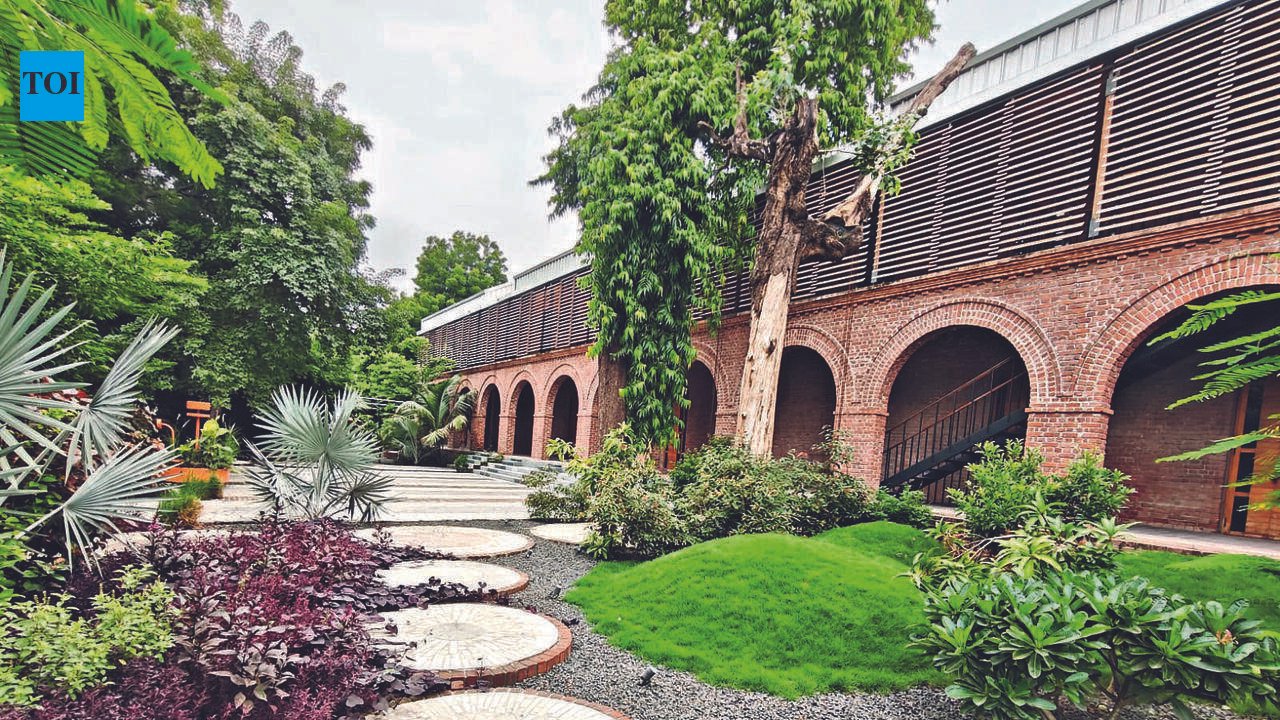
On a winter afternoon in 2020, Spanish architect Manuel M de Las Heras was passing through Ahmedabad’s Raikhad neighbourhood when a century-old govt girls’ high school caught his eye. The elegant vintage facade drew him closer, and what he found was a building in a state of deep neglect.“My partner and I spoke to the erstwhile director and learned that it was a school building that had been unused for nearly two decades since the 2001 earthquake. Cracks had appeared, and the roof had deteriorated. The school moved to a newer building in the same compound. The old structure was locked and left to age,” says Manuel.Today, the restored heritage building is preparing to open a new chapter as an Education and Innovation Centre for girls, thanks to a Spanish architect’s curiosity that led him to take up the restoration and reuse project on his own initiative. For Manuel, restoring the building was only the beginning; the larger question was what it could offer the girls it was built to serve.“I began to wonder if it could be brought back — not as a museum, cafe or commercial property, but as a school or learning centre for girls,” he says.
The school building before restoration
That choice stemmed from his own journey with Ahmedabad’s heritage. “I first came to the city in 2014 as an exchange student at CEPT University, after studying architecture in Madrid. A scholarship later led me to stay and work with the city’s heritage ecosystem. There was never a grand plan to build a career in Ahmedabad’s heritage sector. I simply went with the flow,” he says. The school became the next step. After approaching the state education department, Manuel found support for his proposal under a public-private partnership model backed by CSR funding.Construction began in 2022. Three years later, the building was restored. Workers scraped off the plaster and exposed the brick structure. But Manuel sees restoration as only one part of conservation. “Old buildings cannot survive simply as objects to admire. They need to remain part of everyday life. They should be usable again,” he says. “Bring in new generations, bring new activities so people can keep using them. Otherwise, the buildings will decay.”
Manuel M de Las Heras, who restored the school building
The restored school reflects that philosophy. The centre will primarily cater to girls, particularly those from non-science streams who are seeking employment after Classes XI and XII. Its programmes will range from short-term courses to year-long programmes, covering around 10 skills, including project management, computer training, Hindi, Gujarati and English-language skills, corporate behaviour, presentation skills and supply-chain management.“If someone commissioned me to repair the city, I would accept the challenge,” he says.“The city hosted me very warmly. This is my way of contributing something in return.” Ahmedabad has many heritage structures that need attention. Manuel believes the work has to be incremental — smaller interventions, sensible costs, and careful restoration.The restored school is his way of testing that idea. Its success, however, will not be measured only by its restored facade or repaired roof. It will be measured by what happens inside.“A girl learning a new skill. Another finding a career path. Someone gaining the confidence to make a presentation. Another discovering an opportunity she had not considered. If that happens, the building will have done more than survive. It will have remained useful,” says Manuel.
