


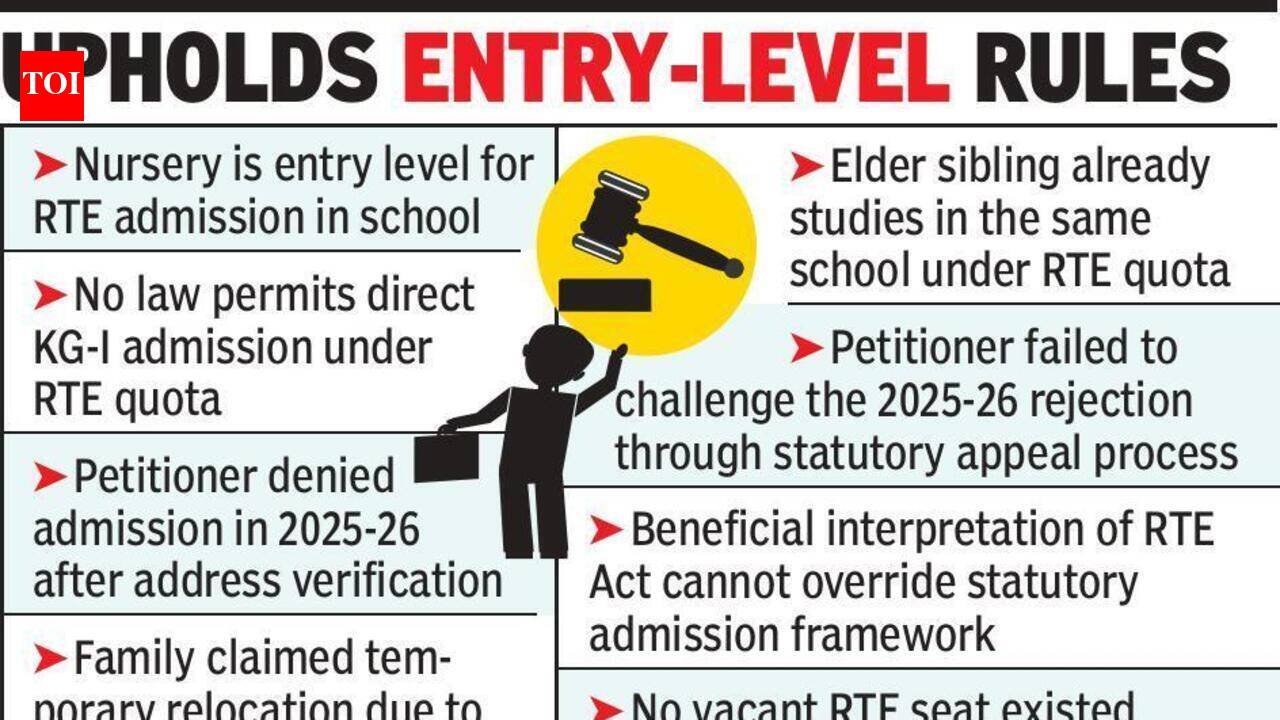
Nagpur: The Nagpur bench of Bombay High Court last week refused to order the admission of a four-year-old boy to KG-I under Right of Children to Free and Compulsory Education (RTE) Act, holding that the statutory scheme does not permit direct admission to KG-I, where nursery is the entry level and the child’s family failed to challenge the earlier denial of admission through the prescribed legal mechanism.A division bench of Justices Urmila Joshi Phalke and Nivedita Mehta dismissed the petition by a 4-year-old student from Civil Lines here, through his father, who sought admission to KG-I at Bharatiya Vidya Bhavan’s School for the 2026-27 academic year.The petitioner was provisionally allotted the school under the RTE quota last year but was excluded from the final admission list after physical verification allegedly found that the family was not residing at the address mentioned in the online application. The child’s father claimed the house was under renovation and produced Aadhaar and electricity bills to establish permanent residence. He also pointed out that the petitioner’s elder sister was already studying in the same school under the RTE quota.The school, represented by senior counsel MG Bhangde, assisted by Ninad Lande, argued that admissions under RTE Act are conducted exclusively through a centralised online process administered by the state school education department and they have no independent authority to grant admissions outside that process. It further submitted that nursery is the entry point for the 25% RTE reservation and students admitted in nursery during 2025-26 automatically progressed to KG-I, leaving no vacant RTE seat.The bench observed the petitioner had not produced any statutory provision, govt policy or rule permitting direct admission to KG-I under the RTE quota where nursery is the notified entry level.“In the absence of any such statutory provision, this court cannot issue a writ directing creation of a seat or directing admission contrary to the admission procedure prescribed under the Act and Rules,” the bench said.The court also noted that although the RTE Act is a beneficial legislation intended to secure children’s right to education under Article 21-A of the Constitution, “a beneficial interpretation cannot be stretched to create a right which the statute itself does not recognise or to bypass the procedure prescribed under the Act”.The judges further held the petitioner’s grievance essentially related to the denial of admission for the 2025-26 academic year. Since the family neither filed the statutory appeal available under RTE Act nor immediately challenged that decision before the court, the earlier decision attained finality.While acknowledging that “education of a child is of paramount importance,” the bench held that equitable considerations cannot override the statutory framework governing admissions.
