


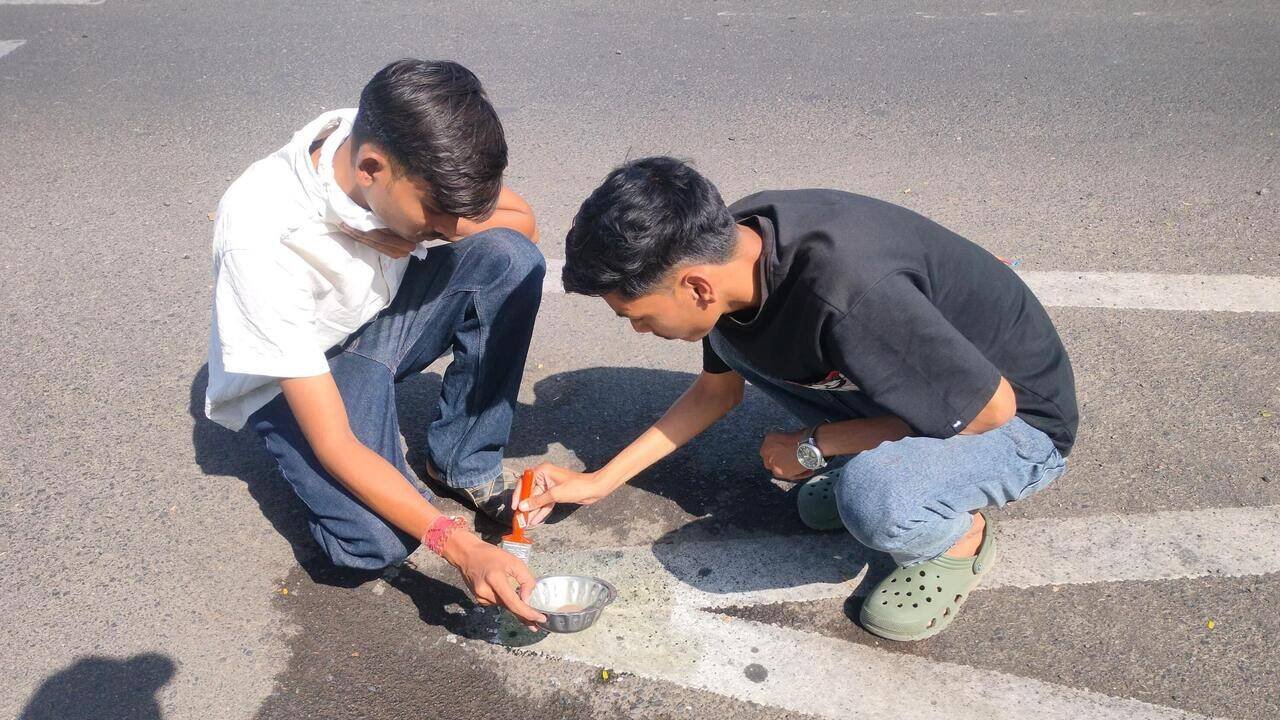
Nagpur: Offering a sustainable solution to India’s perennial pothole problem, two engineering students from Shegaon in Buldhana district have developed an innovative Bio-Self-Healing Night Visibility Road Technology capable of repairing minor road cracks while simultaneously improving night-time visibility through glow-in-the-dark features.Rajvardhan Thakur and Atharv Deshmukh developed this as part of a college project, drawing inspiration from a similar concept pioneered in the Netherlands. The innovation combines two distinct elements—bio-healing and luminescent road markings. According to the students, a specially formulated coating containing bio-bacteria is applied to road surfaces, cement structures or plastered areas. The bacteria present in it becomes active and help naturally repair the damaged sections before they can develop into larger cracks or potholes.Explaining the concept, student innovator Thakur said the technology mimics the way the human body heals wounds. “Just as a wound gradually heals after an injury, our solution repairs cracks in an organic manner. The technology can be used on roads, cement surfaces and even plastered structures,” he said.The second component of the project focuses on road safety. The specially treated surface or paint possesses bioluminescent properties that enable it to glow in the dark without requiring electricity. White road markings such as lane dividers remain visible throughout the night, helping motorists navigate safely even in poorly lit areas.“The glow-in-the-dark technology ensures that road markings remain clearly visible. This is especially beneficial in villages and rural areas where electricity supply is unreliable or absent. The paint continues to glow without any external power source, reducing the dependence on street lighting,” Thakur explained.The students have already tested the technology at the premises of Shegaon Railway Station and within the Shri Sant Gajanan Maharaj Temple complex. According to them, the trial yielded encouraging results. At the temple premises, treated pathways remained clearly visible at night while surrounding untreated areas remained dark.The idea first emerged through practical exposure to civic works. Thakur said his father, who works with the Shegaon Municipal Council, encouraged experimentation with the technology during a particular phase of municipal operations. The promising results prompted the students to present the concept at their college, where faculty members appreciated the innovation and encouraged further development.Remarkably, the project was developed on a modest budget of around Rs 7,000 to Rs 7,500, with the expenses borne personally by the student from his own pocket money. He added that they have applied for patent as well.With India spending thousands of crores annually on road repairs and maintenance, this duo believe their innovation could provide a cost-effective and environmentally sustainable alternative. If successfully scaled up, the technology has the potential to reduce pothole formation, improve road safety and offer enhanced visibility in regions with limited lighting infrastructure.
