






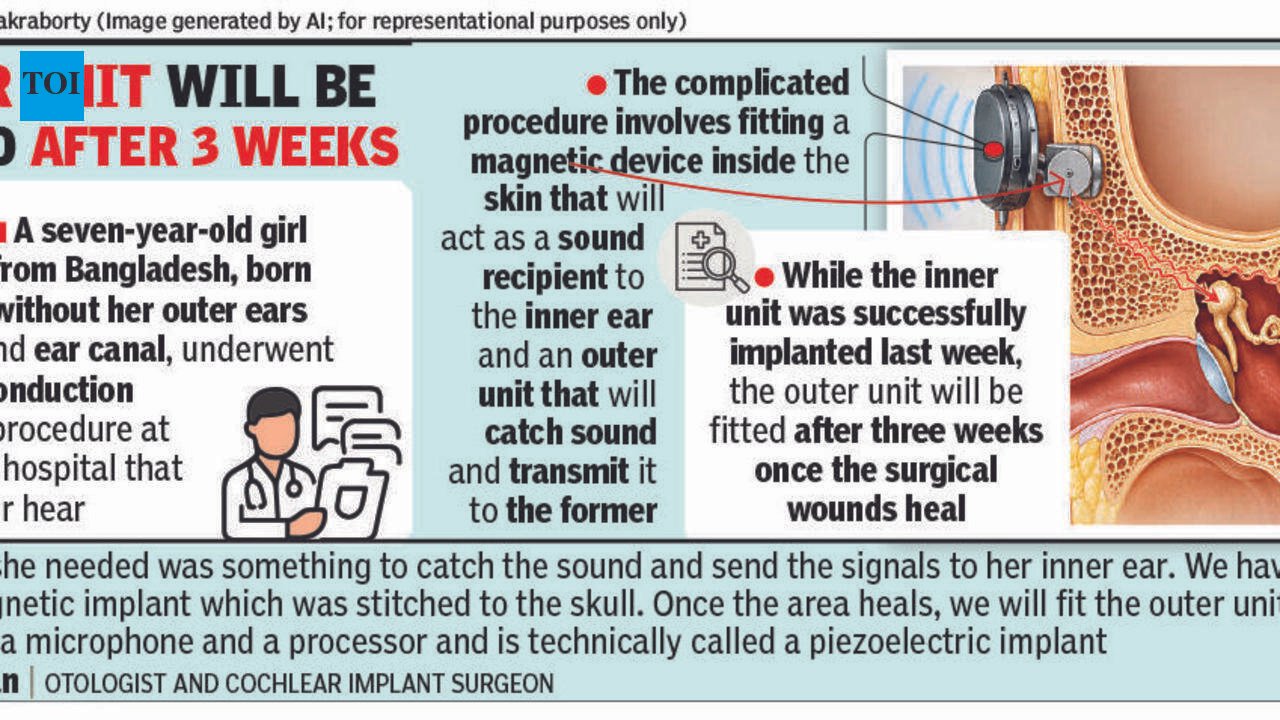
Kolkata: A seven-year-old girl from Bangladesh, born without her outer ears and ear canal, underwent a ‘bone conduction implant’ procedure at a city pvt hospital that will let her hear. The complicated procedure involves fitting a magnetic device inside the skin that will act as a sound recipient to the inner ear and an outer unit that will catch sound and transmit it to the former. While the inner unit wassuccessfully implanted last week, the outer unit will be fitted after three weeks once the surgical wounds heal.The procedure, conducted at CMRI CK Birla Hospital, is distinct from a cochlear implant, explained NVK Mohan, otologist and cochlear implant surgeon who led the procedure along with a surgical team. “While the girl’s inner ear is functioning normally, the bony canal is missing, which has been preventing sound transmission. She has no eardrumeither, so she has so far been completely deaf. We decided to conduct a bone conduction implant since all she needed was something to catch the sound and send the signals to her inner ear. We have used a magnetic implant which was stitched to the skull. Once the area heals, we will fit the outer unit, which comprises a microphone and a processor and is technically called a piezoelectric implant,” said Mohan.The external unit or the sound processor can be worn on or behind the ear, and its microphones pick up surrounding noises. In passive systems, it converts these noises into vibrations. In active systems, it sends digital signals to the implant.The internal implant is a small titanium fixture in the skull bone behind the ear. This titanium integrates naturally with the bone. The external processor connects to it either via a snap-on post (percutaneous) or a magnetic connection through the skin (transcutaneous).The implant transfers the vibrations directly through the skull to the inner ear (cochlea), entirely skipping the eardrum and ear canal.A cochlear implant is an electronic medical device that bypasses damaged parts of the ear to directly stimulate the auditory nerve, providing a sense of sound to individuals with severe to profound hearing loss.“We assessed the malformation of her ear and the results were poor. Had we reconstructed her ear canal, she would have required multiple surgeries which may not have provided a satisfactory result, so we decided against it,” said Mohan.Once the external unit is implanted, the outer ears or pinna can be constructed, said Mohan. “She can wear prosthetic ears, too. It was not decided yet. The priority now is to make the child hear. Since the inner ear is functioning fine, once the outer implant is fitted, she should hear fine even without the outer ears or pinna.”The outer unit or the processor is like a magnetic coin which sticks and will be placed slightly removed from the area where the outer ears would be. It is detachable like a hearing aid. She can take it off while bathing or sleeping. The patient has been discharged. She will be readmitted three weeks later to fit the outer processor.


