









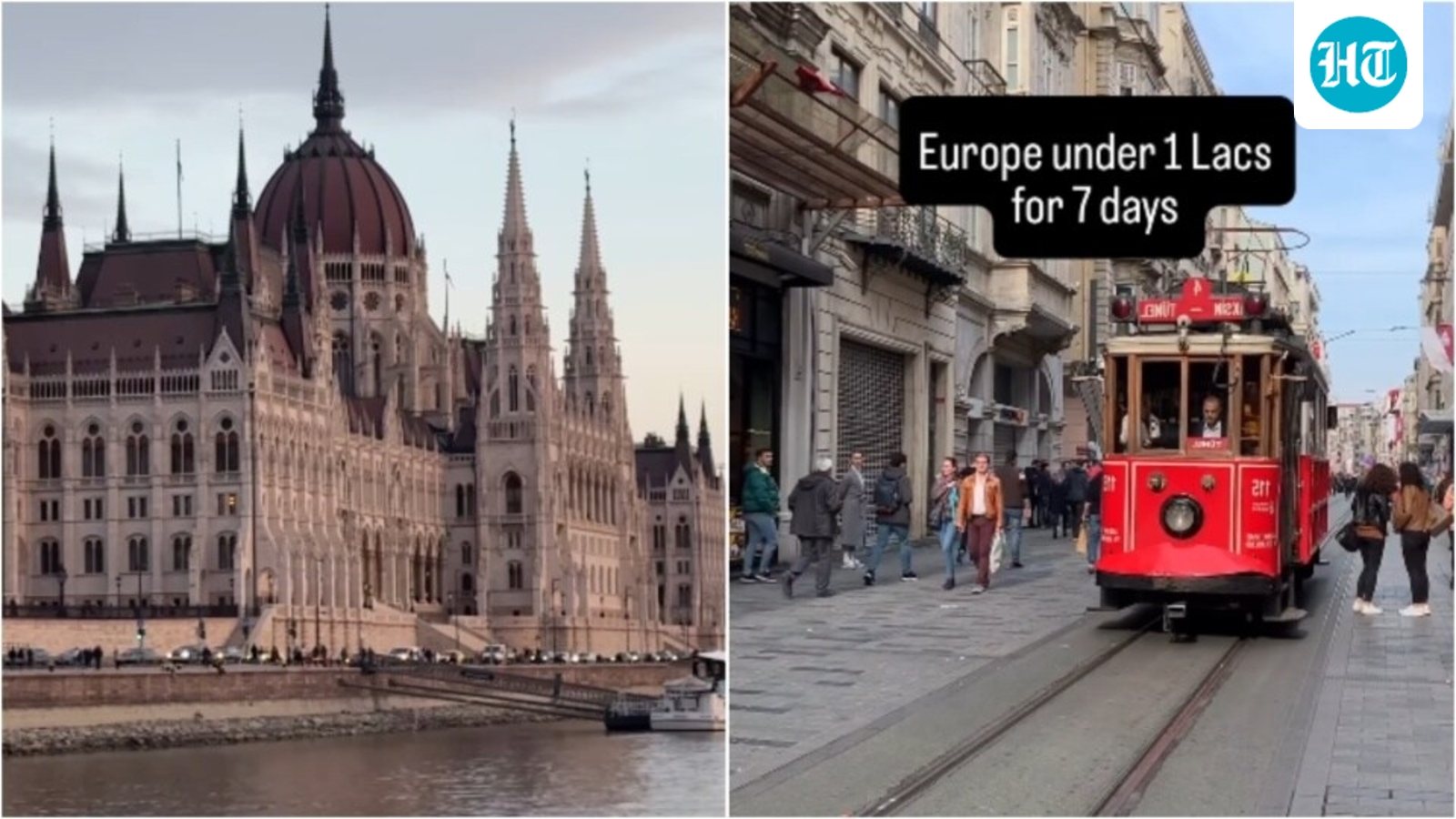
Think a week-long holiday in Europe requires emptying your life savings? Think again. If your Instagram feed is full of people posing by historic cathedrals while you’re calculating the cost of beachside beer in Goa, Rahul and Shivani have news for you. Also read | Move over Paris and Switzerland: 4 top European destinations that offer more than just sightseeing
The content creators — who happen to be ‘corporate managers and have explored 31 countries’ — recently revealed a budget-friendly plan that proves Europe can cost less than a lavish domestic getaway. Their September 19 post outlines a seven-day tour of three iconic capital cities: Budapest (Hungary), Vienna (Austria), and Prague (Czech Republic).
With architectural wonders, historical landmarks, and vibrant street markets, Central Europe delivers a classic European holiday at a fraction of Western Europe’s sky-high prices. Here is the exact cost breakdown and actionable advice from Rahul and Shivani to turn your Euro-trip dream into reality without breaking the bank. Also read | Dreaming of a European vacation? These 5 festivals and experiences deserve a spot on your travel bucket list
The ₹1 lakh per person budget breakdown
According to Rahul and Shivani, the entire trip can be completed for ‘ ₹84,000 to ₹1,00,000 per person’, assuming smart planning and booking in advance:
⦿ Roundtrip flights: ₹38,000 – ₹48,000 (book 3–4 months ahead)
⦿ Schengen Visa + travel insurance: ₹8,500 – ₹10,000
⦿ Hostels or budget stays (6 nights): ₹14,000 – ₹18,000
⦿ Intercity transport (FlixBus or RegioJet): ₹3,500
⦿ City Metro or tram passes: ₹1,500
⦿ Meals and street food: ₹8,000 – ₹12,000
⦿ Sightseeing and museums: ₹5,000 – ₹8,000
⦿ Local eSIM: ₹800
⦿ Shopping or miscellaneous expenses: ₹5,000
5 golden rules to master budget travel in Europe
To stay firmly under the ₹1 lakh threshold, Shivani and Rahul shared five crucial strategies that every Indian traveller should follow:
1. Ditch short-haul flights: Skip costly intra-Europe flights that carry hidden baggage fees. Instead, ‘use Flixbus between cities, starts from €10 (around ₹1,100)’.
2. Eat like a local, not a tourist: Avoid sitting down at overpriced restaurants on main tourist squares. Instead, head to bistros and street vendors to sample local food, which is ‘cheaper and often better’.
3. Stay 2–3 Metro or tram stops outside main town: Accommodation in city centres comes with a steep price. By booking hostels or budget stays just a few tram stops from main areas, you can slash room costs.
4. Aim for the off-season: Timing is everything. Plan your visit during the shoulder months — ‘April to May or September to October’. You’ll enjoy pleasant spring or autumn weather, significantly cheaper airfares from India, lower accommodation rates, and lesser tourist crowds.
5. Get a regional eSIM: Skip expensive daily international roaming packs from Indian mobile carriers. Buy a ‘Europe-wide eSIM’ — you’ll get reliable data coverage across all three countries.
A city-by-city cost breakdown
According to Shivani and Rahul, Budapest, is where you save, Vienna is where you spend, and Prague is where you get the best of both:
⦿ Budapest (2 nights) estimate: ₹18,000 – ₹22,000
The trip’s value anchor. Imperial architecture and thermal baths at a fraction of Western Europe’s prices.
⦿ Vienna (2 nights) estimate: ₹22,000 – ₹26,000
The splurge. A higher daily budget for cafe culture, museums, and classical concerts.
⦿ Prague (3 nights) estimate: ₹25,000 – ₹30,000
The balance. Moderate costs for some of the region’s most impressive historic sites.
Note to readers: This report is based on user-generated content from social media. HT.com has not independently verified the claims and does not endorse them.
This article is for informational purposes only.


