



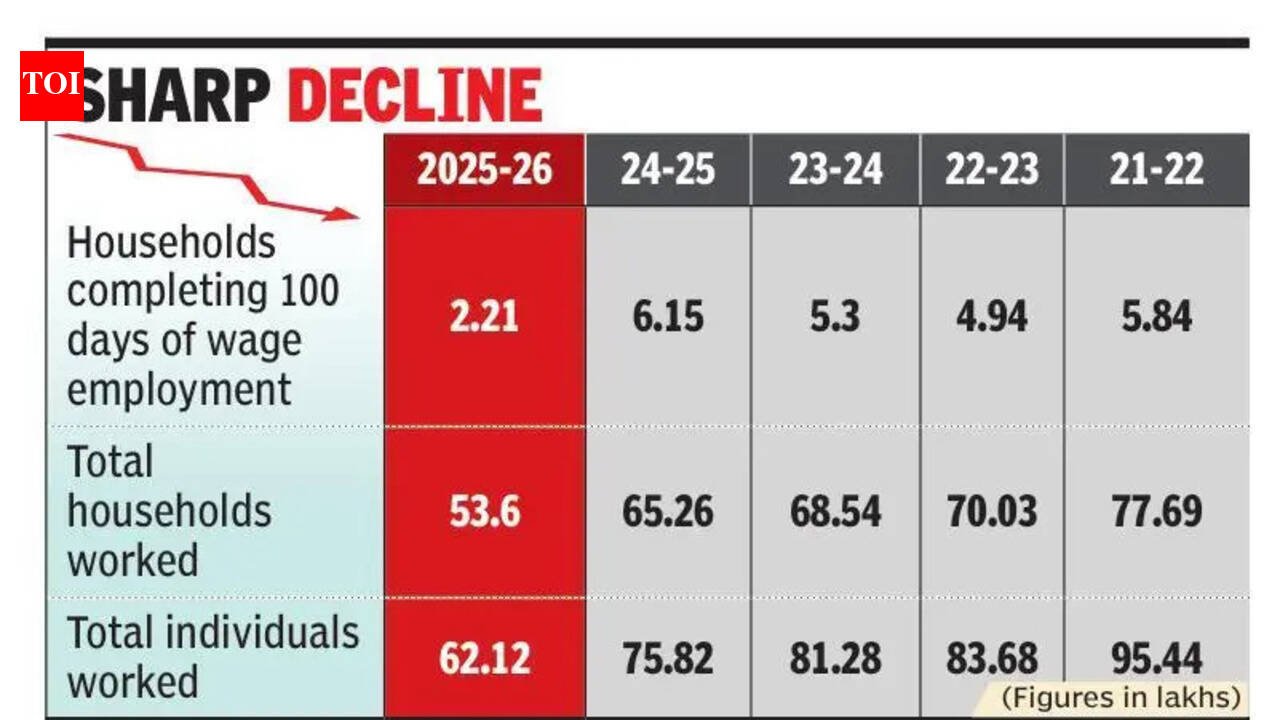
Lucknow: The number of households completing 100 days of employment under the Mahatma Gandhi National Employment Guarantee Scheme (MNREGS) fell by almost 65% in Uttar Pradesh in the 2025-26 fiscal.Rural development data (as on March 31) showed that the number of households that completed 100 days of employment dropped from around 6.15 lakh in 2024-25 to a little over 2.21 lakh in 2025-26. This was the lowest figure recorded in the last five fiscals.The decline comes at a time when the programme is being repositioned under the Viksit Bharat — Guarantee for Rozgar and Ajeevika Mission – Gramin (VB-G RAM G) framework, which promises to expand the guaranteed employment limit from 100 to 125 days.However, the ground-level data suggests a widening gap between policy intent and actual delivery.A closer look at the numbers indicates that the contraction is not limited to households completing the full quota of work.The total number of households that availed employment under the scheme also fell by around 18%, from 65.26 lakh in 2024-25 to 53.6 lakh in 2025-26.Similarly, the number of individuals engaged dropped from 75.82 lakh to 62.12 lakh, reflecting a comparable decline.This downturn came despite the increase in notified wages, which rose from Rs 237 to Rs 252 per day during the fiscal. Analysts point out that the wage hike appears to have had little impact on participation levels, suggesting that availability of work, rather than wage rates, remained the primary constraint.A senior official in the rural development department attributed the sharp fall primarily to delays in the release of funds from the Centre, which disrupted the execution cycle.“The focus had to shift to ensuring timely payment of wages rather than generating additional man-days,” the official said, indicating a change in administrative priorities driven by financial constraints.Sources said that funds were released in tranches, leading to liquidity stress at the state level. This, in turn, forced implementing agencies to prioritise the clearance of pending wage liabilities to avoid legal complications, including compensation claims for delayed payments mandated under the Act.The shift had a direct bearing on employment generation. Sources said that field-level functionaries, operating under tight financial conditions, reportedly adopted a cautious approach in sanctioning new works.As a result, while many households may still be accessing the scheme, they are receiving shorter durations of work, reducing the likelihood of completing the full entitlement.Analysts said the drop in 100 days of employment was less about improvement in rural prosperity and more about administrative constraints reshaping the scheme’s functioning.


