



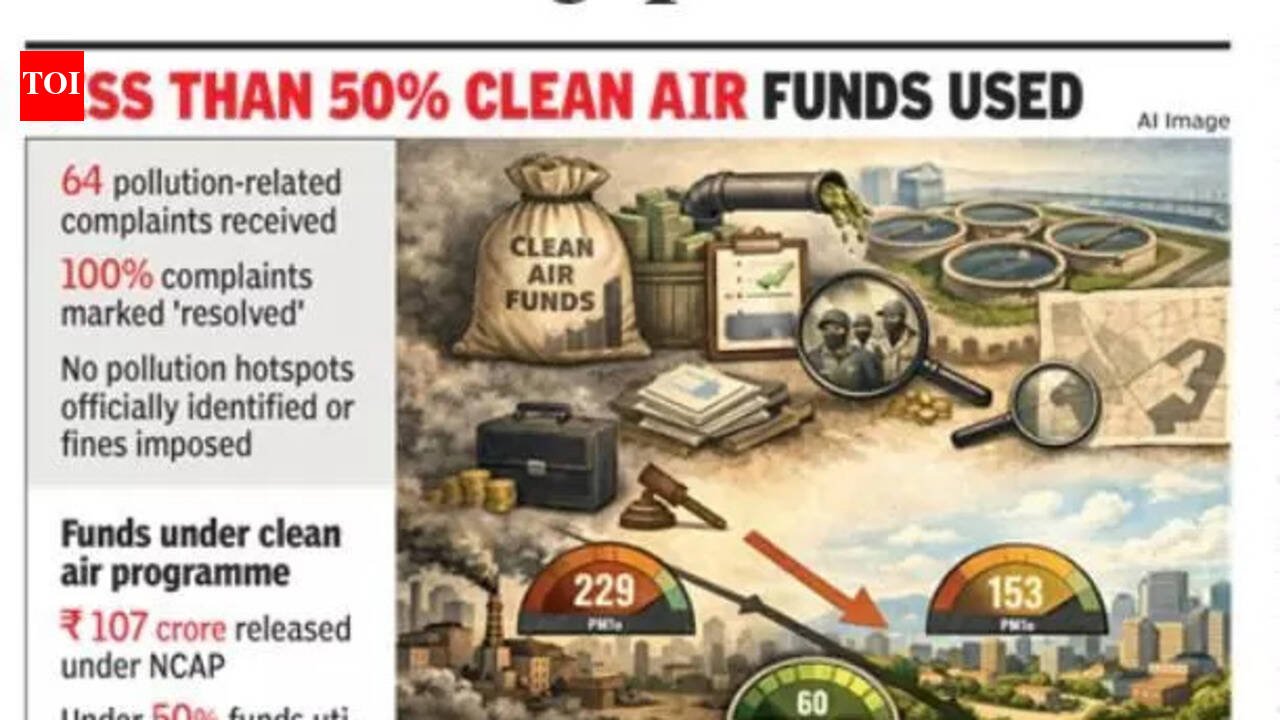
Gurgaon: Faridabad received 64 pollution-related complaints in 2025 but did not impose a single fine or environmental compensation on any violator.All 64 complaints were marked “resolved” — according to a Right to Information (RTI) reply — raising fresh questions about the city’s enforcement record. The RTI had been filed by Noida-based activist Amit Kumar. However, the reply, provided by the Ballabgarh regional office of Haryana State Pollution Control Board’s (HSPCB), offers no details on the nature of violations, who the alleged offenders were or what corrective action was taken on the ground. “As per this office record, no fine or EC was imposed in the said complaints,” the response notes.The activist said the reply reflects “a worrying pattern of denial” rather than enforcement. “They closed them (complaints) all. They are even saying there is no pollution hotspot. Basically, they are suggesting that everything is fine,” he said.The RTI reply was issued on Feb 8 in response to Kumar’s application of Feb 5, seeking city-wise complaint data, action taken and penalties imposed. The new RTI came after a series of disclosures over the past year that point to systemic lapses in Faridabad’s clean-air efforts.Environmental experts say the findings underline the need for stronger monitoring, transparent reporting and clear accountability in how agencies respond to pollution complaints. Without it, they warn, Faridabad risks continuing a pattern of slow progress, weak enforcement and missed clean-air targets. Govt data accessed by TOI in Feb 2025 showed that the city utilised just under 50% of the Rs 107 crore released to it under the National Clean Air Programme (NCAP), despite remaining a ‘non-attainment city’ for seven years. At the time, experts said that underutilisation of funds, slow execution and unclear accountability limited Faridabad’s progress.A separate RTI in Oct 2025 found that the civic body — MCF — diverted NCAP funds for the construction of a sewage treatment plant (STP) — an expenditure explicitly flagged as “not permissible” by Central Pollution Control Board. A CPCB inspection also highlighted substandard plantation work, delays in tendering and slow implementation of key interventions.Activists say the new RTI fits squarely into this pattern of poor utilisation and weak accountability. With no fines imposed in a full year, they argue, the deterrence mechanism remains virtually absent. Despite repeated complaints from areas such as NIT, Old Faridabad, Mewla Maharajpur and the industrial belt along Mathura Road, the HSPCB’s reply says no location in the city is identified as a “major hotspot”. Residents and environmental researchers, for years, flagged these pockets as chronic sources of dust, industrial emissions and waste burning.Faridabad remained one of the most polluted districts in NCR, though its PM10 levels gradually improved. Annual PM10 concentration dropped from 229 µg/m³ in 2020-21 to 153 µg/m³ in 2024-25, a 33% reduction — but still 2.5 times higher than the national safe limit of 60 µg/m³.Analysts say such improvement, while significant, cannot be sustained without strict enforcement. Under pollution norms, state boards are empowered to levy environmental compensation on industries, construction sites and institutions violating emission standards. But in 2025, Faridabad imposed none.


