



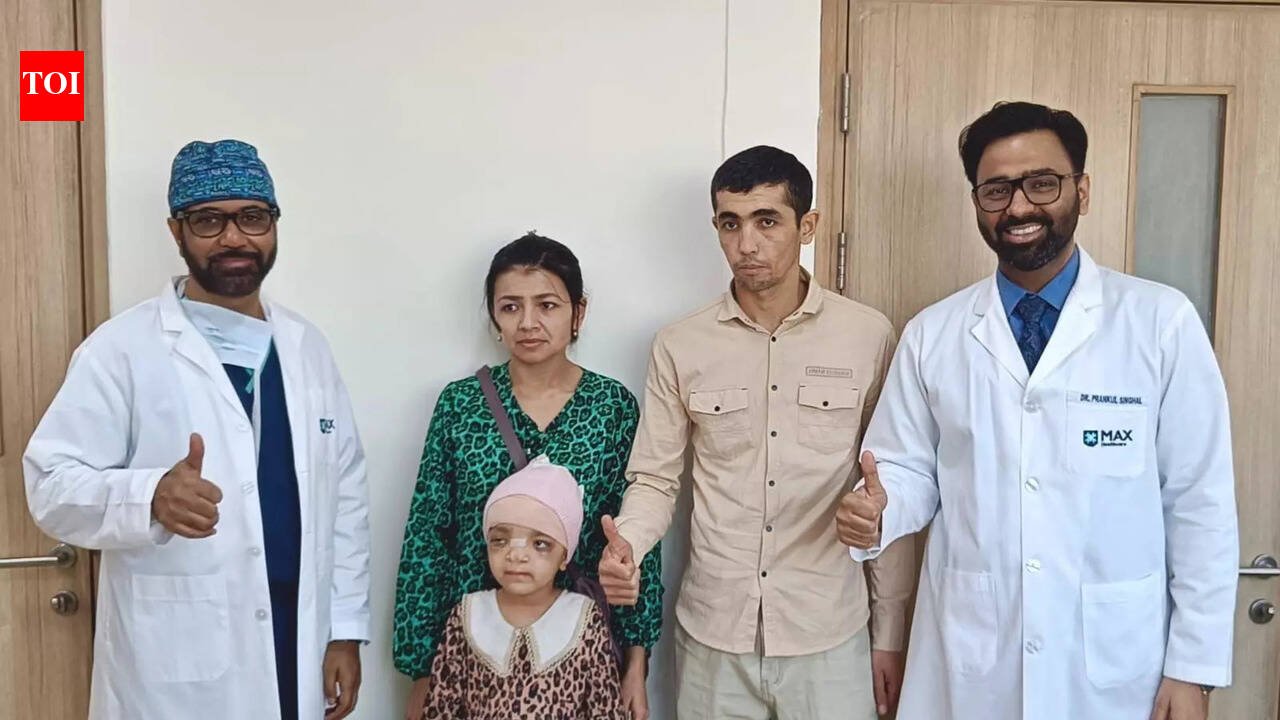
Noida: A six-year-old girl from Uzbekistan with paramedian craniofacial cleft with hypertelorism, an extremely rare congenital condition that caused abnormal development of her facial bones, leading to widely spaced eyes and nasal deformities, has undergone a 10-hour-long complex reconstructive surgery at a private hospital in the city.Occurring in roughly one in 1 lakh live births, craniofacial clefts are extremely uncommon. The severity and complexity of the child’s condition made treatment difficult in her home country, prompting the family to seek care abroad.A multidisciplinary team of doctors at Max Super Speciality Hospital, led by Dr Ashish Rai, senior director, plastic, aesthetic and reconstructive surgery and Dr Prankul Singhal, principal consultant and unit head, neurosurgery, has performed the procedure to correct the deformities.It required surgeons to operate in a sensitive anatomical zone involving the brain, optic nerves, and major blood vessels, where even a deviation of a few millimetres could have led to blindness or brain injury.“This was an extremely rare and technically demanding case. Given her age and the involvement of delicate structures such as the skull, brain and eyes, the case required meticulous multidisciplinary planning. The child’s inner canthal distance, the gap between the eyes, was nearly 45 mm, significantly higher than the normal 25 to 30 mm range. The surgery involved precise cutting and repositioning of the bones around the eyes, along with reconstruction of the nasal framework,” Dr Rai said.Dr Prankul Singhal said, “ We have repositioned the bones of the skull and upper face to bring the eye sockets closer and restore a more natural facial structure. The nose was also reconstructed using a bone graft. The distance between the inner corners of the eyes was reduced to 28 mm.”The post-operative phase was equally challenging for the doctors. During recovery, the child developed secondary pneumonia, which was promptly managed by the paediatric and neuro-anaesthesia teams. After close monitoring in the PICU, the breathing tube was removed on the fifth day.The girl has now been discharged in stable condition, with normal vision and age-appropriate mobility.


