



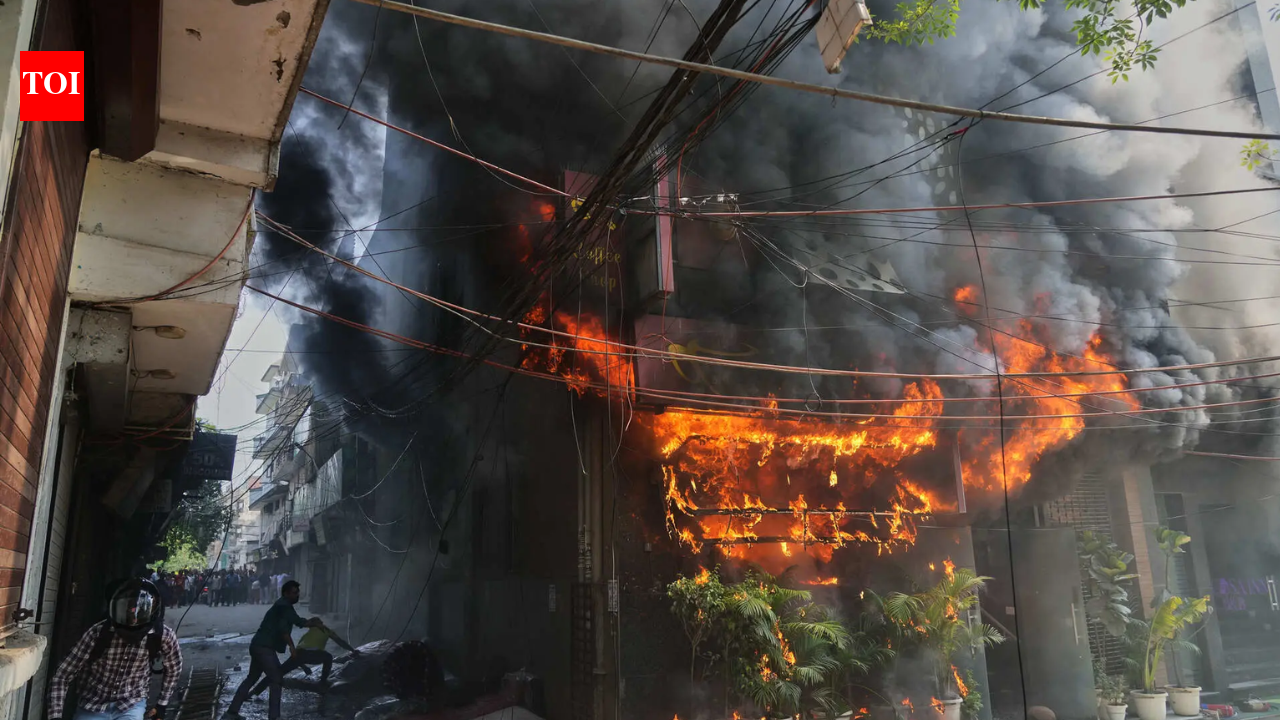
NEW DELHI: Nearly five months before the devastating fire at a bed-and-breakfast facility in south Delhi’s Malviya Nagar that claimed at least 21 lives on Wednesday, the Delhi high court had directed civic and government authorities to urgently address concerns over inadequate fire safety measures in hotels, restaurants and other hospitality establishments across the city, according to news agency PTI.Despite the court’s January 7 order, authorities are yet to formulate a comprehensive action plan aimed at strengthening fire safety standards and preventing such incidents, according to petitioner Arpit Bhargava.The issue has gained renewed attention following the deadly blaze at Flourish Stay hotel in Hauz Rani, Malviya Nagar, one of the worst fire tragedies witnessed in the capital in recent years.Bhargava alleged that repeated reminders sent to the Chief Secretary of the Delhi government, the Commissioner of the Municipal Corporation of Delhi (MCD), and the Chairperson of the New Delhi Municipal Council (NDMC) seeking compliance with the court’s directions have gone unanswered.According to news agency PTI, The public interest litigation (PIL) was filed after a nightclub fire in Goa on December 6, 2025, in which 25 people lost their lives. In his plea, Bhargava highlighted widespread violations of safety norms by hospitality establishments operating in Delhi.“There has been no decision whatsoever despite clear directions from the court to prepare an action plan. I had even sent reminders which were not taken into consideration. Complete apathy,” said Bhargava, a practising lawyer.He said his latest reminder was sent on May 5, urging authorities to act on the court’s directions in view of several fire incidents reported in recent months.On January 7, a bench comprising Chief Justice D K Upadhyaya and Justice Tejas Karia directed the Delhi government, MCD and NDMC to treat the PIL as a representation and take an appropriate decision on the issues raised.“We dispose of this writ petition with the direction that the writ petition itself shall be treated to be a representation by the petitioner, which shall be attended to and an appropriate decision thereon shall also be taken by the respondents with expedition.“The decision to be taken under this order by the authorities concerned shall be as per rules/laws, and shall address the issues and devise an action plan to put in place the safety measures so that fire incidents and other accidents may be avoided.“We provide that the decision under this order shall be taken with expedition,” the bench had ordered.According to the petition, Bhargava became aware of “inadequate and/or non-existent fire safety” measures in hotels, clubs and restaurants after personally visiting hospitality hubs such as Hauz Khas and Rajouri Garden, where several establishments operate in narrow lanes with limited access and exit points.The PIL contended that while compliance with the Delhi Fire Services Act, 2007, the National Building Code, 2016, and the Unified Building Bye-laws is mandatory for hotels, clubs and restaurants, enforcement by authorities has remained weak.Citing a newspaper report, the petition stated that out of nearly 1,000 licensed hospitality establishments in Delhi, only 52 hotels and 38 clubs possessed valid fire safety no-objection certificates (NOCs) issued by the Delhi Fire Services.The plea further pointed out that although fire safety NOCs remain valid for three years, violations occurring after approval often escape scrutiny due to a lack of regular inspections.It argued that unauthorised hotels and restaurants pose a serious threat to public safety and called for time-bound measures to identify loopholes and prevent future disasters.Among its key demands, the PIL sought directions for a comprehensive safety audit of hotels, clubs and restaurants, including fire safety assessments, along with remedial action wherever deficiencies are found.It also sought the formulation of a compensation mechanism for victims of fire incidents and the fixing of accountability on officials responsible for conducting regular inspections of such establishments.


