



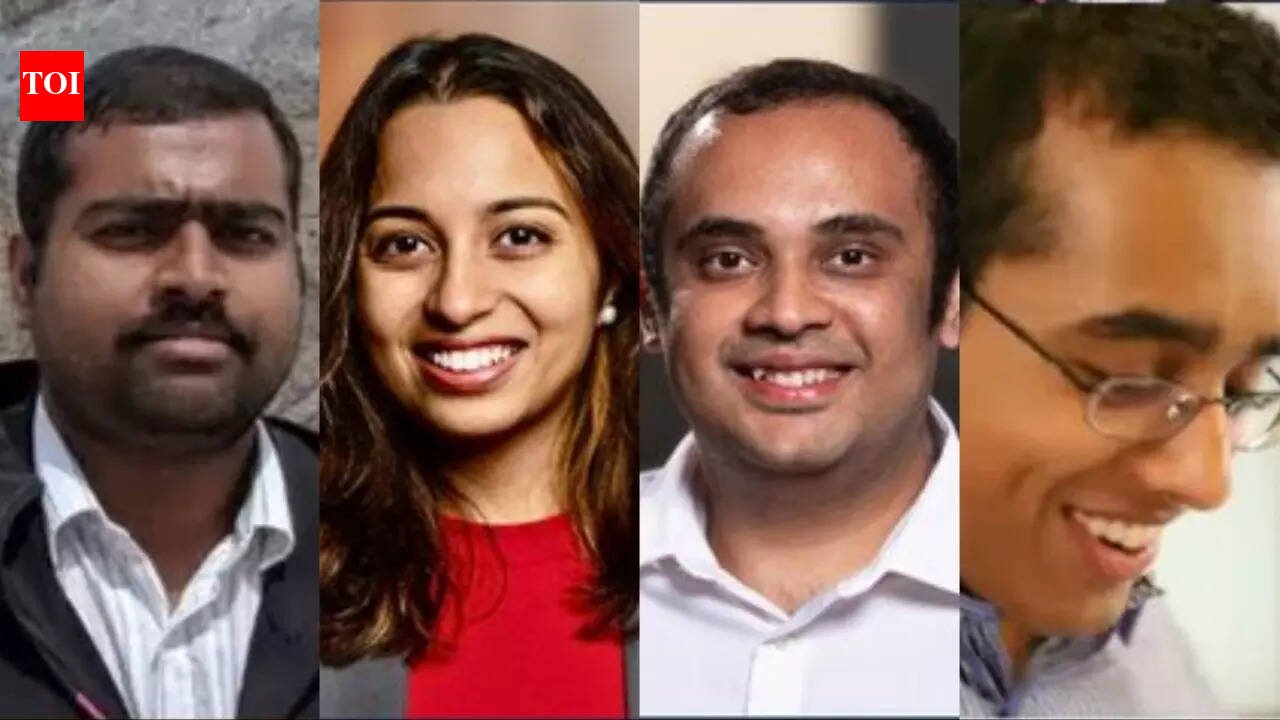
In a celebration of scientific excellence and innovation, four Indian American researchers have been named 2026 Sloan Research Fellows, one of the most coveted early-career recognitions in science, mathematics and engineering. The annual Sloan Research Fellowship program, run by the Alfred P. Sloan Foundation, honours outstanding early-career scholars whose work displays exceptional creativity and potential to produce transformative research. Winners are awarded a two-year, USD 75,000 fellowship to support their independent research efforts, offering flexible funds that can accelerate breakthroughs in fundamental science and technology.This year’s class of fellows includes Aayush Jain, Arun Kumar Kuchibhotla and Aditi Raghunathan, all from Carnegie Mellon University, along with Anand Natarajan from the Massachusetts Institute of Technology. Their selection among 126 Sloan Fellows underscores the rising influence of Indian-origin researchers in cutting-edge scientific fields shaping the future of computing, artificial intelligence, cryptography and quantum information.
What the Sloan Fellowship represents
Founded in 1955, the Sloan Research Fellowship is one of the oldest and most respected programs supporting young scientific talent in the United States and Canada. It seeks to identify researchers at a “critical stage” in their careers, those who are poised to become leaders in their fields. Fellows are selected through a rigorous nomination process involving peer scientists, ensuring that only those with exceptional promise and impactful work are recognised. Past Sloan Fellows have gone on to win Nobel Prizes, Fields Medals, Turing Awards and other top honours, demonstrating that this fellowship often predicts future scientific stars. The prestigious award helps early-career researchers secure resources, build collaborations and pursue bold research directions with fewer funding constraints.
Meet the Indian American fellows and their research domains
- Aayush Jain – Cryptography and Secure Computation: Assistant Professor of Computer Science at Carnegie Mellon University, Aayush Jain’s research focuses on the mathematical foundations of modern cryptography, the science that underpins secure digital communication. His work addresses computational hardness assumptions that form the backbone of encryption and aims to strengthen the long-term security of cryptographic systems, including efforts to close gaps in post-quantum cryptography, the next frontier of secure communications against quantum computing threats. By tackling these foundational questions, Jain’s research directly contributes to ensuring that digital infrastructure remains robust against evolving cyber threats, an area of increasing global importance as societies digitise.
- Arun Kumar Kuchibhotla – Statistics and Predictive Learning: Arun Kumar Kuchibhotla, Associate Professor in the Department of Statistics and Data Science at Carnegie Mellon, develops advanced statistical techniques that address fundamental challenges in uncertainty quantification and predictive learning. His work is influential in fields like machine learning, where understanding prediction accuracy and reliability matters deeply. Kuchibhotla is especially known for creating “honest statistical procedures”, methods that provide reliable inference even in complex, high-dimensional settings where traditional tools often fail. These techniques have applications in everything from financial forecasting to causal analysis in health and economic data.
- Aditi Raghunathan – Safe and Trustworthy AI: Aditi Raghunathan, Assistant Professor of Computer Science at Carnegie Mellon, is tackling one of the most critical challenges today and that is trustworthy and reliable artificial intelligence. Her research centers on identifying where AI systems fail and developing methods to make them more robust and dependable in real-world environments. Leading the AI Reliability Lab, Raghunathan brings rigorous scientific analysis to AI safety issues, an area of growing concern as automated systems influence sectors such as healthcare, finance and autonomous systems. Her work helps ensure AI behaves consistently and transparently even under unpredictable conditions.
- Anand Natarajan – Quantum Complexity Theory: Associate Professor at MIT and a principal investigator at both MIT’s Computer Science and Artificial Intelligence Laboratory (CSAIL) and the MIT-IBM Watson AI Lab, Anand Natarajan’s research explores quantum complexity theory, the study of what can be computed efficiently in a quantum setting. By examining how quantum systems compute and interact, Natarajan’s work seeks to define the fundamental limits and capabilities of quantum computers, bridging insights between theoretical computer science and emerging quantum technologies. His research has implications for cryptography, simulation of quantum systems and the future of computational hardware.
The recognition of these Indian American researchers as Sloan Fellows reflects not only their individual brilliance but also the growing influence of diaspora scientists in global research ecosystems. From cryptography and AI safety to statistical theory and quantum computing, their work spans fields that are central to shaping tomorrow’s technology landscape. Recent years have seen several Indian origin researchers gain prominence, including multiple selections as Sloan Fellows in past cohorts; a trend that highlights the sustained presence of Indian talent at the forefront of scientific innovation.These achievements also showcase how early-career support through fellowships and research grants can catalyse scientific progress. Programs like the Sloan Fellowship offer essential resources that help researchers pursue high-risk, high-reward ideas that traditional funding might overlook.
Sloan Fellowship and the broader landscape of early-career scientific recognition
The Sloan Fellowship is part of a broader ecosystem of awards and fellowships that honour emerging researchers. For instance, institutions across the US regularly announce Sloan recipients, including faculty at University of Wisconsin–Madison and MIT, underscoring a competitive and vibrant research environment.Such recognitions help elevate researchers’ visibility, attract collaborators, and secure future funding — important steps in building long-term research programs that push the boundaries of human knowledge and tackle global challenges.
What the Indian American Sloan fellows plan next
While the Sloan Fellowship typically does not stipulate specific deliverables, it gives fellows the flexibility to pursue ambitious projects. Whether deepening theoretical foundations, designing safer AI systems or probing the quantum frontier, the award empowers these researchers to push their fields forward without restrictive grant constraints.Given these scholars’ already notable records, from foundational cryptographic frameworks to pioneering AI reliability methods, the next few years promise exciting contributions to technology, science and academia at large.Four Indian American researchers have been named 2026 Sloan Research Fellows, earning prestigious support for early-career scientific research. The fellows come from Carnegie Mellon University and MIT and their work spans cryptography, statistics, AI reliability and quantum computing. Sloan Fellowships are among the most respected early-career awards in science, helping researchers pursue bold, impactful ideas. Their recognition highlights the global influence of Indian-origin scientists and the strength of diaspora research excellence.


