






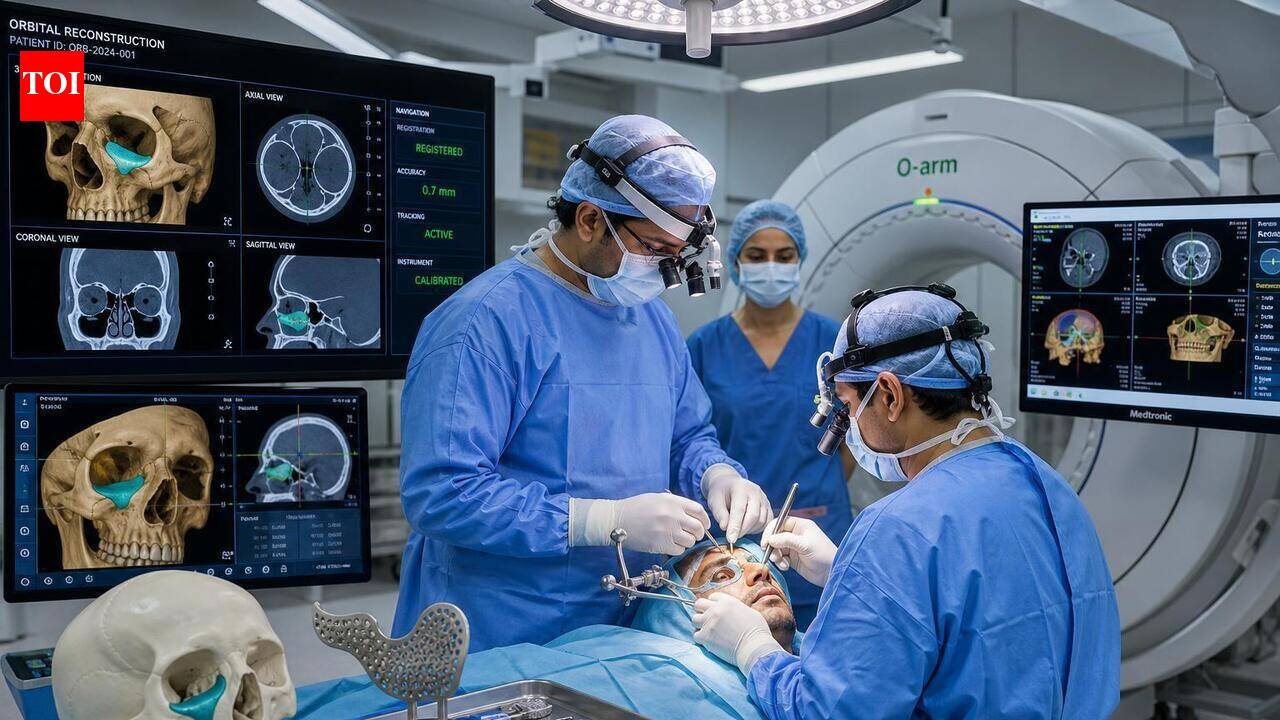
Lucknow: Doctors at the apex trauma centre of Sanjay Gandhi Postgraduate Institute of Medical Sciences, Lucknow reconstructed the eye socket of a patient who suffered severe facial injuries in an accident. The patient had been living with double vision, changes in facial appearance and problems in eye movement after the trauma.The institute said this is the first time in UP that surgeons have used computer-guided navigation, a customised implant and O-arm imaging—a system that creates three-dimensional scans inside the operation theatre—to repair an eye socket damaged by an old injury.The surgery was performed by Dr Kuldeep Vishwakarma and Dr Bharat Shukla, along with residents Dr Deeksha, Dr Shashank, Dr Abhijeet and Dr Apoorva. The anaesthesia team included Dr Rafat Shamim, Dr Vansh, Dr Nikhil and Dr Shariaa.The walls of the eye socket hold the eyeball in position and help control its movement. Doctors said reconstruction becomes difficult when fractures heal and scar tissue alters the normal structure of the face.“Even small errors while rebuilding the eye socket can affect vision and the position of the eye,” said Dr Bharat Shukla, assistant professor in the department of oral and maxillofacial surgery. “Operations on old injuries are particularly challenging because normal anatomical landmarks are often lost.”During the procedure, surgeons used a navigation system that matched scans taken before the operation with the patient’s anatomy in real time, allowing them to identify important structures and position the implant according to the surgical plan.The implant was designed specifically for the patient using three-dimensional scans of the face. Before completing the operation, the team performed an O-arm scan to check the placement of the implant and assess the reconstruction while the patient was still in the operation theatre.Shukla said the combination of pre-operative planning, computer guidance during surgery and imaging inside the operation theatre helped doctors restore the shape of the eye socket with greater accuracy.SGPGIMS director Prof R K Dhiman said the use of such technologies would help improve treatment for patients with complex facial injuries and post-traumatic deformities.


