



Last Updated:
BJP sources say multiple ground assessments indicate a telling shift in West Bengal, especially in the Presidency region—Kolkata and its surrounding urban belt
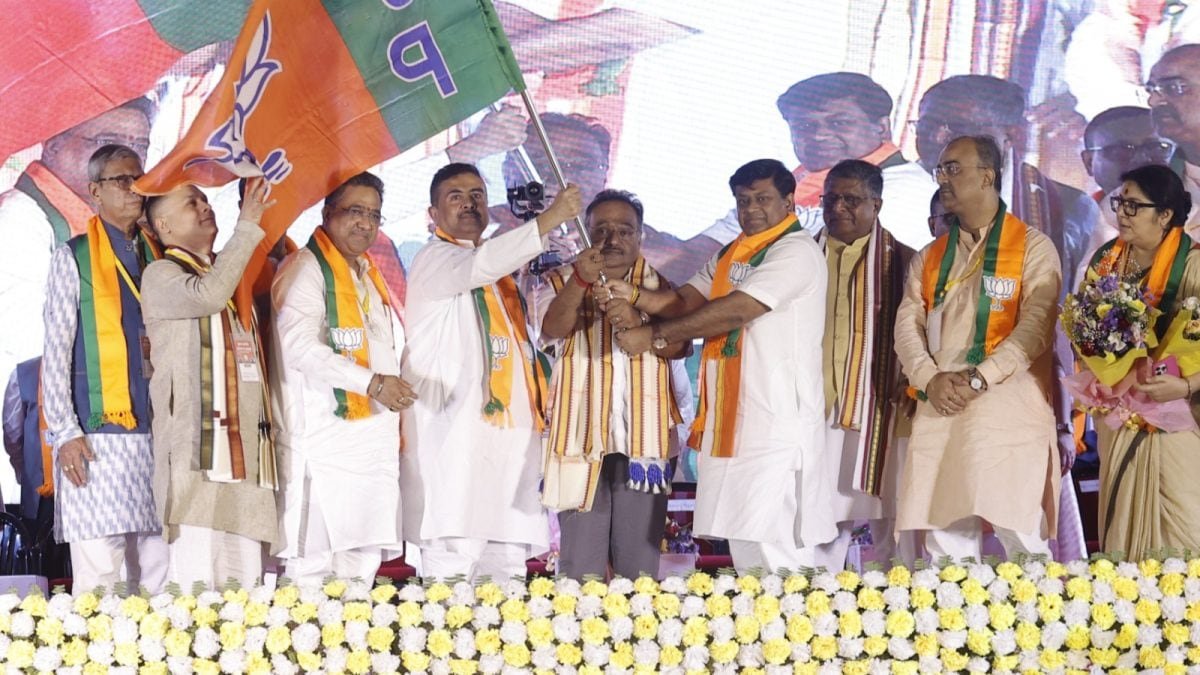
Top West Bengal BJP leaders including Samik Bhattacharya, Sukanta Majumdar, and Suvendu Adhikari. File pic
For years, West Bengal’s politics appeared locked in a rigid pattern. But beneath the surface, the electoral map is shifting in ways that are increasingly difficult to ignore. Multiple ground assessments now suggest that the BJP commands roughly 35% of the vote share across nearly 210 of the state’s 294 assembly seats. In a state where politics often swings dramatically once momentum builds, such numbers point to something larger than routine opposition growth.
The most telling signs of this shift are emerging from the Presidency region—Kolkata and its surrounding urban belt. In nearly 110 seats across this region, the BJP was leading in urban body elections that were held after years, claims a senior BJP leader responsible for West Bengal.
Urban Bengal has traditionally been politically decisive, and a shift here often signals broader electoral currents. What was once dismissed as an isolated surge now appears to be turning into a structural presence.
But electoral numbers alone do not explain the changing mood in Bengal.
A large section of the state’s youth—particularly the unemployed—has grown increasingly restless. The promise of welfare without opportunity has begun to wear thin. Recognising this sentiment, the BJP is preparing to roll out competitive welfare schemes targeted at jobless youth, positioning them as more robust alternatives to those offered by the ruling government. The message being crafted is simple: welfare must lead to empowerment, not dependence.
Another narrative battle is also underway—one over identity.
For years, Mamata Banerjee and the ruling establishment have attempted to portray the BJP as an “outsider” force in Bengal. Yet the BJP counters that the charge rings hollow when one remembers that one of the party’s founders was the Bengali nationalist leader Syama Prasad Mookerjee. His legacy remains deeply intertwined with Bengal’s political history. By invoking that lineage, the party is attempting to reclaim its Bengali credentials and blunt the regionalist narrative deployed against it.
“We are a Bengali party. Our founder is a Bengali. Who is Mamata Banerjee to question our Bengali credentials?” asks the BJP leader.
Politics, however, is rarely decided by arguments alone. It is decided by moments—moments when voters collectively feel that the existing order has run its course.
The BJP leader insists that the moment may now be approaching in Bengal.
Across districts, from urban Kolkata to semi-urban belts, there are signs that the electorate’s patience is thinning, he argues. Economic anxieties, governance fatigue, and a growing desire for political competition are combining to create a mood that political observers often describe as a “tipping point”, he claims.
Whether that tipping point ultimately translates into a change of power remains to be seen. Bengal has a long history of surprising political outcomes. The question is, will 2026 be surprising enough?
March 05, 2026, 20:07 IST
Read More


