


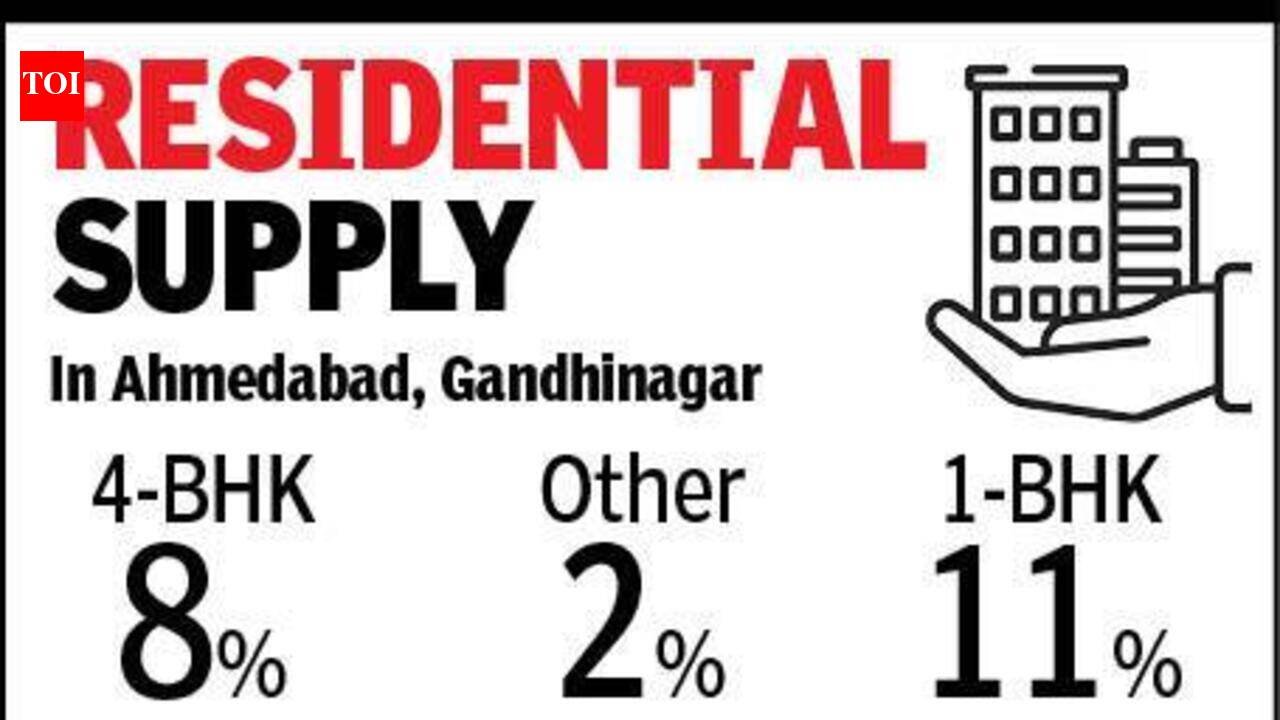
Ahmedabad: There’s no place better than home for residents of Ahmedabad and Gandhinagar, so long as it comes with a little more room. A three-bedroom apartment has overtaken the traditional two-bedroom home as the most preferred residential format in the twin cities.Official registration data confirms the move up in size. A CEPT University student study of RERA records from 2016 to 2025 shows that 3BHK units account for 42% of housing supply, while 2-BHKs make up 37%.Together, the two formats account for roughly 80% of the residential real estate market, said researchers Karvy Shah and Tarang Mevada of CEPT University’s Faculty of Planning, who prepared the direct research project under the guidance of Prof Sejal Patel.The duo studied 4,665 projects registered with RERA since 2016 across the AMC, GMC, Auda and Guda areas, covering 5.4 lakh residential units. Just two clusters — Bopal-Shela-Shilaj and Sargasan-Kudasan-Raysan — accounted for 24% of the total built-up supply.The sharpest increase in activity, the researchers noted, came in the three years after Covid. Of the 4,665 projects registered over the decade, 1,941 — or 42% — were registered between 2021 and 2023 alone. In two of those years, the number of units on offer crossed 80,000: Year 2021 recorded the decade’s high of 88,896 units, followed by 83,232 in 2023.Alap Patel, president of Credai Ahmedabad, said the city’s housing preferences shifted noticeably after Covid-19, with buyers gravitating towards larger homes in newer localities. Many have sold older, smaller houses to upgrade, placing greater importance on lifestyle amenities within projects, he said.“People arriving from outside the city are increasingly opting for 3-BHK apartments, adding to demand in emerging residential corridors. The most active buyer segment is now the 35-40 age group, which is prioritising spacious homes and better living standards,” Patel said. “They are choosing bigger areas and better amenities. Lower home-loan interest rates after the pandemic supported purchases.”The team also mapped project costs to see where developers are parking their money. Five clusters alone absorb about 51% of total investment — a concentration that points to larger-scale or luxury development, the researchers said.Bopal-Shela-Shilaj leads with 360 projects and an investment of Rs 28,582 crore, followed by Sargasan-Kudasan-Raysan at Rs 22,784 crore and Thaltej-Bodakdev-Vastrapur at Rs 21,026 crore. Vaishnodevi-Zundal-Tragad (Rs 14,106 crore) and Chandlodia-Ranip-Nava Vadaj (Rs 11,439 crore) round off the top five.Kiran Patel, former president, Credai Gandhinagar, said, “Connectivity between Gandhinagar and Ahmedabad has improved markedly over the past decade, and the twin-city development model has accelerated Gandhinagar’s growth. Most new residential launches in Gandhinagar are now predominantly 3-BHK homes, driven by stronger demand from new-age professionals, particularly those working in the IT sector. They prefer larger, well-planned apartments with better amenities and easier access to employment hubs.”Prof Sejal Patel, dean and programme chair, MBA in Real Estate, CEPT University, said key factors enabling real estate growth include faster delivery of serviced land through town planning schemes, a dense road network that improves mobility, and easier access to construction finance and home loans after affordable housing was included under priority-sector lending by RBI.“We also conducted consumer perception surveys for 18 major clusters in the twin cities to gauge interest, and it closely matched the ongoing real estate development on the ground,” she said.
